



What Merv Filter Should You Use for Your HVAC System?
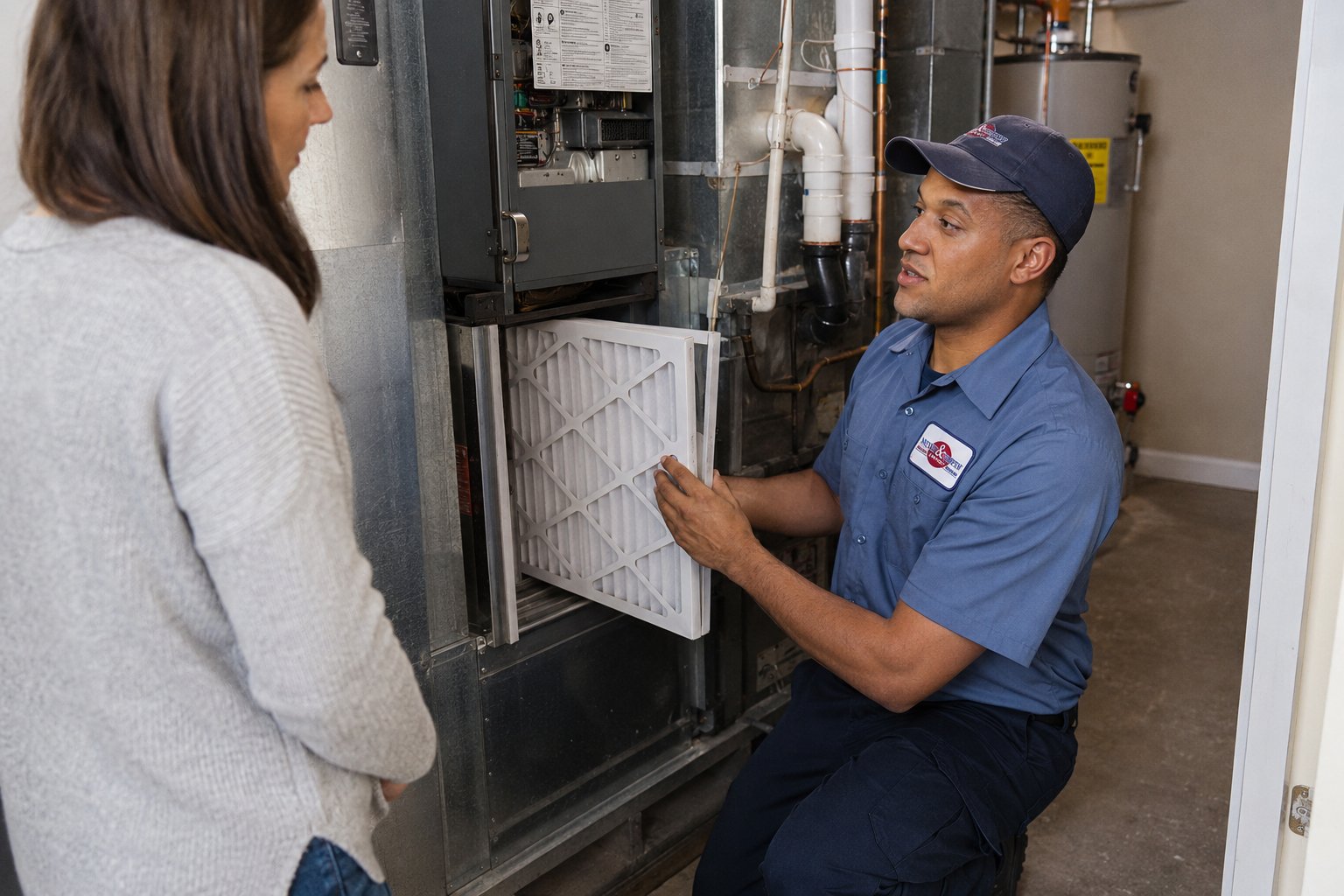
For many homes and small businesses, a MERV 8 to MERV 11 filter is often a practical starting point, while some systems may be able to handle MERV 13 when airflow, equipment design, and maintenance habits support it. The right answer is not simply the highest number on the package. A filter has to help capture particles without making your HVAC system work harder than it should.
In Central and Northern New Jersey, where homeowners deal with pollen, humidity, renovation dust, pet dander, and long heating and cooling seasons, filter choice can affect both comfort and equipment performance. If you are unsure what your system can handle, Meyer & Depew can help during routine AC service and maintenance or a broader HVAC service plan visit.
Most standard residential HVAC systems do well with a MERV 8 to MERV 11 filter. Homes with allergies, pets, smoke concerns, or stronger indoor air quality needs may benefit from MERV 11 to MERV 13, but only if the system can maintain proper airflow. If your filter is too restrictive, it can contribute to weak airflow, longer run times, uneven temperatures, and added strain on equipment.
What does MERV mean?
MERV stands for Minimum Efficiency Reporting Value. It is a rating that describes how effectively an air filter captures particles as air passes through it. A higher MERV rating generally means the filter can capture smaller particles, but it may also create more resistance to airflow.
That airflow piece is important. Your HVAC system was designed to move a certain amount of air across the coil, heat exchanger, blower, and ductwork. When a filter is too dense for the system or is left in place too long, the equipment may struggle to breathe. That does not mean higher MERV filters are bad. It means the filter has to match the system, the ductwork, and the maintenance routine.
Common MERV ratings and where they fit
Filter packaging can make the choice feel more complicated than it needs to be. Here is a practical way to think about the most common ranges:
- MERV 1 to 4: Basic filtration that may stop larger debris, but usually offers limited particle capture for typical indoor air quality concerns.
- MERV 5 to 8: A common range for many standard HVAC systems, often used to capture dust, lint, and larger household particles.
- MERV 9 to 11: A stronger middle range that may help with smaller particles such as finer dust, pollen, and some pet-related particles while still being workable for many systems.
- MERV 12 to 13: A higher-efficiency range that may be useful for homes with allergies, pets, smoke exposure, or indoor air quality concerns, provided the HVAC system can handle the airflow resistance.
- MERV 14 and higher: Often used in more specialized applications and not automatically appropriate for a standard residential system without professional evaluation.
Why the highest MERV rating is not always the best choice
It is easy to assume that a higher rating means a better filter for every home. In reality, a filter that is too restrictive can create problems that have nothing to do with filter quality. Your system may move less air, rooms may feel less comfortable, and the blower may have to work harder to circulate air.
In cooling season, poor airflow can also contribute to coil problems, reduced comfort, and longer run times. In heating season, airflow restrictions can affect how evenly warm air moves through the home. These problems can be especially noticeable in older New Jersey homes with undersized returns, older ductwork, finished basements, additions, or rooms that already struggle with airflow.
The best filter is one that balances particle capture with the airflow your equipment needs. That balance depends on the system, the filter size, the duct design, and how consistently the filter is replaced.
When MERV 8 may be enough
A MERV 8 filter may be a reasonable choice for many homes without major indoor air quality concerns. It can help protect the HVAC equipment from larger dust and debris while keeping airflow manageable in many standard systems.
This range may make sense if your home has no pets, no significant allergy concerns, no smoke exposure, and no recent construction dust. It can also be a safer choice for older systems that seem sensitive to airflow restriction. Still, filter quality varies by brand and design, so the rating is only one part of the decision.
When MERV 11 or MERV 13 may be worth considering
A MERV 11 filter may be a good step up for homeowners who want better particle capture without immediately moving into a very high-efficiency filter. This can be useful for homes with pets, seasonal pollen, light dust concerns, or family members who are more sensitive to airborne particles.
MERV 13 may be worth discussing if indoor air quality is a priority, especially in homes dealing with allergies, wildfire smoke events, nearby road dust, or recurring comfort complaints. However, MERV 13 should not be treated as a universal upgrade. Some systems can use it comfortably, while others may experience airflow issues, especially if the filter is small, thin, or not changed often enough.
If you are considering a higher-efficiency filter because of indoor air concerns, it may also be helpful to look beyond the filter alone. Meyer & Depew offers air quality and comfort solutions that can be evaluated alongside your existing HVAC system.
Filter thickness matters too
Two filters with the same MERV rating may not behave the same way. A one-inch MERV 13 filter can create more resistance than a deeper media filter designed to provide more surface area. That extra surface area can allow better filtration with less airflow penalty, depending on the system setup.
This is one reason a professional recommendation can be useful. The right filter is not just about the number printed on the package. It is also about filter depth, cabinet size, ductwork, blower capacity, and how quickly the filter loads with dust in your specific home or building.
How often should you change your HVAC filter?
Many homeowners hear a simple rule, such as changing the filter every 90 days. That can be a useful reminder, but real homes vary. A filter may need to be changed more often if you have pets, high system use, dusty conditions, recent remodeling, nearby construction, or a household member with allergies.
During heavy AC use in summer or steady heating use in winter, checking the filter monthly is a smart habit. You may not need to replace it every time, but a quick visual inspection can help you avoid running the system with a loaded filter. If the filter looks dark, matted, or packed with debris, it is usually time for replacement.
- Confirm the filter size printed on the old filter before buying a replacement.
- Make sure the airflow arrow on the filter points in the correct direction.
- Check that supply and return vents are open and not blocked by furniture, rugs, or storage.
- Replace a dirty filter and see whether airflow improves.
- If weak airflow, short cycling, unusual noises, or comfort issues continue, schedule professional service.
Signs your filter may be too restrictive
A filter that does not match the system can show up in everyday comfort problems. You may notice weaker airflow from the vents, rooms taking longer to reach the thermostat setting, the system running more often than usual, or more temperature variation from room to room.
In some cases, a restrictive filter can contribute to equipment issues that require a technician to evaluate. Do not open sealed equipment panels, bypass safety controls, or try to modify the HVAC system yourself. A qualified technician can check static pressure, blower performance, coil condition, duct restrictions, and whether the filter choice is part of the problem.
What should businesses and commercial properties consider?
Commercial buildings have different demands than homes. Offices, retail spaces, medical settings, nonprofits, and multi-zone buildings may have higher occupancy, longer run hours, rooftop units, specialized ventilation needs, or stricter indoor air expectations. In those cases, filter selection should be part of a larger maintenance plan, not a quick guess from a shelf label.
Facility managers should consider the equipment design, filter rack size, maintenance schedule, occupant complaints, and any IAQ goals for the building. For many commercial properties, the best answer comes from reviewing the system as a whole rather than simply increasing the MERV rating.
FAQ: MERV filters and HVAC systems
Is MERV 13 too high for a home HVAC system?
Not always. Some residential systems can handle MERV 13, especially when designed with the right filter cabinet and airflow capacity. Other systems may struggle with it. If you are not sure, ask a professional to evaluate airflow before making it your regular filter choice.
Can a high-MERV filter damage my HVAC system?
The filter itself is not the issue. The concern is airflow restriction. If the system cannot move enough air through the filter, it may operate under added strain or develop comfort and performance problems. A technician can help determine whether the filter is appropriate.
Should I use a washable filter?
Washable filters can be convenient, but they vary widely in filtration performance and require careful cleaning and drying. For many homeowners, a properly sized disposable pleated filter with an appropriate MERV rating is simpler and more consistent.
Does a better filter replace air purification?
Not necessarily. A higher-efficiency filter may help capture more particles, but it is only one part of indoor air quality. Depending on your concerns, ventilation, humidity control, duct condition, and dedicated air purification may also matter.
What filter should I buy if I do not know my system?
Start by matching the exact filter size and checking the equipment or owner information if available. If you still are not sure, a MERV 8 to MERV 11 filter is often a practical range for many homes, but professional guidance is the safest way to avoid airflow issues.
Bottom line: choose the filter your system can actually use well
The best MERV filter for your HVAC system is the one that improves filtration while still allowing proper airflow. For many homes, that means MERV 8 to MERV 11. For homes with stronger indoor air quality needs, MERV 13 may be appropriate when the system is designed or confirmed to handle it.
If your home has weak airflow, uneven rooms, frequent dust, allergy concerns, or an older HVAC system, filter selection is worth discussing during routine maintenance. A small filter decision can have a real effect on comfort, equipment performance, and how confidently your system handles New Jersey’s heating and cooling seasons.
Want to make HVAC maintenance easier to stay on top of?
A service plan can help keep routine heating and cooling maintenance on your calendar before small issues become bigger headaches.
You can also request a service appointment.