



How Closet Locations Can Affect Thermostat Readings
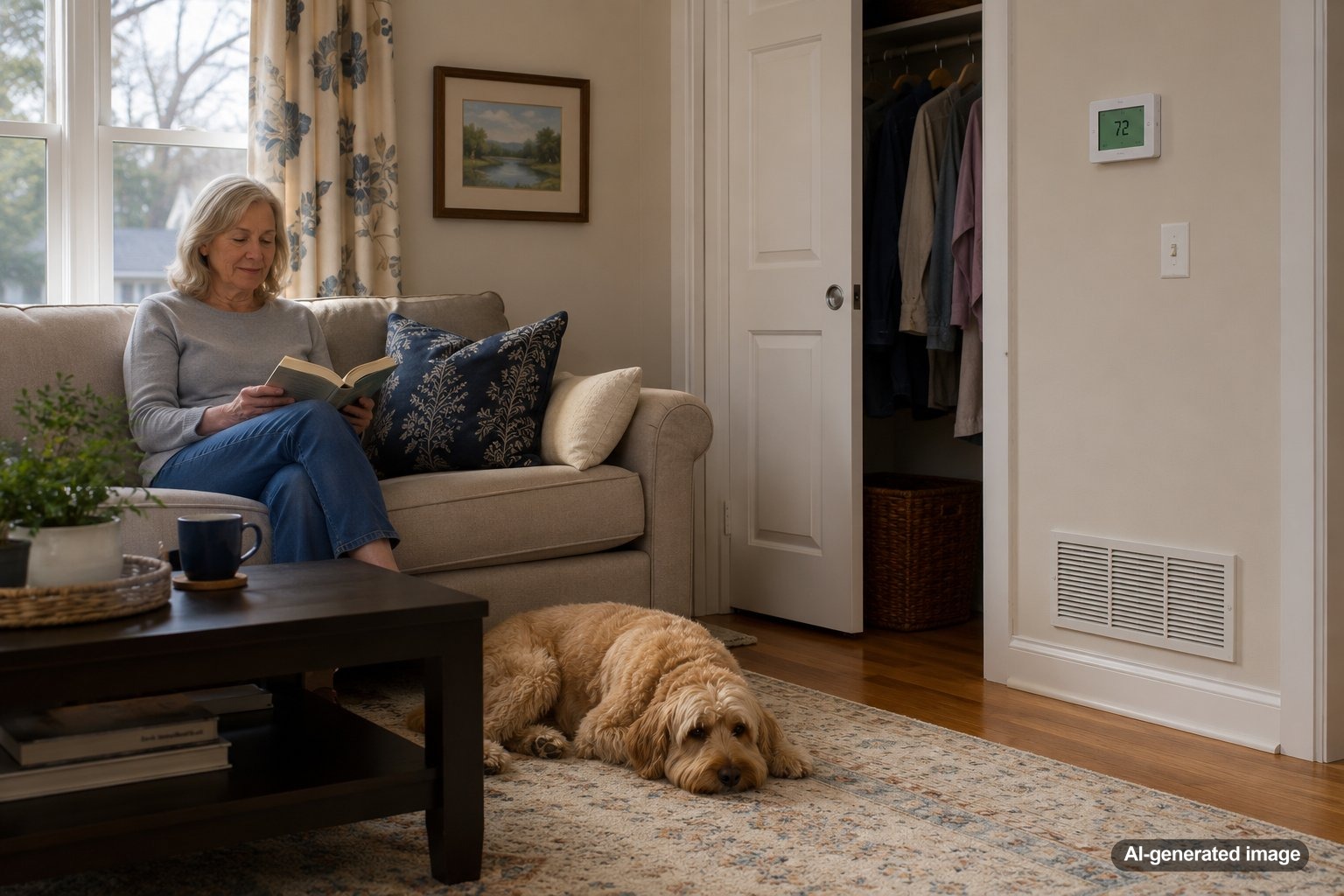
Closet locations can affect thermostat readings because closets often sit near dead-air zones, door swings, return paths, interior pockets, or small spaces that do not represent the temperature people actually feel in the room. If the thermostat is mounted too close to a closet, inside a narrow hallway beside one, or on a wall influenced by a nearby closed space, it may tell your HVAC system to start or stop at the wrong time.
That can make a home feel warmer or colder than the number on the thermostat suggests. In Central and Northern New Jersey homes, where older layouts, additions, finished basements, and tight hallways are common, thermostat placement can quietly affect comfort. If you are already exploring better temperature control, Meyer & Depew can help with all thermostats, smart thermostat options, and whole-home comfort solutions.
A thermostat near a closet may read too warm, too cool, or too stagnant if the air around it does not move like the air in the occupied room. The result can be short cycling, uneven comfort, longer run times, or rooms that never quite match the set temperature.
Why a closet can confuse a thermostat
A thermostat is not measuring the whole house. It is measuring the temperature at one spot on one wall. Your HVAC system then uses that reading to decide whether to heat, cool, or shut off. When that one spot is influenced by a closet, the reading can be misleading.
Closets are often closed, less ventilated, and separated from the main air movement in a room. A thermostat placed beside a closet door, on a wall shared with a closet, or in a cramped hallway between closets may sit in air that is warmer, cooler, or more stagnant than the surrounding living space. The HVAC system responds to that number even when the rest of the home feels different.
Common closet-related thermostat problems
Dead air near a closet door
Air movement matters. A thermostat should usually be exposed to natural room air circulation. When it is tucked beside a closet, in a recess, or behind furniture near a closet wall, air may not pass over the sensor normally. The thermostat may be slow to notice temperature changes, causing the system to run longer than needed or shut off too late.
A wall that does not reflect the room
A thermostat on a wall shared with a closet may be affected by the temperature of that enclosed space. For example, a closet packed with stored items may hold heat differently than the room. If the closet backs up to an attic knee wall, garage, stairwell, mechanical chase, or poorly insulated area, the wall temperature can influence the thermostat.
Door swings and drafts
Closet doors can create small bursts of air movement when opened and closed. In a hallway, nearby bedroom doors, attic access doors, basement doors, or exterior-adjacent spaces can also create drafts. Even small drafts near the thermostat can make the system react as if the whole home has changed temperature.
Blocked sensing from furniture or storage
Sometimes the problem is not the closet itself, but how the area around it is used. A tall cabinet, coat rack, shelving unit, or stacked storage near the thermostat can block airflow. The thermostat may be technically visible, but it is not sensing the same air the people in the room are feeling.
How this affects heating and cooling performance
Incorrect thermostat readings can create several comfort issues. During cooling season, a thermostat in a cooler hallway near a closet may shut the AC off before sunny rooms are comfortable. During heating season, a thermostat near a warmer interior pocket may stop the furnace or boiler system too soon, leaving bedrooms or living areas chilly.
The opposite can happen too. If the thermostat sits near a closet wall that stays warmer in summer or cooler in winter, the system may run longer than necessary. That can contribute to extra wear, uneven comfort, and frustration when adjusting the set point does not solve the real problem.
| Closet placement issue | What it can cause |
|---|---|
| Thermostat beside a closet in a narrow hall | Stale air readings and delayed system response |
| Thermostat on a wall shared with an enclosed closet | Readings influenced by the closet temperature instead of the room |
| Storage or furniture near the thermostat | Blocked airflow around the sensor |
| Closet near attic, garage, or unconditioned space | Wall temperature that does not match the occupied room |
Safe checks before assuming the thermostat is bad
- Make sure furniture, coats, shelving, curtains, or decor are not blocking the thermostat.
- Keep nearby supply and return vents open and unobstructed.
- Check whether the issue happens only when closet or nearby room doors are open or closed.
- Replace or inspect the air filter if airflow throughout the home feels weak.
- Compare comfort in the main living space with the thermostat reading, but do not open HVAC equipment or wiring yourself.
If the thermostat seems off by a few degrees, avoid repeatedly making large set point changes. That can mask the placement issue and may cause longer run times. A better next step is to look at the thermostat location, airflow patterns, and whether the home would benefit from a different thermostat strategy.
When relocation or sensors may help
In many homes, the best thermostat location is on an interior wall where natural room air can circulate, away from direct sunlight, doors, windows, supply registers, lamps, electronics, and blocked corners. If your thermostat is too close to a closet or hallway pocket, a qualified technician can evaluate whether moving it would give your HVAC system a better temperature reference.
Relocation is not always the only option. Some homes benefit from smart thermostats, remote sensors, or zoning strategies that account for how people actually use the space. For homes with additions, finished attic rooms, finished basements, or rooms over garages, zoning systems may also help address comfort problems that a single thermostat cannot fully solve.
Why this matters in New Jersey homes
Many homes in Central and Northern New Jersey have layouts that were changed over time. A thermostat may have been installed years ago before a renovation, closet addition, wall change, finished basement, or HVAC upgrade. What once worked reasonably well may no longer represent the main living area.
Seasonal swings make the problem more noticeable. In summer, humidity and solar gain can make some rooms feel warmer even when the thermostat is satisfied. In winter, closed doors and hallway placement can leave bedrooms uncomfortable while the thermostat reads normally. Placement is not the only possible cause, but it is an often-overlooked one.
When to call a professional
Call a qualified HVAC professional if the thermostat reading seems inconsistent, the system cycles too often, some rooms never feel comfortable, or you are considering moving a thermostat. Thermostat wiring, HVAC controls, zoning panels, and system setup should be handled carefully so the equipment operates correctly.
A technician can check whether the problem is placement, airflow, duct design, thermostat calibration, zoning, equipment performance, or a combination of factors. If you are dealing with uneven comfort or questionable readings, Meyer & Depew can evaluate your home comfort setup and discuss practical options through its residential HVAC services.
FAQ: Closet locations and thermostat readings
Can a thermostat be too close to a closet?
Yes. A thermostat near a closet can be affected by poor air circulation, nearby door movement, blocked airflow, or a wall temperature that does not match the occupied room.
Should a thermostat ever be installed inside a closet?
In most home comfort applications, no. A thermostat inside a closet usually cannot measure the air where people are actually spending time, which can lead to poor heating and cooling decisions.
Can a smart thermostat fix a bad location?
A smart thermostat can help in some situations, especially when paired with remote sensors, but it cannot always overcome a poor wall location by itself. Placement and setup still matter.
Is thermostat relocation a DIY project?
Thermostat relocation involves low-voltage wiring, system compatibility, and control setup. Homeowners can safely check for blocked airflow or obvious location issues, but relocation should be handled by a qualified professional.
If your thermostat is near a closet and your home never feels quite right, the issue may be the reading, not the setting. Proper placement helps your HVAC system respond to the temperature people actually feel.
Need help with your heating, cooling, or HVAC system?
Meyer & Depew serves homeowners and businesses throughout Central and Northern New Jersey.
Get a quote or call 908.272.2100.