

How Can Fall Pollen Get Into Your HVAC System?
Fall pollen does not have to enter your HVAC equipment directly from outdoors to become part of your home’s air circulation. Pollen can come inside through open doors and windows, small gaps in the building envelope, clothing, shoes, pets, and outdoor air pathways. Once those particles are indoors, a forced-air HVAC system can pull some of them toward return vents and circulate them through the system whenever the blower runs.
That can be especially noticeable during fall allergy season in Central and Northern New Jersey. Understanding how pollen moves through a home can help you make smarter decisions about filtration, HVAC maintenance, and indoor air quality and comfort.
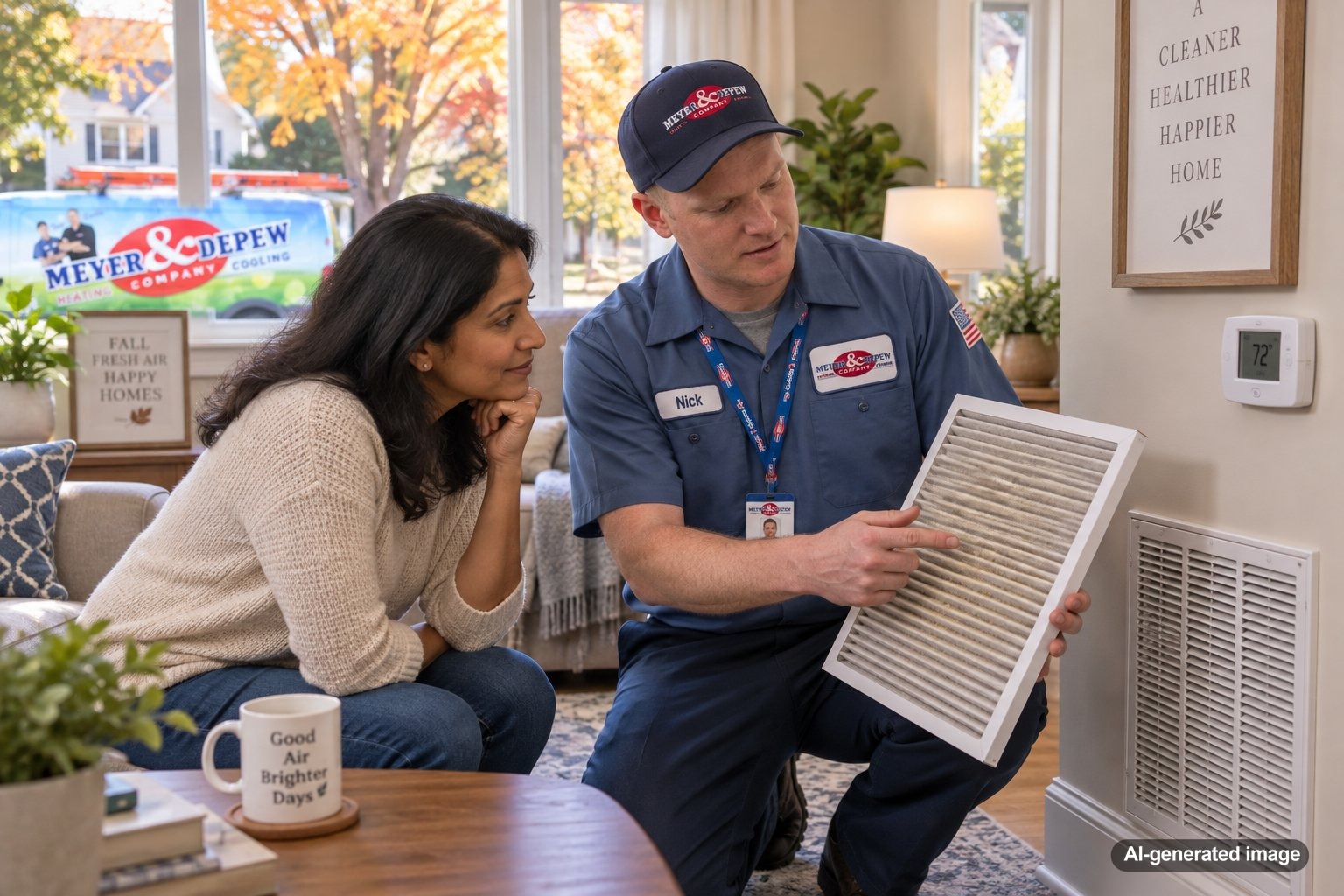
Fall pollen can reach your HVAC system after entering the house through doors, windows, cracks, clothing, pets, and other outdoor air pathways. Return vents then draw indoor air toward the HVAC system. A properly fitted filter can capture some airborne particles before the conditioned air is sent back into your rooms.
How does fall pollen get inside in the first place?
Most residential heating and cooling systems do not constantly pull large amounts of outdoor air directly into the home. Instead, outdoor particles often enter through everyday air movement and normal household activity.
Common pathways include:
- Open windows and exterior doors
- Small cracks and gaps around windows, doors, walls, and other parts of the building envelope
- People carrying pollen indoors on clothing, hair, bags, and shoes
- Dogs and other pets bringing pollen inside on their coats and paws
- Outdoor air entering when exhaust fans or normal pressure differences move air through the house
- Mechanical outdoor air intakes on systems designed to bring in outside air
During high-pollen periods, these small pathways can add up. You may never see pollen entering, yet particles can accumulate on floors, furniture, fabrics, and other indoor surfaces.
How does pollen reach the HVAC system?
A forced-air HVAC system continually moves indoor air when the blower operates. Return vents pull air from the living space back toward the heating or cooling equipment. Air passes through the filtration area before being heated or cooled and redistributed through supply ducts.
If pollen is suspended in that return air, it can travel toward the filter. How much is captured depends on factors such as the filter’s efficiency, its condition, how well it fits, and whether air is leaking around it.
Pollen that has already settled on surfaces is less likely to move through the HVAC system until something disturbs it. Walking across carpeting, making a bed, vacuuming, opening an exterior door, or a pet moving through a room can put settled particles back into the air.
Can your HVAC system spread pollen around the house?
It can circulate airborne particles that are already inside. That does not necessarily mean the HVAC system created the pollen problem. The system is moving household air, and pollen suspended in that air may travel with it.
A properly selected and installed filter can help capture particles before air is recirculated. Higher-efficiency filters generally capture a greater percentage of particles within their rated size ranges, but the highest-rated filter is not automatically the correct choice for every HVAC system.
Filter resistance matters. A filter that is too restrictive for the equipment can interfere with airflow. The appropriate choice depends on the blower, filter cabinet, duct system, and other system characteristics. If you are considering a major filtration upgrade, a qualified HVAC professional can help determine what your system can accommodate.
Why filter fit matters as much as the rating
A filter can only capture air that actually passes through it. If a filter is the wrong size, bent, damaged, or poorly seated, air may travel around the edges instead of through the filter media.
This type of bypass can reduce filtration performance even when the filter itself has a relatively high efficiency rating. Check that the filter is installed in the correct orientation, fits the designated slot properly, and is not crushed or distorted.
You should also inspect the filter periodically. A heavily loaded filter can restrict airflow and should be replaced according to the filter manufacturer’s instructions and the needs of your HVAC system.
Does opening the windows make fall pollen problems worse?
It can during periods when outdoor pollen levels are elevated. Opening windows allows outdoor air to enter freely, and that air can carry pollen with it. Homeowners sometimes open windows on mild fall days because the temperature feels comfortable, only to notice more allergy symptoms indoors afterward.
There is a tradeoff. Natural ventilation can be useful when outdoor conditions are favorable, but people who are sensitive to seasonal pollen may prefer to keep windows closed during particularly troublesome periods and rely on their home’s normal heating, cooling, and filtration strategy.
Can pollen come in through outdoor HVAC equipment?
In a typical central residential system, the outdoor AC or heat pump unit is not simply blowing outdoor air through the ductwork and into the house. The outdoor and indoor portions of the system exchange heat through the refrigeration process, while the indoor blower circulates indoor air through the duct system.
Some HVAC or ventilation configurations do include intentional outdoor air intakes. Commercial buildings are also more likely to use mechanical ventilation arrangements that introduce outdoor air. When an outdoor air intake is present, proper filtration, maintenance, and system design become important parts of managing particles brought in with that air.
What can homeowners safely check during fall pollen season?
- Inspect the HVAC filter and replace it when needed according to the manufacturer’s instructions.
- Make sure the filter is the correct size and sits securely in its slot.
- Confirm that supply and return vents are open and not blocked by furniture, rugs, or other objects.
- Keep doors and windows closed when outdoor pollen is especially bothersome to your household.
- Reduce pollen brought indoors by cleaning pet paws, changing clothes after extended outdoor activity, and managing dust on indoor surfaces.
- Schedule professional service if airflow problems, excessive dust, unusual system behavior, or recurring comfort concerns continue.
Would a better HVAC filter help with pollen?
Potentially. Filter efficiency is commonly compared using MERV ratings. Higher MERV ratings indicate greater particle-capture efficiency within specified particle-size ranges. However, your HVAC system has to be capable of moving enough air through the filter without creating excessive resistance.
A higher-efficiency filter may be useful for households focused on particle control, but filter selection should be based on both filtration goals and equipment compatibility. If you are unsure which level is appropriate, Meyer & Depew can evaluate the system rather than relying on a one-size-fits-all recommendation.
Homes with more significant indoor air quality concerns may also benefit from discussing additional air purification options. Filtration can help reduce airborne particles, but no HVAC filter can eliminate every indoor pollutant or allergen source.
Could pollen already be inside even after the outdoor count drops?
Yes. Once pollen enters a home, some of it can settle onto carpeting, upholstered furniture, bedding, window treatments, shelves, and other surfaces. Those particles may later become airborne again through normal activity.
That is one reason indoor symptoms do not always rise and fall at exactly the same time as outdoor conditions. The HVAC filter only handles particles carried through the return airflow. Pollen sitting on a surface will not be captured until it becomes airborne and reaches the filter.
When should you have the HVAC system professionally evaluated?
Consider professional help if you are dealing with recurring indoor air quality concerns, filters that become unusually dirty, weak airflow, rooms that are difficult to keep comfortable, visible gaps around the filter cabinet, or uncertainty about which filter your equipment can safely handle.
A technician can evaluate airflow, filter fit, equipment condition, and other factors that may affect how effectively the system moves and filters air. The goal is not simply to install the most restrictive filter available. It is to find an approach that balances filtration with proper HVAC operation.
Frequently asked questions about fall pollen and HVAC systems
Does the outdoor AC unit suck pollen into my house?
Not in the way many homeowners assume. A typical central AC or heat pump outdoor unit does not directly send outdoor air into your home’s supply ducts. Pollen usually reaches the indoor HVAC system after it has already entered the home through other pathways.
Can pollen get through an HVAC filter?
Some particles may pass through depending on the filter’s efficiency, condition, fit, and the characteristics of the particles. Air that leaks around a poorly fitted filter can also bypass the filter media completely.
Should I install the highest MERV filter I can buy?
Not automatically. A more efficient filter can also create more airflow resistance. Use a filter that your HVAC system is designed to accommodate. A qualified technician can help determine an appropriate option if you want to increase filtration.
Should I change my HVAC filter more often during allergy season?
Inspecting it more frequently can make sense during periods of heavy use or higher particle loads, but replacement timing depends on the filter type, household conditions, system runtime, and manufacturer guidance. Replace a dirty filter rather than relying solely on a fixed calendar date.
Can air purification completely eliminate fall pollen indoors?
No. Filtration and air purification may reduce airborne particles, but pollen can continue entering from outdoors and can settle on indoor surfaces. Effective management usually combines source control, housekeeping, appropriate filtration, and proper HVAC operation.
Fall pollen usually reaches your HVAC system after entering the home through ordinary outdoor air pathways or being carried inside. Once airborne indoors, it can be pulled toward return vents whenever the blower runs. A clean, properly fitted filter and a well-maintained HVAC system can help reduce recirculated particles while maintaining appropriate airflow.
Need help with your heating, cooling, or HVAC system?
Meyer & Depew serves homeowners and businesses throughout Central and Northern New Jersey.
Get a quote or call 908.272.2100.