



Why Do Commercial Buildings Feel Too Hot in the Afternoon and Too Cold in the Morning During Fall?
Estimated reading time: 13 minutes
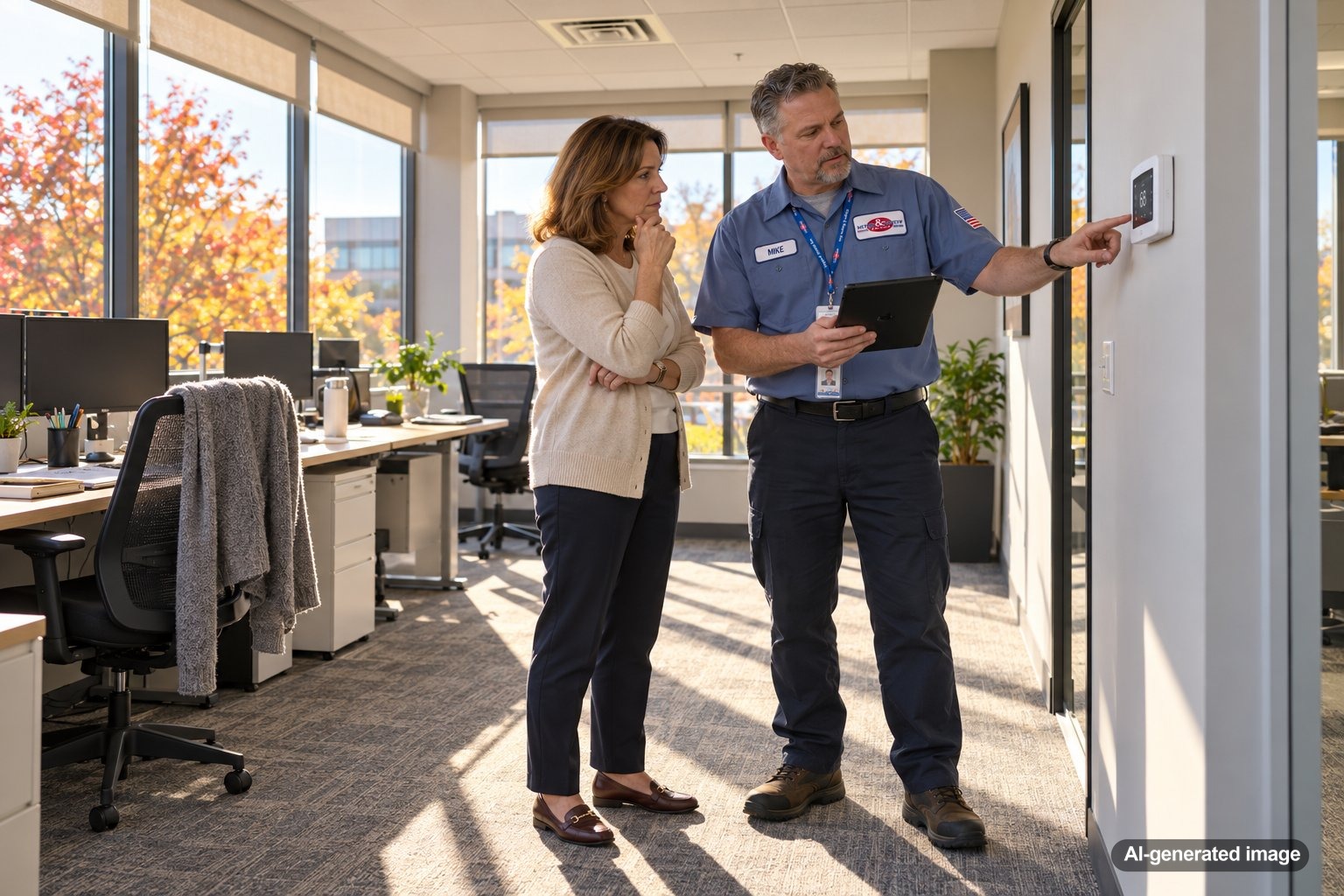
Your office feels like a refrigerator when employees arrive at 8 a.m. By 2 p.m., the conference rooms are stuffy, the sunny side of the building is uncomfortable, and someone is asking why the air conditioning isn’t running. By the time everyone leaves, the temperature has started dropping again. Sound familiar? This frustrating pattern is especially common during fall in Central and Northern New Jersey, when chilly mornings and surprisingly warm afternoons can challenge commercial heating and cooling systems.
The problem usually involves more than the outdoor temperature. Solar heat gain, changing occupancy, thermostat schedules, ventilation requirements, building insulation, and HVAC control settings can all contribute to dramatic temperature swings. Understanding how these factors interact is the first step toward making your building more comfortable without constantly switching between heating and cooling. For property managers and business owners, a closer look at commercial HVAC systems and services can also help identify when professional adjustments or maintenance may be appropriate.
Commercial buildings often feel too cold in the morning and too hot in the afternoon during fall because outdoor temperatures change quickly while internal heat loads, sunlight, occupancy, and HVAC controls respond at different rates. The most common contributing factors include:
- Cold overnight temperatures combined with heating systems that start too late.
- Afternoon sunshine warming windows, walls, and occupied spaces.
- Employees, computers, lighting, and equipment adding heat throughout the day.
- Thermostat schedules or control settings that do not match fall conditions.
- HVAC zoning, airflow, or maintenance problems that make temperatures uneven.
Why Fall Creates Such Different Heating and Cooling Needs
During a typical New Jersey fall day, a commercial building may need substantial heating before sunrise but relatively little heating several hours later. Depending on the weather, building design, and occupancy, parts of the same property may even require cooling by the afternoon.
Buildings do not respond instantly to changing outdoor conditions. Their walls, floors, furnishings, and structural materials absorb and release heat over time. This thermal mass can make indoor temperatures lag behind what is happening outside.
Consider an office that has been unoccupied overnight. Its heating system may have operated at a reduced temperature setting to limit unnecessary conditioning. When employees arrive, indoor temperatures may still be recovering. Meanwhile, sunlight begins warming the building, computers are switched on, and meeting rooms fill with people. Several hours later, those combined heat sources may push occupied areas beyond their comfortable temperature range.
The result is a building that seems unable to settle on a comfortable temperature, even though the heating and cooling equipment may be operating as programmed.
1. Morning Heating Schedules May Start Too Late
Many commercial buildings use setback schedules that reduce heating during unoccupied hours. This can be an effective operating strategy, but the morning recovery period must account for the building’s heating capacity, insulation, weather conditions, and thermal characteristics.
If a building is set to a lower temperature overnight and the heating schedule changes to the occupied setting only when employees arrive, the building may take considerable time to warm up.
A large office, warehouse, medical facility, or retail building may recover more slowly than a smaller space. Buildings with extensive glass, high ceilings, significant outside-air requirements, or older envelope construction can be particularly challenging.
What makes this confusing? The thermostat may display a heating setpoint of 70 degrees while the actual room temperature remains much lower. The system is attempting to reach the target temperature, but the building has not finished recovering from its overnight setback.
A qualified HVAC professional can evaluate whether the building management system or programmable controls should begin morning warm-up earlier. Some control systems include optimized start functions that automatically adjust startup timing based on operating conditions.
2. Afternoon Sunshine Can Overheat Certain Areas
Solar heat gain is one of the most overlooked reasons commercial buildings experience afternoon overheating during fall.
Sunlight entering through windows can warm floors, desks, furniture, and surrounding surfaces. These materials then release heat into the occupied space. South-facing and west-facing windows can create particularly noticeable temperature differences, depending on the building’s orientation and shading.
Imagine a commercial building with offices along its western exterior wall. Those offices may feel comfortable in the morning when direct solar exposure is limited. During the afternoon, however, sunlight can substantially increase their cooling requirements.
Interior offices with little direct sunlight may remain comfortable or even require heating at the same time.
This creates an important distinction: The building may not have one temperature problem. It may have several different heating and cooling requirements happening simultaneously.
Closing available blinds or adjusting window shades may reduce some solar heat gain. Persistent differences between building exposures may require an evaluation of HVAC zoning, control sequences, airflow, or building-envelope performance.
3. People and Office Equipment Add Heat Throughout the Day
Outdoor weather is only part of a commercial building’s heating and cooling load. Occupants and operating equipment also contribute heat.
Think about what happens between opening time and midafternoon. Employees arrive, computers and monitors run, lights operate, printers and other equipment generate heat, and conference rooms become occupied.
Each person and operating device contributes to the building’s internal heat load. Individually, these contributions may seem small. Together, they can significantly affect certain spaces, especially smaller offices, densely occupied conference rooms, and areas with substantial electronic equipment.
For example, a conference room might feel cold before its first meeting. After several people spend an hour inside with laptops and presentation equipment running, the room may feel warm even though the outdoor temperature has barely changed.
Occupancy patterns also matter in restaurants, retail stores, medical offices, and other commercial properties. An area that is comfortable when nearly empty may become noticeably warmer during peak activity.
Proper commercial HVAC design and controls account for changing internal loads rather than assuming every room requires identical conditioning all day.
4. Thermostat Programming May Not Match Fall Weather
A commercial building’s thermostat or building automation system may operate according to schedules and settings that were established months or years ago.
Those settings might work well during consistently hot summer weather or consistently cold winter conditions. Fall introduces a different challenge because heating and cooling demands can change considerably within a single workday.
Several control issues can contribute to uncomfortable temperature swings:
- Incorrect occupied hours: The system may begin conditioning too late or switch to unoccupied settings while people are still working.
- Overly aggressive setbacks: A large overnight temperature reduction can create an extended morning recovery period.
- Improper heating and cooling setpoints: Closely spaced or poorly coordinated settings can contribute to unnecessary heating and cooling operation.
- Control sensor placement: A thermostat exposed to direct sunlight, drafts, or nearby equipment may not reflect conditions throughout its zone.
- Outdated schedules: Building occupancy may have changed without corresponding HVAC programming adjustments.
For buildings with sophisticated controls, operating schedules, sensor readings, and trend data can help explain whether temperature swings result from programming, equipment performance, or changing internal loads.
Facility managers should document comfort complaints and confirm approved operating schedules before requesting major changes. Control adjustments that affect ventilation, equipment sequencing, or system safety should be handled by qualified personnel.
5. HVAC Zoning Problems Become More Obvious During Fall
Zoning allows different areas of a building to receive heating or cooling according to their individual requirements. When zoning is poorly designed, improperly configured, or malfunctioning, fall weather can make the limitations especially noticeable.
Consider a building with a sunny perimeter office, a windowless interior workspace, and a large conference room. Those areas may have very different temperature requirements throughout the day.
If multiple spaces share one temperature sensor or depend on a single control zone, the equipment may satisfy one area’s needs while leaving another uncomfortable.
In some commercial buildings, variable air volume systems adjust the amount of conditioned air delivered to individual zones. Others use rooftop equipment, terminal units, or more specialized system configurations.
Where appropriate for the property’s design and operating needs, variable refrigerant flow (VRF) systems may offer more individualized temperature control. Certain heat recovery VRF configurations can also support simultaneous heating and cooling in different zones.
However, replacing equipment is not automatically necessary. A professional assessment may reveal a failed sensor, incorrect airflow setting, improperly operating damper, or control sequence that needs attention.
6. Ventilation and Outside-Air Settings Affect Indoor Temperatures
Commercial HVAC systems must address ventilation as well as temperature control. Many systems introduce outdoor air to support indoor air quality and applicable ventilation requirements.
During fall, outdoor air can be beneficial for cooling under suitable conditions. Some commercial systems use economizer controls to take advantage of favorable outdoor temperatures and reduce mechanical cooling when appropriate.
But improperly functioning outside-air dampers, temperature sensors, or economizer controls can contribute to comfort problems.
For example, excessive outdoor air entering the building during a cold morning may increase heating demand. Later, an economizer that fails to operate correctly could prevent the system from taking advantage of cooler outdoor conditions when the occupied space needs cooling.
Ventilation requirements should never be reduced casually to address a comfort complaint. A qualified commercial HVAC technician can evaluate outside-air controls while maintaining appropriate ventilation and building operating requirements.
7. Deferred Maintenance Can Make Normal Temperature Changes Worse
Not every uncomfortable fall temperature pattern indicates a mechanical failure. However, equipment performance problems can make ordinary seasonal fluctuations much harder to manage.
Dirty filters, restricted airflow, faulty temperature sensors, worn components, malfunctioning dampers, and control problems can all affect how effectively a commercial HVAC system responds to changing demands.
Rooftop units are particularly important to consider because many commercial properties rely on them for heating, cooling, and ventilation. A unit may appear to operate normally during mild weather but struggle when morning heating or afternoon cooling demand increases.
Regular inspections can help identify issues before they become major comfort disruptions. A commercial HVAC maintenance plan provides a structured way to address recurring equipment inspections and seasonal operating concerns.
How to Identify What Is Causing Your Building’s Temperature Swings
Before assuming your commercial heating and cooling equipment is undersized or failing, gather a few days of information about the problem. A simple comfort log can help distinguish scheduling issues from problems affecting individual zones or equipment.
Record the time, location, observed temperature, and circumstances whenever a complaint occurs. Note whether the affected room receives direct sunlight, has unusually high occupancy, or contains equipment that generates considerable heat.
What Different Temperature Patterns May Suggest
| Observed problem | Possible contributing factor | What to investigate |
|---|---|---|
| Entire building is cold at opening | Late heating startup or excessive overnight setback | Occupied schedules, warm-up timing, and heating performance |
| West-facing offices become hot after lunch | Afternoon solar heat gain | Window shading, zoning, sensors, and cooling capacity |
| Conference room overheats during meetings | Occupancy and equipment heat loads | Zone airflow, controls, ventilation, and room loads |
| Adjacent offices have opposite comfort complaints | Zoning or airflow imbalance | Zone boundaries, dampers, thermostats, and airflow |
| Temperatures fluctuate throughout the workday | Control sequencing, sensor errors, or equipment performance | System operating trends and professional diagnostics |
These patterns are useful clues, not definitive diagnoses. More than one condition can occur simultaneously, especially in larger buildings with multiple HVAC systems.
What Business Owners and Facility Managers Can Safely Check
Some comfort problems can be investigated without opening equipment cabinets, handling electrical components, or changing technical control settings.
- Confirm that thermostat schedules match actual building occupancy hours.
- Compare the displayed room temperature with the desired occupied temperature.
- Review authorized building management system alerts and visible operating information.
- Make sure accessible supply and return vents are not blocked by furniture, boxes, or stored materials.
- Check whether complaints consistently occur in the same rooms or at the same times.
- Note whether direct sunlight or unusually high occupancy contributes to overheating.
- Review maintenance records to see when the affected HVAC equipment was last inspected.
- Ask occupants to report the location and time of comfort problems rather than repeatedly changing thermostat settings.
Coordinate any schedule or setpoint changes through the person responsible for building operations. Avoid repeatedly switching between heating and cooling modes in an attempt to chase changing room temperatures.
Do not open rooftop equipment, bypass controls, adjust electrical components, or modify ventilation systems without qualified professional assistance.
Should You Adjust the Thermostat or Have the HVAC System Inspected?
The answer depends on whether the problem follows a predictable operating pattern or indicates that the building cannot meet its intended temperature settings.
If the entire building is cold only during the first hour of occupancy and later becomes comfortable, the morning warm-up schedule may deserve attention. If the same offices overheat every sunny afternoon, solar exposure and zoning deserve a closer look.
However, if temperatures remain uncomfortable despite reasonable schedules, certain zones receive little airflow, equipment frequently cycles, or the system cannot maintain normal occupied setpoints, a professional inspection is appropriate.
A qualified commercial HVAC technician may evaluate:
- Heating and cooling operation under actual building loads.
- Supply-air temperatures and airflow distribution.
- Thermostat and temperature sensor accuracy.
- Occupied and unoccupied control schedules.
- Zone dampers, terminal units, and rooftop equipment operation.
- Economizer and ventilation control performance.
- Building automation trends and heating-to-cooling changeover sequences.
The goal is to identify the source of the imbalance before making costly assumptions about replacement equipment or major system changes.
How Commercial Buildings Can Prepare for Fall Temperature Changes
Fall comfort management works best when building operations are reviewed before colder weather becomes consistent.
For properties throughout Central and Northern New Jersey, this means preparing for both early morning heating demands and occasional afternoon cooling requirements.
A practical seasonal approach includes reviewing occupancy schedules, confirming heating readiness, checking cooling availability where needed, evaluating temperature control settings, and arranging appropriate commercial HVAC maintenance.
Facility managers should also consider changes in how their spaces are used. An office that now hosts more in-person meetings, a retail space with new equipment, or a commercial property with modified operating hours may have different conditioning requirements than when its original controls were configured.
Buildings with recurring seasonal complaints may benefit from a broader assessment of their control strategy, zoning arrangement, and equipment capabilities. The right solution could be a modest scheduling correction, a targeted repair, airflow balancing, or an equipment improvement, depending on the underlying cause.
Frequently Asked Questions
Why is my office building cold every morning but warm by lunchtime?
Overnight thermostat setbacks, delayed morning heating startup, and the building’s thermal mass can contribute to cold mornings. As sunlight, occupants, and office equipment add heat throughout the day, indoor temperatures may rise. A review of heating schedules and actual room temperatures can help identify the cause.
Can a commercial building need heating and cooling on the same fall day?
Yes. Fall weather can create substantial temperature differences between morning and afternoon. Some buildings also have zones with different needs at the same time because of solar exposure, internal heat loads, and occupancy. Whether simultaneous heating and cooling is available depends on the HVAC system’s design and controls.
Should we turn off the air conditioning once fall begins?
Not necessarily. Commercial buildings can experience cooling demand even when outdoor temperatures are relatively mild. Offices with significant internal equipment loads, high occupancy, or strong solar exposure may still need cooling during fall. Cooling operation should be managed according to the building’s design, operating requirements, and conditions.
Will installing more thermostats fix uneven commercial building temperatures?
Additional thermostats alone may not solve the problem. Effective temperature control depends on how equipment, sensors, dampers, airflow, and HVAC zones work together. An assessment can determine whether a control adjustment, zoning modification, or equipment repair is more appropriate.
When should a property manager schedule commercial HVAC service for temperature fluctuations?
Schedule an evaluation when comfort complaints persist, temperatures consistently fail to reach occupied setpoints, zones behave unpredictably, or heating and cooling equipment shows signs of poor performance. A qualified technician can identify whether the issue involves programming, airflow, equipment, or other building conditions.
Make Fall Comfort More Predictable for Your Building
A commercial building that feels cold in the morning and hot in the afternoon is not necessarily experiencing a major HVAC failure. Often, fall weather exposes the interaction between building heat retention, sunlight, occupancy, ventilation, and temperature controls.
For business owners and property managers, the most productive approach is to document the pattern, check operating schedules, and investigate persistent differences between spaces. Addressing the actual cause can help reduce comfort complaints and support more consistent building operation through the changing seasons.
Need commercial HVAC support in New Jersey?
Meyer & Depew works with businesses, organizations, and commercial properties throughout Central and Northern New Jersey.
Learn more about commercial HVAC maintenance plans.