



Can Thick Rugs Block Floor Heating Vents?
Estimated reading time: 12 minutes
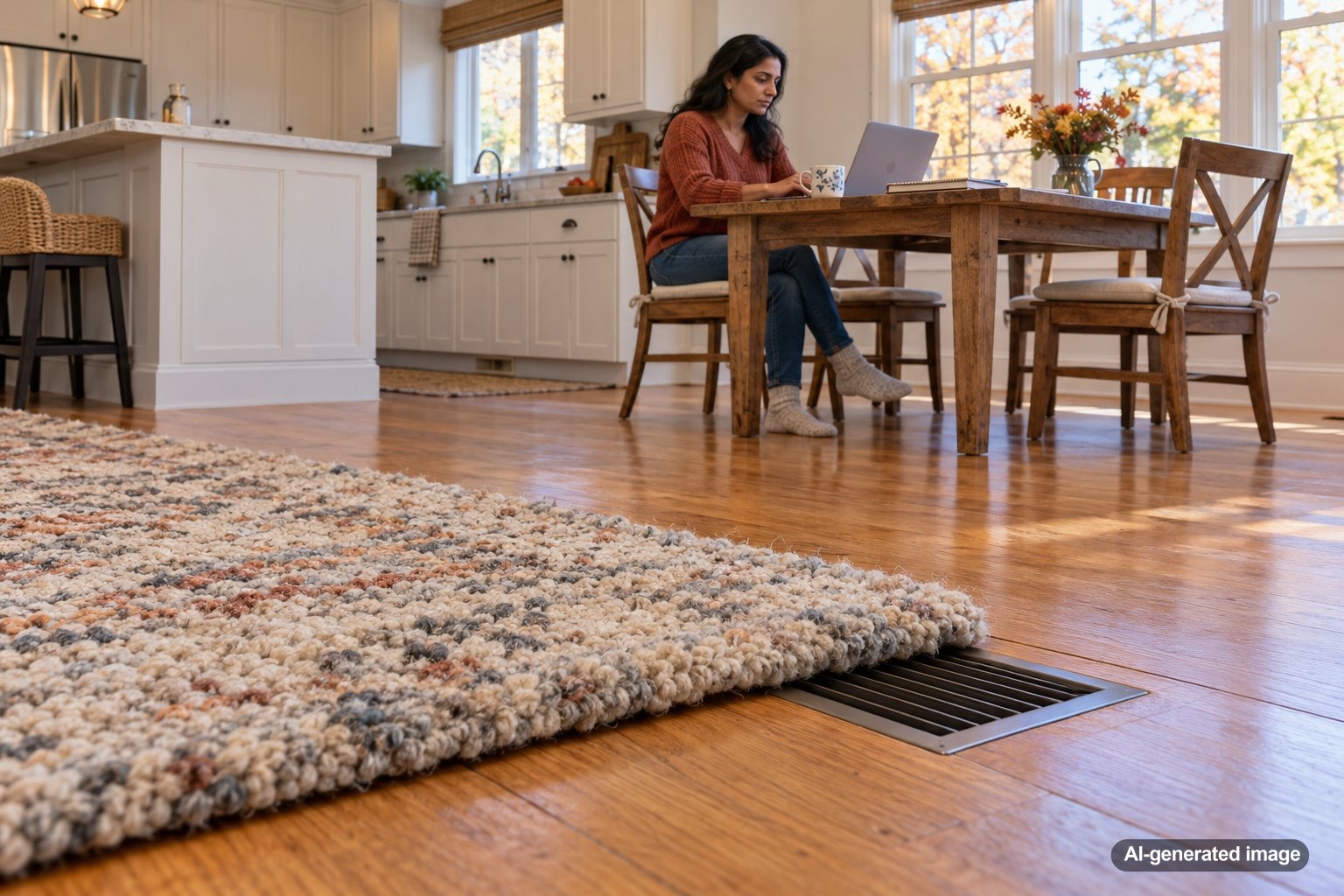
Yes, thick rugs can block floor heating vents, and the problem is often more noticeable than homeowners expect. A plush area rug, heavy runner, or thick rug pad can partially or completely cover a floor register, restricting the warm air your heating system is trying to deliver into the room. The result may be a colder living space, uneven temperatures, and longer heating cycles as your thermostat continues calling for heat. In Central and Northern New Jersey, where heating systems work through months of cold weather, something as simple as rug placement can make a noticeable difference in everyday comfort.
The important distinction is that a blocked heating vent does not necessarily mean your furnace is failing. Before assuming your equipment needs repair, it makes sense to look at the way warm air moves through your home. Proper airflow is an important part of effective residential heating, and floor registers need an unobstructed path to distribute conditioned air.
- Thick rugs and rug pads can restrict warm air when they cover or overlap a floor supply register.
- A completely covered vent may reduce heat delivery to that room and create unnecessary airflow resistance.
- Plush rugs can also obstruct nearby register openings when their edges bunch up or shift.
- Leave floor registers uncovered and avoid placing furniture directly over them.
- If a room remains cold after airflow obstructions are removed, professional HVAC evaluation may be appropriate.
How Thick Rugs Interfere With Floor Heating Vents
Many forced-air heating systems distribute warm air through ducts connected to supply registers in the floor, walls, or ceilings. When the thermostat calls for heat, a blower moves conditioned air through the ductwork and into occupied rooms.
Floor registers are particularly vulnerable to accidental obstruction because they occupy the same surfaces used for rugs, furniture, and everyday walking paths. A rug does not need to cover the entire register to interfere with airflow. If its edge rests across part of the grille, warm air may encounter additional resistance or be directed into the underside of the rug instead of circulating freely through the room.
Thick rugs can create several different problems depending on how they are positioned.
A Rug Completely Covers the Register
This is the clearest example of an airflow obstruction. A large area rug may hide a floor vent entirely, especially when homeowners rearrange furniture or replace an older rug with a larger one.
Warm air cannot circulate into the room as intended when the register is covered. The affected room may feel cooler than neighboring spaces, particularly during colder weather.
The Rug Edge Partially Overlaps the Opening
Partial coverage can be harder to notice. A rug might overlap only a few inches of a register, leaving much of the grille visible. However, the remaining opening may not provide the airflow distribution originally intended.
The impact depends on the register size, duct design, system airflow, and extent of the obstruction. A small overlap does not automatically create a serious problem, but keeping the complete grille clear is the better approach.
A Thick Rug Pad Creates an Additional Obstruction
Homeowners sometimes cut a visible rug around a floor register but forget about the pad underneath. Dense felt pads, rubber-backed underlays, and layered cushioning can still overlap the grille or restrict the space immediately around it.
Check both the rug and its underlayment. The register should remain fully exposed, with no loose material that can slide over the opening.
Why a Blocked Floor Vent Can Make a Room Feel Colder
A floor vent is designed to deliver conditioned air into the occupied space. When a rug blocks that delivery point, less warm air may reach the room. Depending on the system and the degree of obstruction, air may be redirected through other available supply registers, while the room with the blocked opening receives less heat.
Imagine a New Jersey living room with a large wool rug covering one of its main floor registers. The furnace may be running normally, and other rooms may reach their thermostat settings. Yet the living room feels chilly near the seating area because the intended supply of warm air is restricted.
This creates a common source of confusion: homeowners may turn up the thermostat to compensate for one uncomfortable room. If the thermostat is located elsewhere, however, increasing the setting may overheat other rooms without resolving the blocked register.
Before changing thermostat schedules or assuming the heating system is undersized, inspect the room’s supply vents and verify that they are open and unobstructed.
Can a Rug Over a Heating Vent Damage the HVAC System?
Covering one floor register does not automatically damage a furnace or create an emergency. The potential consequences depend on how much airflow is restricted, how many registers are blocked, and the characteristics of the HVAC system.
Forced-air heating equipment is designed to operate within an appropriate airflow range. When significant supply restrictions develop, the system may experience increased static pressure, reduced airflow, and changes in operating conditions.
In some forced-air furnace systems, severely restricted airflow can contribute to excessive temperature rise and may cause a high-temperature safety limit to interrupt burner operation. This possibility is particularly relevant when several vents are obstructed or other airflow problems already exist, such as a heavily loaded air filter or restrictive ductwork.
It is important not to overstate the risk. A small amount of rug overlap does not mean the furnace will overheat. Still, deliberately blocking supply registers is not a good method of controlling room temperature, and unnecessary restrictions should be avoided.
If the heating system frequently shuts down before reaching the thermostat setting, runs unusually long, or produces inconsistent airflow across multiple rooms, a qualified technician can evaluate the equipment and duct system.
Thick Rugs Versus Thin Rugs: Does Material Make a Difference?
The biggest factor is whether the rug covers the vent, not simply how thick the material is. A thin cotton rug that completely covers a register can cause more obstruction than a thick wool rug positioned several inches away.
Nevertheless, certain rug characteristics can make accidental vent coverage more likely.
- High-pile or shag rugs: Long fibers can extend across nearby grille openings, particularly when a rug edge sits close to the register.
- Thick wool rugs: Their weight and dense construction can make overlapping material less likely to shift away from the opening on its own.
- Layered rugs: Decorative rug layering introduces multiple materials that may cover or partially conceal a register.
- Heavy rug pads: Thick cushioning may remain over a floor vent even if the visible rug is repositioned.
- Lightweight runners: These can gradually slide into a register’s path in busy hallways or entryways.
For a typical forced-air heating system, the practical rule is straightforward: choose any rug material you like, but keep the supply register exposed.
How Much Space Should You Leave Around a Floor Heating Vent?
There is no single universal clearance measurement that applies to every floor register and HVAC installation. Register designs, airflow direction, equipment requirements, and surrounding furnishings vary.
At a minimum, the entire grille opening should remain uncovered. Avoid letting the rug edge, pad, fringe, or furniture overlap the register.
Additional space around the opening can help prevent a thick rug edge from curling or drifting into the airflow path. When a register is positioned close to a sofa or other large piece of furniture, pay attention to whether the warm air can actually enter the room instead of being trapped beneath or behind furnishings.
For a floor register with a directional grille, the angle of airflow matters too. Warm air should be able to circulate as intended rather than striking a nearby obstruction immediately after leaving the opening.
If the manufacturer specifies clearance requirements for a particular register, floor-mounted heater, or other heating appliance, follow those instructions. A conventional forced-air floor register is not the same as an electric floor heater or baseboard heating unit, which may have different safety and clearance requirements.
Is It Safe to Cut a Hole in a Rug for a Floor Vent?
Some homeowners prefer to keep a large area rug in place and create an opening where the floor register sits. This can be an option for certain rugs, but the result needs to be stable, properly finished, and compatible with the flooring and register design.
A poorly finished opening may allow rug fibers to unravel, expose loose padding, or create an uneven edge around the register. Cutting a thick rug may also affect its backing and appearance.
Before modifying an expensive rug, consider whether a smaller rug or slightly different furniture arrangement would solve the problem more simply.
If a rug opening is professionally finished, make sure the complete register remains uncovered and accessible. Do not fasten fabric, cushioning, or decorative trim over the grille. Avoid modifying the ductwork or register assembly as part of the rug project.
What About Furniture Sitting Over Floor Heating Vents?
Rugs are not the only common obstruction. Sofas, bookcases, cabinets, storage benches, and entertainment furniture can also block floor registers.
Furniture with a solid base positioned directly over a floor vent can severely restrict the air leaving that opening. Even furniture raised on legs may interfere with airflow if the clearance beneath it is limited.
This combination is particularly common in older New Jersey homes, where floor registers may have been positioned for an earlier room layout. Homeowners add a sectional sofa or larger entertainment center, then place a thick area rug beneath the furniture. Without realizing it, the new arrangement covers a register that previously supplied warm air to the room.
When planning a room layout, locate the supply registers and return-air openings before positioning large furniture. Both supply and return airflow matter to the performance of a forced-air HVAC system.
Can You Close an Unused Floor Vent Instead?
A common question is whether homeowners can simply close the floor register in a room they rarely use. Closing a register is not always equivalent to reducing the heating load in a controlled way.
Closing multiple supply registers can increase airflow resistance and change how air moves throughout the duct network. The resulting effects depend on the system’s design and blower operation.
If certain rooms consistently receive too much or too little heat, a professional evaluation may identify better options for balancing the system. Homes with persistent room-to-room temperature differences may also benefit from learning about properly designed HVAC zoning systems.
A rug should never be used as a substitute for an HVAC damper, zoning control, or professionally evaluated airflow adjustment.
Simple Ways to Check Whether Your Rug Is Affecting Heating
You do not need to open ductwork or perform mechanical repairs to check for obvious obstructions. Start with a few visual and comfort-related observations.
- Locate every floor register. Look beneath rugs, furniture, and storage items to make sure no openings have been hidden.
- Check the rug pad. Lift the rug edge and verify that underlayment is not covering the grille.
- Move obstructions away. Reposition rugs or furniture so conditioned air has a clear path into the room.
- Confirm registers are open. Check any accessible register adjustment without forcing stuck components.
- Inspect the air filter. Replace a dirty filter when appropriate, following the equipment manufacturer’s recommendations.
- Observe room comfort. After restoring clear airflow, notice whether the room warms more consistently during normal heating operation.
Try to compare comfort under similar conditions. A room may feel warmer in the afternoon because of sunlight, for example, rather than because you moved a rug that morning.
It is also worth noting whether the room has other characteristics affecting heat distribution, including large windows, drafty exterior doors, high ceilings, or inadequate insulation.
When a Cold Room Is Not Just a Rug Problem
Removing a rug obstruction may help, but it cannot correct every heating problem. If the register remains weak after it is completely uncovered, the underlying issue may be elsewhere.
Possible explanations include an overly restrictive filter, duct leakage, an airflow-balancing issue, a closed damper, or a heating system that is not operating as intended. Room insulation and air leakage can also contribute to cold spots even when the supply airflow is adequate.
One useful distinction is whether the register delivers a noticeable amount of warm air while the heating system runs. If it does, yet the room remains cold, the concern may involve heat loss or insufficient heating capacity for that space. If little air reaches the register, the system’s airflow and duct distribution may deserve closer inspection.
A technician can assess the situation using appropriate measurements rather than guessing from the temperature of a single room.
For recurring heating issues, professional heating service and maintenance can help identify whether the problem involves airflow, equipment operation, or another part of the system.
Frequently Asked Questions About Rugs and Floor Heating Vents
Can a rug over a floor vent make my heating bill higher?
It can contribute to inefficient comfort management, particularly if restricted airflow causes homeowners to raise the thermostat or the heating system operates longer to satisfy a temperature setting. The actual energy impact varies with the system, home, thermostat location, and extent of the blockage. A covered vent does not guarantee a measurable increase in every home’s heating costs.
Will warm air pass through a thick area rug?
Some warmth may transfer through the material, but that is not equivalent to the intended movement of heated air through an open supply register. Rug fibers, backing, and pads can substantially restrict direct airflow. Keeping the grille uncovered allows the register to function as designed.
Can I use a vent extender under a rug or sofa?
Certain commercially available register deflectors or extenders are intended to redirect supply air around furniture. Suitability depends on the product, register design, clearance, and installation requirements. An accessory should not crush, conceal, or significantly restrict the opening. Avoid homemade arrangements involving flammable materials or alterations to heating equipment. If you are unsure whether an accessory is appropriate, ask an HVAC professional.
Should every floor vent stay open during winter?
For a typical forced-air heating system, keeping supply registers open and unobstructed is a sound starting point. Some systems have professionally designed balancing or zoning controls that regulate airflow differently. Avoid closing multiple registers without understanding how the system was designed to operate.
Does this advice apply to radiant floor heating?
Not in exactly the same way. Radiant floor heating warms the floor surface rather than delivering heated air through a register. Thick rugs and insulating pads can reduce heat transfer into the room, but manufacturer-approved floor coverings, temperature limits, and clearance requirements depend on the specific radiant system. Follow the flooring and heating manufacturers’ guidance rather than applying forced-air vent advice to radiant heat.
The Bottom Line: Keep Floor Heating Vents Clear
Thick rugs can block floor heating vents when they cover or overlap the register. The most common result is reduced heat delivery to the affected room, although extensive airflow restrictions can also interfere with overall system operation. Keep rugs, pads, and large furniture away from supply openings, and do not use covered registers as a temperature-control strategy.
In many homes, restoring airflow is as simple as moving a rug a few inches or reconsidering furniture placement. If a room stays uncomfortable after the registers are clear, that is a reasonable point to investigate the heating system itself.
For homeowners throughout Central and Northern New Jersey, addressing visible airflow obstructions before the coldest weather arrives is a practical way to support more consistent indoor comfort. And when the problem extends beyond a blocked floor vent, a qualified HVAC professional can help determine what needs attention.
Need help with your heating, cooling, or HVAC system?
Meyer & Depew serves homeowners and businesses throughout Central and Northern New Jersey.
Get a quote or call 908.272.2100.