


Can a Weak Run Capacitor Cause an HVAC Motor to Start Intermittently?
Estimated reading time: 13 minutes
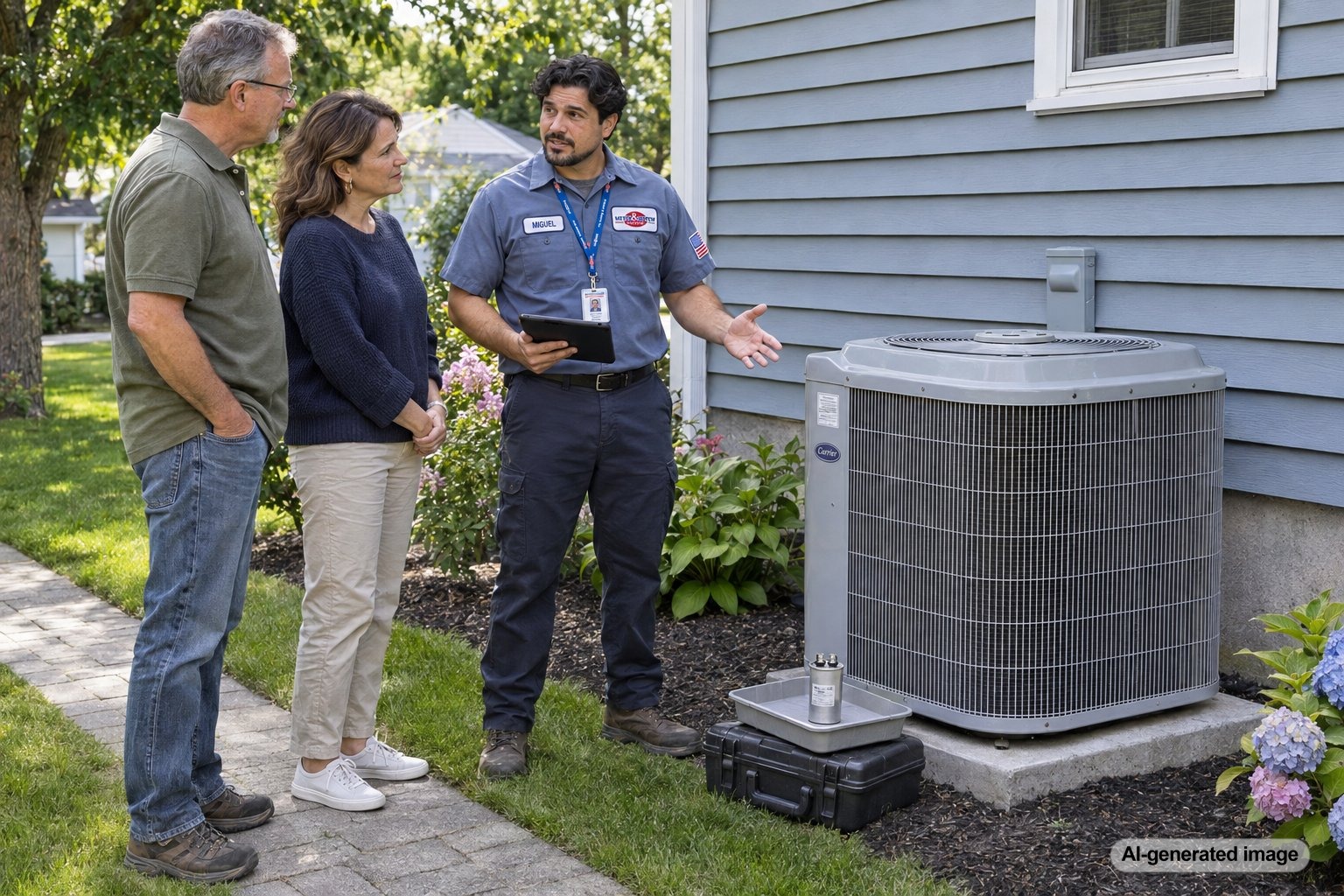
Yes, a weak run capacitor can cause an HVAC motor to start intermittently. A motor may start normally on one cooling cycle, hesitate or hum on the next, and then appear to work again later. This unpredictable behavior can happen when a capacitor has deteriorated enough to affect motor performance but has not completely failed. However, intermittent starting does not automatically mean the capacitor is responsible. Motor wear, electrical connections, control problems, and other equipment conditions can produce similar symptoms.
For homeowners and property managers in Central and Northern New Jersey, recognizing this distinction matters. An air conditioner that starts inconsistently during humid summer weather or a heating system with an unreliable blower deserves attention before repeated starting problems place additional stress on equipment. Understanding what a run capacitor does, how its condition affects motor operation, and what a technician should evaluate can help you make informed repair decisions. Meyer & Depew provides air conditioning service and maintenance for homeowners experiencing these types of problems.
A deteriorating run capacitor can contribute to intermittent HVAC motor starting, particularly when its capacitance falls outside the motor manufacturer’s acceptable range. Important points include:
- A motor may hum, hesitate, start inconsistently, or fail to reach normal operating speed.
- Symptoms can change with motor temperature, mechanical load, and electrical conditions.
- A weak capacitor does not always prevent the motor from starting immediately.
- Intermittent starting can also result from motor defects, loose connections, control issues, or supply-voltage problems.
- A qualified HVAC technician can test the capacitor and evaluate the complete motor circuit before recommending repairs.
How Does an HVAC Run Capacitor Help a Motor Operate?
A run capacitor is an electrical component used with certain single-phase HVAC motors. It helps establish the phase relationship between current in the motor’s windings, supporting the rotating magnetic field needed for proper operation. Unlike a start capacitor, which is used only during startup in systems designed with one, a run capacitor normally remains connected while the motor operates.
Run capacitors are commonly found in residential air conditioning condenser fan motors and in certain compressor and blower motor designs. Not every HVAC motor uses an external run capacitor. Many modern electronically commutated motors, commonly called ECMs, use electronic controls instead.
Run capacitors are rated in microfarads, abbreviated as MFD or uF. Their ratings must correspond to the requirements of the connected motor. A capacitor that has lost capacitance may no longer provide the electrical characteristics the motor needs for reliable starting and efficient operation.
What Happens as a Run Capacitor Gets Weaker?
A run capacitor can deteriorate gradually because of age, repeated thermal exposure, and electrical stress. As its capacitance changes, the motor’s auxiliary winding may no longer receive the intended phase-shifted current.
Depending on motor design and operating conditions, this can contribute to reduced starting torque, inefficient operation, increased heating, or unreliable starting. A motor may continue operating after successfully starting even though the capacitor is no longer performing within specifications.
That difference between starting and running is one reason capacitor-related problems can seem inconsistent rather than appearing as a complete equipment failure.
Why Can a Weak Run Capacitor Cause Intermittent Starting?
A deteriorating capacitor does not necessarily produce identical symptoms every time the thermostat requests heating or cooling. Several factors can influence whether a marginal motor successfully starts.
1. Reduced Starting Torque Can Make Startup Less Reliable
When a motor’s run capacitor falls significantly below its specified capacitance, the motor may have less starting torque available. Under favorable conditions, the motor might still overcome the mechanical resistance of the fan or other connected load. Under less favorable conditions, it may struggle.
For example, an outdoor condenser fan motor might start on several consecutive cooling calls but fail to start during another cycle. The underlying electrical weakness may be present throughout, even though the visible symptom appears only occasionally.
2. Motor Temperature Can Influence the Symptoms
Motor temperature affects winding resistance and other operating characteristics. A motor that starts when cool may behave differently after operating for an extended period.
If a weak capacitor is already compromising motor performance, changing temperatures can make the problem more noticeable. An overheating motor may also activate its internal thermal protection, interrupting operation until it cools.
This creates an important diagnostic distinction: a motor that stops and later restarts may be experiencing thermal protection events rather than a capacitor problem alone. A technician should determine whether excessive heat is a cause, a consequence, or an unrelated symptom.
3. Mechanical Resistance Can Change the Starting Load
Worn bearings, increased friction, and deterioration inside a fan motor can make startup more difficult. A marginal capacitor may be unable to support reliable starting when the motor’s mechanical condition has also declined.
Replacing a weak capacitor without recognizing a mechanically failing motor could leave the original starting problem unresolved.
4. Electrical Conditions Can Make a Marginal Motor Less Dependable
Supply-voltage fluctuations, deteriorating electrical contacts, and other circuit problems can affect motor starting. A motor operating with a weak capacitor may have less margin for these additional problems.
However, low voltage or a defective contactor can cause intermittent starting even when the capacitor is healthy. Professional testing is necessary to separate these possibilities.
Warning Signs That May Point to a Weak HVAC Run Capacitor
Run capacitor problems do not always announce themselves with an obvious failure. Instead, homeowners often notice changes in the way equipment starts, sounds, or operates.
- The outdoor fan starts inconsistently: The air conditioner runs normally during some cycles, but the condenser fan does not operate during others.
- A motor hums without starting: An electrical humming sound may indicate that power is reaching a motor that cannot successfully begin rotating.
- The motor starts slowly or hesitates: A fan may appear to struggle before reaching its expected operating speed.
- The motor stops unexpectedly: Overheating or an internal protective device may interrupt operation, although several different faults can produce this symptom.
- Cooling performance becomes unreliable: If a condenser fan fails to operate properly, the air conditioning system may struggle to reject heat and maintain indoor comfort.
- Electrical components show visible damage: A technician may find a swollen, leaking, or otherwise damaged capacitor during inspection, although a capacitor can test weak without visible damage.
These are warning signs, not a definitive diagnosis. The particular combination of symptoms, motor type, and equipment operating sequence helps determine which component should be examined.
Is the Problem a Weak Capacitor or a Failing HVAC Motor?
This distinction is particularly important because both failures can cause humming, hesitation, overheating, and intermittent operation. A weak capacitor is often less involved to replace than a failed motor, but replacing the wrong component wastes time and may leave the equipment at risk.
Clues That Make a Capacitor Worth Testing
A capacitor deserves attention when a compatible single-phase motor exhibits inconsistent starting, reduced startup performance, or humming without rotation. Age-related component deterioration or a capacitor that measures outside its specified tolerance can strengthen the diagnosis.
However, even an out-of-spec capacitor does not prove that every observed symptom originates there. Additional motor testing may still be appropriate.
Clues That Suggest Motor Problems
Abnormal bearing noise, excessive shaft resistance, damaged windings, persistent overheating, or repeated thermal-protection trips can suggest motor deterioration. Some motors also have internal electrical defects that become noticeable only after warming up.
A technician may need to evaluate motor current, winding condition, operating temperature, and mechanical condition alongside capacitor measurements.
Clues That Suggest an Electrical Control Problem
If the motor sometimes receives power and sometimes does not, the issue may involve a contactor, relay, control board, wiring connection, or protective control.
A capacitor cannot correct a missing electrical command or an open circuit elsewhere in the system. Confirming that the motor receives the correct supply voltage during the failed-start condition is an essential part of distinguishing electrical control problems from motor and capacitor defects.
Why the Type of HVAC Motor Matters
One overlooked detail is that capacitor diagnosis depends on the motor design. Different HVAC motors use different starting and operating arrangements.
Permanent Split Capacitor Motors
Permanent split capacitor, or PSC, motors are common in many traditional HVAC fan applications. These motors typically use a run capacitor as part of their normal operating circuit. A capacitor that is significantly out of specification can affect both startup and running performance.
Motors With Separate Starting Components
Some single-phase motors use additional starting components, such as a start capacitor and a switching or relay arrangement. In these systems, an intermittent starting problem may involve the start circuit, run circuit, motor, or another electrical component.
A run capacitor and a start capacitor are not interchangeable simply because both are associated with motor operation.
Electronically Commutated Motors
Many newer HVAC systems use ECM blower motors or other electronically controlled motor designs. These motors generally do not rely on an external run capacitor in the same way as traditional PSC motors.
Intermittent operation in an ECM may involve the electronic control module, power supply, control signals, or the motor itself. Assuming that every HVAC motor has a replaceable run capacitor can lead to an incorrect diagnosis.
Can a Weak Run Capacitor Damage an HVAC Motor?
Potentially, yes. A weak capacitor can contribute to inefficient motor operation, abnormal current relationships, reduced torque, and excessive heating in some motor applications. If the motor repeatedly struggles to start or remains energized while unable to rotate, additional electrical and thermal stress may develop.
Some motors have internal thermal protection intended to reduce the risk of damage from overheating. That protection should not be treated as permission to continue operating malfunctioning equipment. Repeated protective shutdowns indicate that a problem needs evaluation.
For an outdoor air conditioning unit, a nonoperating condenser fan can also affect the refrigeration system by interfering with normal heat rejection. If the outdoor fan is not running while the compressor appears to be operating, shut the system off using the normal thermostat controls and arrange professional service.
Continuing to demand cooling from malfunctioning equipment can increase the risk of a more expensive repair.
Can a Run Capacitor Test Good Sometimes and Bad Other Times?
Capacitor testing introduces another important distinction between intermittent symptoms and intermittent component failure.
A capacitor with permanently reduced capacitance may measure below its rated value during every test, even though the connected motor only fails to start occasionally. The motor’s changing operating conditions can explain the inconsistent symptoms.
Other capacitor defects may be influenced by temperature or internal connection problems, making their behavior less predictable. However, a single normal capacitance reading does not automatically eliminate every possible electrical fault.
A qualified technician evaluates the measurement against the capacitor’s labeled rating and tolerance, considers the motor manufacturer’s specifications, and checks other parts of the circuit when the symptoms warrant further investigation.
How Does an HVAC Technician Diagnose Intermittent Motor Starting?
Proper troubleshooting involves more than looking at the capacitor or replacing whichever component seems most likely to fail.
Confirm the Actual Starting Problem
The technician first identifies which motor is affected and whether the failure occurs during startup, while running, or during the equipment’s normal control sequence.
This matters because a motor that never receives a start command requires different troubleshooting from one that receives power but cannot rotate.
Inspect and Test the Capacitor
Where the motor design uses a run capacitor, the technician can inspect the component and measure capacitance using appropriate instruments and safe electrical procedures.
The measurement is compared with the component’s specified microfarad rating and acceptable tolerance. A capacitor outside the required range may need replacement with a properly specified component.
Evaluate Voltage, Current, and Electrical Connections
A technician may check the electrical supply, contactor operation, motor current, and wiring condition. These observations can reveal problems that resemble capacitor failure or contribute to repeated component damage.
Examine Motor Condition
Mechanical resistance, overheating, winding problems, and signs of bearing wear may indicate that capacitor replacement alone is insufficient.
Because an intermittent fault may not appear during a brief service visit, documenting when the problem occurs can help narrow the investigation.
What Can Homeowners Safely Check Before Scheduling Service?
Capacitors and HVAC motor circuits are not appropriate homeowner troubleshooting projects. Capacitors can retain a dangerous electrical charge even after power has been disconnected, and HVAC equipment may contain additional high-voltage components.
There are still several useful observations you can make without opening equipment or touching electrical parts.
- Review thermostat settings: Confirm the system is set to the intended heating or cooling mode and that the temperature setting actually calls for operation.
- Note when the problem occurs: Does the motor fail on the first startup, after an extended operating cycle, or only during particularly hot weather?
- Listen from a safe distance: Report unusual humming, clicking, or other sounds without opening the equipment cabinet.
- Check the air filter: If the system uses an accessible homeowner-replaceable filter, inspect it and replace it when needed.
- Keep airflow paths unobstructed: Make sure indoor supply and return vents are not blocked and that the outdoor unit is free from obvious surrounding debris.
- Observe the system’s behavior: Note whether the thermostat is calling for cooling while the outdoor fan remains stopped.
- Avoid repeated restart attempts: If the motor repeatedly hums without starting, overheats, or fails to operate normally, turn the system off through its normal controls and request service.
Do not attempt to discharge, measure, disconnect, or replace a capacitor yourself. Do not touch fan blades, manipulate electrical contacts, bypass safety devices, or try to make a stalled motor start manually. These actions can expose you to electrical and mechanical hazards.
If there is smoke, sparking, or an electrical burning smell, prioritize safety, keep away from the equipment, and contact appropriate emergency assistance or a qualified professional.
Should You Replace Only the Capacitor or Consider a Larger Repair?
If professional testing confirms that the capacitor is defective and the motor is otherwise in acceptable condition, replacing the capacitor with the correct specification may restore normal operation.
The replacement must match the required capacitance and have an appropriate voltage rating and physical application. A capacitor should never be selected merely because it looks similar to the original.
If the motor has sustained damage, exhibits abnormal current draw, or has significant bearing deterioration, further repairs may be required. Replacing the capacitor alone may not address those conditions.
When an aging HVAC system has experienced repeated electrical failures, it may also be reasonable to compare the condition of the complete equipment with the cost and expected value of additional repairs. A single faulty capacitor, however, is not by itself a reason to replace an entire air conditioning system.
Routine professional inspections can help identify deteriorating electrical components and motor performance concerns. Homeowners interested in ongoing equipment care can explore Meyer & Depew’s residential HVAC service plans.
Frequently Asked Questions About Weak HVAC Run Capacitors
Can an HVAC capacitor work sometimes and fail other times?
Yes. A deteriorating capacitor may still provide enough support for a motor to start under some conditions but not others. Temperature, motor load, voltage, and mechanical condition can influence the outcome. Intermittent symptoms can also originate from components other than the capacitor.
Can a weak capacitor make an HVAC fan hum without spinning?
Yes. Insufficient motor starting torque can produce humming without successful rotation. However, failed windings, mechanical resistance, and supply-voltage problems can cause similar behavior. The system should not be left repeatedly attempting to start in this condition.
Will a weak run capacitor always cause the air conditioner to stop cooling?
No. Some motors continue operating despite a deteriorated capacitor, while others start inconsistently or stop running. The effect depends on which motor is involved and how severely the capacitor has deteriorated. Cooling performance can become unreliable before the system fails completely.
Can a brand-new run capacitor fail?
Yes. Manufacturing defects, incorrect component selection, excessive heat, electrical stress, or underlying equipment problems can contribute to premature failure. If a recently replaced capacitor appears to be causing problems again, the complete motor circuit should be evaluated rather than assuming another identical replacement will solve the issue.
How do I know whether my HVAC motor uses a run capacitor?
That depends on the motor design and equipment configuration. Traditional PSC motors commonly use external run capacitors, while many ECM motors use electronic controls instead. An HVAC technician can identify the motor type from the equipment documentation and component specifications.
When Should You Call an HVAC Professional?
Schedule professional service when a fan or blower starts unpredictably, hums without rotating, stops unexpectedly, or repeatedly fails to respond to normal thermostat calls. These symptoms can indicate capacitor deterioration, but they may also involve a failing motor or electrical control problem.
For New Jersey homeowners, a small starting problem can become especially disruptive when cooling equipment is needed through extended periods of summer heat and humidity. The most practical approach is to identify the actual cause before unreliable operation creates additional stress on connected components.
The bottom line: A weak run capacitor can absolutely contribute to intermittent HVAC motor starting, but the symptom alone cannot confirm the diagnosis. Testing the capacitor alongside the motor and its electrical controls provides a much stronger basis for choosing the correct repair.
Need help with your heating, cooling, or HVAC system?
Meyer & Depew serves homeowners and businesses throughout Central and Northern New Jersey.
Get a quote or call 908.272.2100.