

Why Might a Brand-New AC Still Have Trouble Cooling the House?
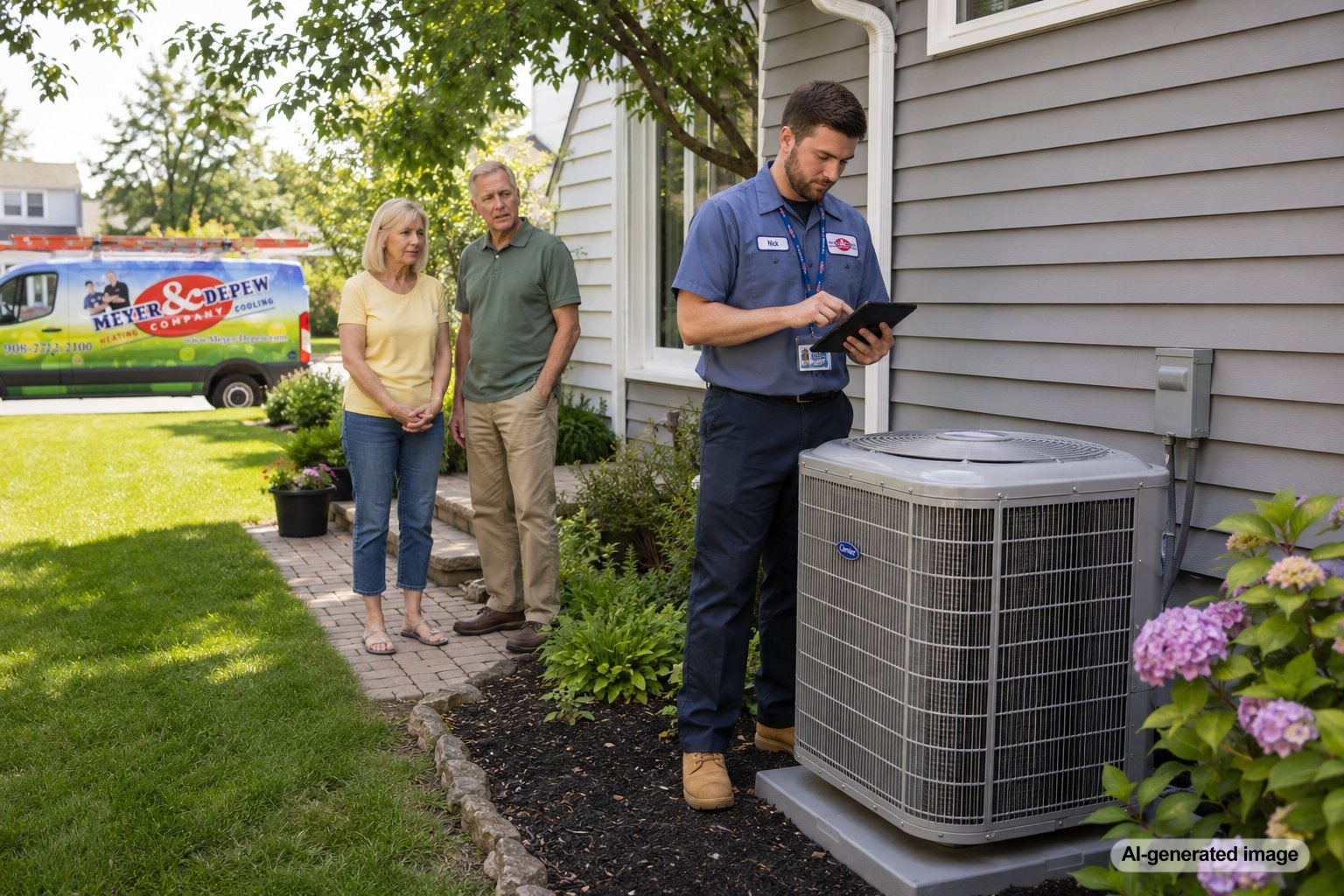
A brand-new AC can still have trouble cooling a house when the equipment is not properly matched to the home, airflow is restricted, ductwork has problems, installation details were missed, or the building is gaining heat faster than the system can remove it. New equipment does not automatically correct every comfort issue that existed before the replacement.
In Central and Northern New Jersey, high humidity, intense afternoon sun, older duct systems, additions, finished attics, and uneven insulation can all affect cooling performance. If a recently installed system is running for long periods, leaving rooms warm, or failing to control humidity, the issue deserves a careful evaluation rather than an assumption that the new unit is simply defective. Meyer & Depew’s AC service and maintenance team can evaluate the complete system, including equipment operation, airflow, controls, and duct performance.
A new AC may struggle to cool because of incorrect sizing, installation errors, restricted airflow, duct leakage, thermostat problems, excessive indoor humidity, or heat gain from the home itself.
- The equipment may be too small or too large for the actual cooling load.
- Airflow may be limited by filters, returns, ducts, dampers, or blower settings.
- Refrigerant charge, electrical setup, drainage, or control settings may need correction.
- The house may have insulation, air-sealing, window, or ductwork problems that new equipment cannot solve by itself.
- A professional should inspect the full installation if basic homeowner checks do not reveal the cause.
The AC may not be sized correctly for the house
Air conditioner sizing should be based on the home’s cooling load, not simply the size of the previous unit. Square footage matters, but it is only one part of the calculation. Ceiling height, window area, insulation, air leakage, orientation, occupancy, appliances, additions, and shaded or sun-exposed rooms can all change how much cooling the house requires.
An undersized system may run almost continuously during hot weather without reaching the thermostat setting. An oversized system can also create comfort problems. It may cool the air quickly, shut off before removing enough moisture, and leave the home feeling cool but clammy. Frequent cycling can also produce wider temperature swings and uneven comfort.
A proper load calculation helps determine whether the installed capacity matches the home. If the new AC was selected by copying the old unit’s capacity without evaluating changes to the house, sizing should be reviewed.
Installation details can affect cooling performance
Even high-quality equipment depends on correct installation. A new system can underperform when refrigerant charge, airflow setup, electrical configuration, condensate drainage, duct connections, or thermostat programming are not properly completed.
For example, the indoor blower may be operating at a setting that does not match the outdoor equipment. A duct connection may be loose. A return opening may be undersized. Refrigerant piping may not be configured or charged correctly for the installation. These are not safe homeowner repairs, and they require testing by a qualified HVAC technician.
New equipment may also need adjustments after it begins operating under real summer conditions. Commissioning measurements should confirm temperature change, static pressure, airflow, refrigerant performance, cycling, drainage, and control operation.
Restricted airflow may be limiting the new system
The AC can only cool the amount of air that moves through the system. Restricted airflow reduces comfort and may cause longer run times, weak airflow at registers, uneven temperatures, or coil icing.
Common airflow restrictions include:
- A dirty, overly restrictive, or incorrectly sized air filter
- Closed or blocked supply vents
- Furniture, rugs, boxes, or curtains blocking return grilles
- Undersized return ductwork
- Crushed, disconnected, or poorly routed flexible ducts
- Closed balancing dampers
- Ductwork that was designed for an older system with different airflow requirements
A new air handler or furnace may move air differently from the previous equipment. If the existing duct system cannot support the required airflow, replacing the outdoor unit alone will not eliminate the restriction.
Leaky or poorly insulated ducts may be wasting cooled air
Duct problems can make a new AC appear weak even when the equipment itself is operating correctly. Supply leaks can release cooled air into an attic, crawlspace, basement, wall cavity, or other unconditioned area. Return leaks can pull hot, humid, dusty air into the system before it reaches the indoor coil.
Ducts running through a hot attic may also gain heat if insulation is missing, damaged, or inadequate. The air leaving the AC may be cold, but it can warm significantly before reaching distant rooms.
Symptoms of duct-related trouble may include one floor cooling better than another, distant rooms staying warm, weak airflow from selected registers, dusty air near vents, unusually hot or cold duct surfaces, or noticeable air movement around visible duct joints.
The thermostat may be contributing to the problem
A thermostat can create misleading comfort problems when it is installed in a poor location, programmed incorrectly, wired improperly, or not configured for the new equipment.
A thermostat near a supply vent may sense cool air too quickly and shut the system off before the rest of the house is comfortable. A thermostat exposed to direct sunlight, kitchen heat, an exterior wall, or a draft may read warmer or cooler than the surrounding living space.
Smart thermostats may also need equipment-specific settings for staging, fan control, temperature limits, schedules, recovery features, or accessory operation. Confirm that the thermostat is set to cooling mode, the fan is set to Auto, the target temperature is reasonable, and programmed schedules are not overriding the setting.
High humidity can make the house feel warmer
New Jersey summers can bring significant humidity, and indoor moisture changes how comfortable a temperature feels. A room at the thermostat setting may still feel sticky or warm when the AC is not removing enough moisture.
Humidity problems can be related to oversized equipment, short cycling, blower settings, duct leakage, excessive outdoor air infiltration, basement or crawlspace moisture, or frequent opening of doors and windows. Bath fans, kitchen exhaust, and other ventilation systems can also affect pressure and moisture levels when they are not operating properly.
If the thermostat reaches its set point but the house remains clammy, ask the technician to evaluate both temperature control and moisture removal. Cooling performance should not be judged by temperature alone.
The home’s heat gain may be greater than expected
A new AC cannot fully compensate for severe air leakage, weak insulation, large unshaded windows, damaged attic insulation, or rooms with unusually high heat loads. These building conditions can become especially noticeable during a heat wave or in spaces facing strong afternoon sun.
Recent changes may also increase the cooling load. A finished attic, enclosed porch, home office, new appliances, additional occupants, or converted garage can add heat without corresponding duct or equipment changes. Rooms above garages and additions are particularly likely to have separate insulation and airflow issues.
In some homes, the best solution involves both HVAC corrections and building improvements. Air sealing, insulation, window treatments, duct modifications, zoning, or supplemental ductless cooling may be more effective than repeatedly lowering the thermostat.
The outdoor unit may not have enough breathing room
The outdoor condenser releases heat collected from inside the house. Its performance can suffer when airflow around the cabinet is restricted by weeds, leaves, fencing, stored items, dense shrubs, or debris.
The unit should have clear space around it according to the manufacturer’s installation requirements. It should not be enclosed tightly for appearance or covered while operating. Homeowners can safely remove loose debris from the immediate area, but internal cleaning, electrical testing, refrigerant work, and fan repairs should be left to a qualified technician.
Safe checks homeowners can make
- Confirm the thermostat is set to Cool and the fan is set to Auto.
- Check whether a schedule or energy-saving setting is changing the target temperature.
- Inspect the air filter and replace it if it is dirty or overdue.
- Make sure supply vents and return grilles are open and not blocked.
- Look for obvious leaves, weeds, or debris around the outdoor unit.
- Check whether the AC breaker has tripped once, if it is safe to do so. Do not repeatedly reset a breaker that trips again.
- Note which rooms are warm, when the problem occurs, and whether airflow feels weak.
Do not open electrical panels, adjust refrigerant components, bypass safety controls, or attempt to modify wiring or blower settings. If you notice smoke, sparks, a burning electrical smell, flooding near equipment, or another unsafe condition, turn the system off when it is safe to do so and contact the appropriate emergency service or qualified professional.
When should a new AC be professionally inspected?
Schedule service when the system cannot reach a reasonable thermostat setting, runs constantly without improving comfort, cycles on and off rapidly, produces weak airflow, leaves multiple rooms warm, freezes, leaks water, makes unusual noises, trips a breaker, or fails to control humidity.
A useful evaluation should look beyond the outdoor unit. The technician may need to review the load calculation, equipment match, refrigerant performance, electrical setup, temperature change, static pressure, blower configuration, filter, return capacity, supply ducts, thermostat settings, drainage, and building conditions.
If the installation is recent, keep records of the proposal, equipment model numbers, load calculations, startup documentation, and prior service findings. Clear documentation can help identify whether the problem involves equipment selection, installation, ductwork, controls, or the house itself.
Could the new AC need replacement already?
It is possible for new equipment to have a defective component, but replacement is not the first assumption. Many cooling complaints are caused by correctable installation, airflow, thermostat, duct, or building-envelope issues.
If testing confirms that the equipment is improperly sized, mismatched, damaged, or unable to meet the documented cooling load, the contractor can explain the available correction or replacement options. Homeowners considering a system change can also review Meyer & Depew’s AC installation and replacement information.
Frequently asked questions
How long should a new AC run to cool a house?
Run time varies with outdoor temperature, humidity, insulation, system size, thermostat setting, and the amount of heat inside the house. Longer cycles are not automatically a problem during very hot weather. Concern is more appropriate when the system runs continuously and still cannot maintain a reasonable temperature.
Why is my new AC blowing cool air but not cooling the house?
The air may be cool at the register while total airflow is too low, ducts are leaking, heat gain is excessive, or the system capacity is insufficient. Measuring both air temperature and airflow is important because cold air alone does not confirm adequate cooling performance.
Can a dirty filter affect a brand-new AC?
Yes. A filter can become restricted quickly during construction, renovation, drywall work, heavy dust, high pollen periods, or continuous operation. An overly restrictive filter can also reduce airflow even when it looks relatively clean.
Should a new AC remove humidity?
A properly designed and operating AC should remove some indoor moisture while cooling. Poor humidity control may indicate short cycling, oversized equipment, airflow settings, duct leakage, excessive outdoor air infiltration, or another moisture source.
What temperature should a new AC be able to maintain?
There is no single temperature that every home and system can maintain under every condition. Outdoor heat, humidity, insulation, air leakage, equipment sizing, and thermostat settings all matter. A technician can compare actual performance with the home’s design conditions and equipment specifications.
A brand-new AC may struggle because the problem involves more than the age of the equipment. Proper sizing, installation, airflow, ductwork, controls, humidity management, and the home’s construction all work together. A complete system evaluation is the most reliable way to identify the real cause.
Need help with your heating, cooling, or HVAC system?
Meyer & Depew serves homeowners and businesses throughout Central and Northern New Jersey.
Get a quote or call 908.272.2100.