



Can a Mini Split Help Cool a Sunroom?
Estimated reading time: 8 minutes
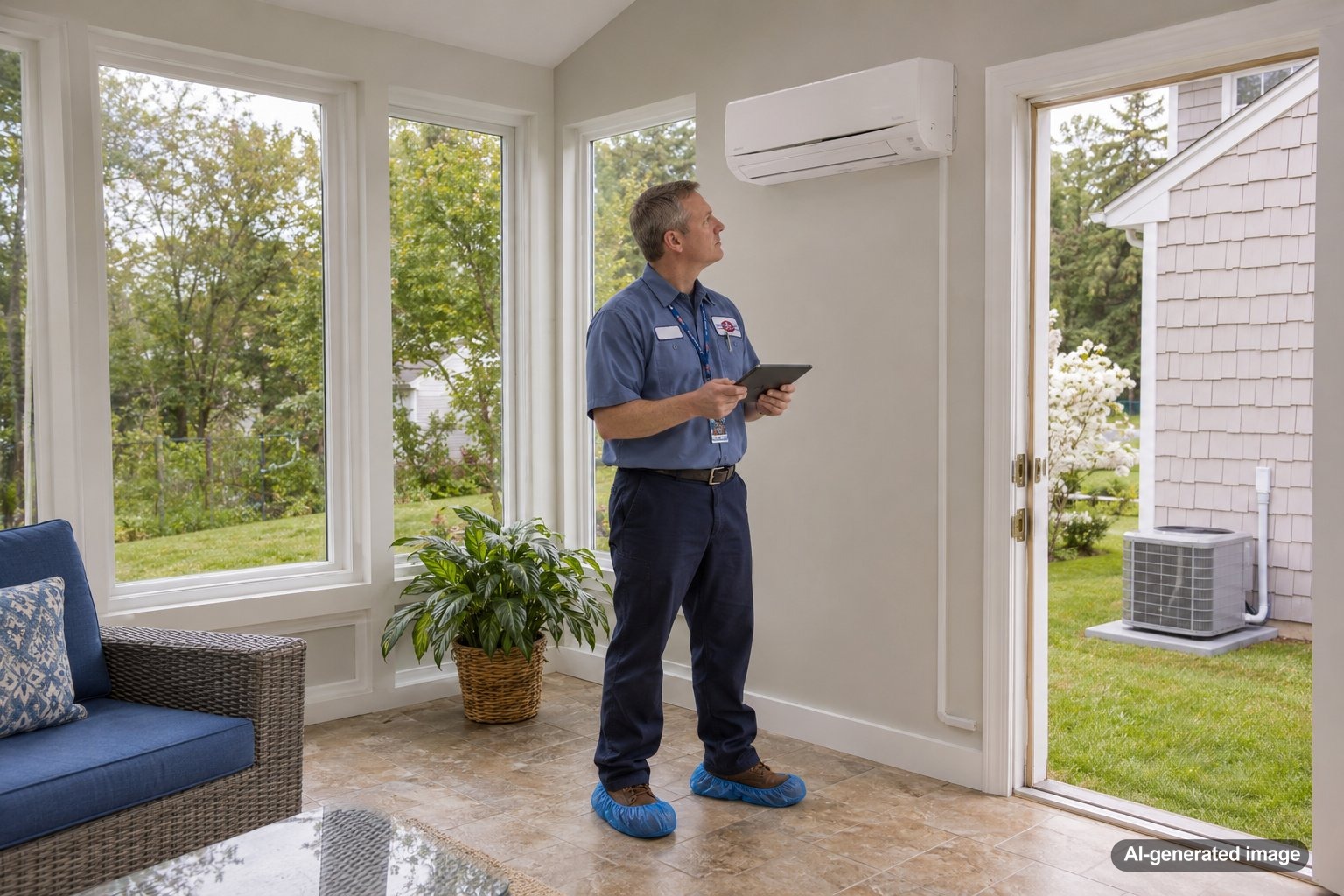
Yes, a mini split can be an effective way to cool a sunroom, especially when extending the home’s existing ductwork would be difficult or inefficient. A ductless system gives the room its own temperature control and delivers conditioned air directly into the space. However, the right result depends on more than measuring the room’s floor area.
Sunrooms can gain heat quickly through large windows, skylights, exterior walls, and roofs exposed to direct sunlight. In Central and Northern New Jersey, summer humidity can make the room feel uncomfortable even when the air temperature seems reasonable. A properly selected and installed ductless mini split system may address both temperature and moisture, but the room’s construction must be evaluated first.
- A mini split can provide dedicated cooling without adding conventional ductwork.
- The system must be sized for the sunroom’s glass exposure, insulation, orientation, and typical use.
- Variable-speed operation can help maintain steadier temperatures and humidity control.
- A poorly insulated three-season room may need building improvements before HVAC equipment can deliver dependable comfort.
- Professional placement matters because the indoor unit needs an unobstructed path for airflow.
Why a mini split often works well in a sunroom
A sunroom commonly falls outside the original home’s heating and cooling design. The central HVAC system may not have enough capacity for the added space, and its duct layout may not offer a practical route into the room. Simply adding a supply vent can also create airflow and pressure problems elsewhere in the house.
A mini split avoids those complications by operating as a separate system. It normally includes an outdoor unit connected to an indoor air handler by refrigerant lines, electrical wiring, and a condensate drain. Because it does not require a network of supply and return ducts, installation can be less disruptive than extending a conventional forced-air system.
Independent control is another advantage. Homeowners can cool the sunroom while it is occupied without lowering the thermostat for the entire house. Many mini splits also use inverter-driven compressors that adjust their output rather than repeatedly running at full capacity and shutting off. That modulation may provide quieter operation, more consistent comfort, and better moisture removal when the equipment is selected correctly.
The amount of glass changes the cooling calculation
Square footage alone is not enough to size a mini split for a sunroom. Two rooms with identical dimensions can have dramatically different cooling requirements. A shaded room with insulated windows may remain reasonably stable, while a west-facing room with older single-pane glass can become intensely hot in the afternoon.
A qualified contractor should consider factors such as:
- The number, size, type, and condition of the windows
- Whether the glass has low-emissivity coatings or effective shading
- The direction the room faces and the hours of direct sun exposure
- Ceiling height, skylights, and roof construction
- Insulation in the ceiling, walls, and floor
- Air leakage around windows, doors, and structural connections
- The number of people who normally use the room
- Heat produced by lighting, televisions, or other equipment
These details should be part of a room-specific load calculation. Choosing equipment based only on a general BTU-per-square-foot rule can lead to an undersized system that struggles on hot afternoons or an oversized system that cools too quickly to manage humidity well.
Three-season and four-season sunrooms are different
A four-season sunroom is usually built with insulated walls, a weather-resistant roof, better-performing windows, and tighter connections to the main house. Those features make its temperature easier to control. In this type of room, a properly sized mini split may deliver dependable cooling and, if it is a heat pump model, supplemental heating during colder weather.
A three-season room may have limited insulation, substantial air leakage, and windows designed primarily for mild weather. A mini split can still make some three-season rooms more comfortable, but it cannot correct every weakness in the building envelope. If hot outdoor air continually leaks in or the roof and glass admit large amounts of solar heat, the unit may run for long periods without achieving the desired temperature.
Before installing equipment, it can be worthwhile to seal obvious gaps, improve insulation where practical, repair poorly fitting doors, and consider shades or window treatments that reduce direct solar gain. These improvements reduce the cooling load instead of asking the HVAC system to compensate for preventable heat gain.
Humidity control matters in a New Jersey sunroom
Cooling is only part of summer comfort. Humid air can make a sunroom feel sticky, contribute to condensation on cool surfaces, and create an environment where musty odors become more noticeable. Most mini splits remove moisture as they cool, but performance depends on appropriate sizing, operating time, drainage, and indoor airflow.
An oversized unit may lower the temperature rapidly and shut down before removing enough moisture. A properly sized variable-capacity system can often run at a lower output for longer periods, supporting more consistent dehumidification. The condensate line must also be routed and installed correctly so collected moisture drains safely.
If the room has persistent condensation, water intrusion, or a musty smell, the source should be investigated rather than assuming new cooling equipment will solve it. Roof leaks, wet framing, drainage problems, or uncontrolled outdoor-air infiltration require separate attention.
Where should the indoor unit go?
Sunrooms offer plenty of windows but sometimes very little usable wall space. The indoor unit should be positioned where it can distribute air across the occupied area without being blocked by furniture, curtains, beams, or tall plants. It also needs suitable access for filter cleaning and future service.
A high-wall unit is common, but it is not the only possible configuration. Depending on the room and the available structure, other equipment styles may be considered. The outdoor unit needs an appropriate location as well, with adequate clearance, stable support, and protection from conditions that could restrict airflow.
Installation planning should account for the refrigerant-line route, electrical requirements, wall penetrations, and condensate disposal. Refrigerant and electrical work should be completed by qualified professionals. Homeowners should not attempt to open sealed equipment, alter high-voltage wiring, or handle refrigerant.
Can a mini split heat the sunroom too?
Many mini splits are heat pumps, which means they can provide both cooling and heating. That can be valuable in a four-season sunroom used throughout the year. Whether the system can meet the entire winter heating load depends on the equipment’s cold-weather performance and the room’s insulation, air leakage, glass area, and exposure.
A sunroom that loses heat rapidly through glass and uninsulated surfaces may remain difficult to heat during a New Jersey cold snap. The contractor should evaluate winter conditions separately instead of assuming that a unit selected for summer cooling will automatically provide sufficient heat in every situation.
What homeowners can evaluate before requesting a quote
- Measure the room’s length, width, and ceiling height.
- Note which direction the largest windows face.
- Identify when the room becomes hottest and how often it is occupied.
- Check whether windows and exterior doors close securely.
- Look for visible gaps, damaged weatherstripping, or missing insulation.
- Decide whether you want cooling only or year-round heating and cooling.
- Identify possible indoor and outdoor unit locations without moving or modifying electrical components.
These observations can make an initial conversation more productive, but they do not replace an on-site load calculation. A contractor should examine the room, discuss comfort expectations, and determine whether the existing electrical service and proposed installation locations are suitable.
When a mini split may not be enough by itself
A mini split may not deliver the expected result if the room has severe air leakage, an uninsulated roof or floor, damaged windows, persistent moisture intrusion, or restrictions that prevent good indoor-unit placement. In some cases, improvements to the room should come first. In others, shading, air sealing, insulation, and a mini split may work together as a complete comfort strategy.
It is also important to set realistic expectations. Turning a lightly built screened or three-season enclosure into a fully conditioned living area may involve building, electrical, and moisture-management considerations beyond the HVAC installation. A professional evaluation can clarify what the equipment can reasonably accomplish.
Frequently asked questions
How large should a mini split be for a sunroom?
The correct capacity depends on more than square footage. Glass area, sun exposure, insulation, ceiling height, air leakage, occupancy, and local design conditions all affect the load. A professional calculation is more reliable than choosing a unit from a simple online sizing chart.
Will a mini split cool a sunroom with many windows?
It may, provided the system is sized for the actual heat gain and the windows and room construction are in reasonable condition. Exterior shading, insulated glass, and effective air sealing can reduce the demand on the equipment.
Can I leave the mini split off when the sunroom is unused?
Operating choices depend on the room, weather, and system. Allowing the room to become extremely hot and humid may make recovery slower and can increase the risk of condensation. A technician can explain temperature settings and operating strategies suited to the installation.
Does a sunroom mini split need maintenance?
Yes. Filters need routine inspection and cleaning according to the manufacturer’s guidance, and the indoor and outdoor components should receive periodic professional service. The condensate drainage system also needs to remain clear and functional.
Should I extend my central AC or install a mini split?
The better option depends on available system capacity, duct access, room usage, installation constraints, and the level of independent control you want. A mini split is often attractive when ductwork would be difficult to add or when the sunroom needs its own comfort schedule.
A mini split can be an excellent sunroom cooling solution when the room’s construction, solar exposure, humidity load, and equipment placement are evaluated carefully. Accurate sizing and professional installation are central to getting comfortable, dependable performance.
Thinking about replacing or upgrading your HVAC system?
Meyer & Depew can help you understand your options for comfort, efficiency, and long-term reliability in your New Jersey home or business.
Questions? Contact Meyer & Depew or call 908.272.2100.