



Can Duct Dampers Shift or Stick Between Cooling and Heating Seasons?
Estimated reading time: 11 minutes
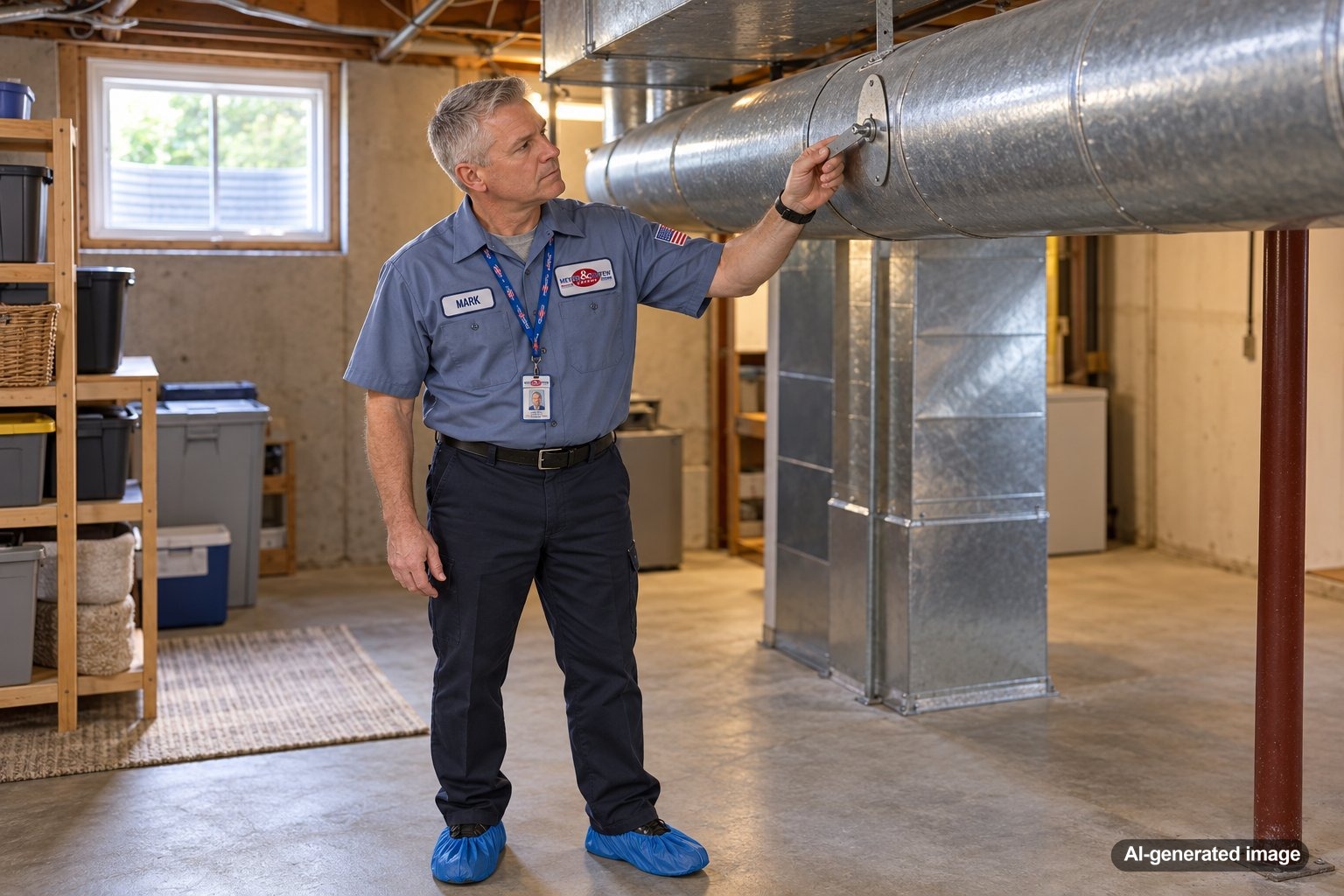
You switch your thermostat from cooling to heating, the furnace starts running, and suddenly one bedroom feels colder than it should. Another room gets plenty of warm air. Everything seemed fine during the summer, so what changed? One possibility is hiding inside your ductwork: an airflow damper that is no longer positioned or operating as expected. Duct dampers can stick, become difficult to move, or end up in a setting that worked better for the previous season. However, a damper does not normally shift simply because the weather changes. Understanding the difference can help New Jersey homeowners avoid unnecessary adjustments and recognize when an HVAC system needs professional attention.
Seasonal airflow differences are especially noticeable in homes with multiple floors, long duct runs, finished basements, or separate temperature zones. Before assuming the heating equipment is failing, it helps to understand how dampers work and why the same duct system can behave differently in summer and winter.
Yes, duct dampers can become stuck, move out of their intended position, or fail to respond correctly between cooling and heating seasons. But seasonal changes alone do not normally cause properly secured manual dampers to reposition themselves.
- Manual dampers may have been deliberately adjusted for summer and never reset for winter.
- Loose adjustment hardware can allow a damper to move away from its intended position.
- Motorized zoning dampers can experience actuator, control, or mechanical problems.
- A damper that appears to be sticking may actually be operating normally while another airflow issue causes uneven temperatures.
- Homeowners can check vents and thermostat settings, but diagnosing or adjusting concealed dampers is best left to a qualified HVAC technician.
What Do Duct Dampers Actually Do?
A duct damper is a movable plate or blade installed inside ductwork to control how much air passes through a particular branch or section of the system. Depending on the design, it may partially restrict airflow, allow most of the air through, or close to limit delivery to a specific area.
Not every home has adjustable dampers, and not every damper serves the same purpose. Two common types are manual balancing dampers and motorized zone dampers.
Manual Balancing Dampers
Manual dampers are commonly adjusted during installation or airflow balancing. Some are accessible near duct branches in basements, utility areas, or other unfinished spaces. A technician may use them to distribute conditioned air more evenly among rooms.
In certain homes, a professional may establish different damper positions for summer and winter. For example, an upstairs area that gets particularly warm during summer might benefit from a different airflow balance than it needs when the heating system is operating.
These dampers do not automatically change position with the seasons. Someone must adjust them, and any change should account for the system’s overall airflow requirements.
Motorized Zone Dampers
Motorized dampers are part of some HVAC zoning systems. Instead of relying on a seasonal manual setting, these dampers open and close in response to zone controls and temperature demands.
For example, when the downstairs thermostat calls for heating but the upstairs zone does not, the system may direct airflow toward the downstairs area. When operating correctly, the dampers respond automatically to the zoning controls.
Because motorized dampers have moving components and electrical controls, they introduce additional potential failure points. A problem may first become obvious when the homeowner switches from cooling to heating, even if the underlying issue existed earlier.
Why Might a Damper Seem to Shift Between Seasons?
There are several explanations for a damper that appears to have changed position. Some involve actual movement. Others involve changes in heating and cooling performance that make an existing airflow imbalance more noticeable.
1. A Previous Seasonal Adjustment Was Never Reversed
This is a practical possibility in homes where technicians or previous owners intentionally changed manual damper settings for summer comfort.
Consider a two-story New Jersey home where more cooling airflow was directed upstairs during the hottest months. When heating season arrives, that same distribution may not provide the most comfortable results. The downstairs rooms might feel cooler than expected, or the upper floor might receive more warm air than it needs.
Nothing necessarily broke. The system may simply be operating with a balancing arrangement that is less suitable for the current season.
Importantly, this does not mean every home needs twice-yearly damper adjustments. Many properly designed systems operate without seasonal changes to their balancing dampers.
2. Loose Hardware Allows Unintended Movement
Some manual dampers use an external handle and locking hardware to hold the internal blade in place. If that hardware becomes loose, the blade may no longer remain securely at its intended angle.
Air pressure, vibration, and repeated equipment operation can contribute to movement when a damper is not properly secured. A loose handle may also create the impression that the damper is in a particular position when the internal blade is not aligned as expected.
A technician can verify the actual damper position and determine whether the adjustment mechanism needs attention.
3. The Damper Mechanism Develops Resistance
Over time, mechanical components can become harder to operate. Corrosion, accumulated debris, deformation, or wear may interfere with the movement of a damper blade or its linkage.
This is not necessarily a seasonal problem. A manual damper that has remained untouched for years may be difficult to move when someone finally attempts to adjust it.
Forcing a resistant damper can damage the mechanism or surrounding ductwork. Professional inspection is preferable to attempting to free a concealed or difficult-to-move component.
4. A Motorized Damper Stops Responding Correctly
In a zoned HVAC system, a failed actuator, disconnected linkage, control problem, or mechanical obstruction can prevent a damper from reaching its commanded position.
Imagine a home with separate upstairs and downstairs zones. During summer, the homeowner mostly notices cooling demands upstairs. In fall, the downstairs heating zone begins operating more frequently. A damper that fails to open for that zone may now create an obvious comfort problem.
The change in season exposed the malfunction rather than necessarily causing it.
Why Heating and Cooling Can Reveal Different Airflow Problems
Warm air naturally tends to rise, while cooler air tends to settle. Although forced-air equipment pushes conditioned air through ducts, these temperature differences still influence how rooms feel.
Solar exposure, insulation, window placement, duct routing, and thermostat location also affect comfort. As a result, a distribution pattern that seemed acceptable during cooling season may feel less balanced during heating season.
For example, an upstairs bedroom with strong afternoon sun might need substantial cooling during July. That same bedroom may become uncomfortably warm during January if it receives excessive heated airflow while the downstairs rooms struggle to reach their thermostat setting.
In older homes throughout Central and Northern New Jersey, renovations and additions may further complicate airflow distribution. A finished attic, converted garage, or basement living space can change the heating and cooling demands without changing the original duct design.
The important distinction is that uneven temperatures do not automatically prove a duct damper is defective. The problem may involve the air filter, duct leakage, equipment performance, thermostat placement, insulation, or another part of the HVAC system.
Signs That a Duct Damper May Be Stuck or Improperly Positioned
Homeowners often notice the comfort symptoms before discovering anything unusual about the ductwork.
- One room suddenly receives much less airflow: A branch damper may be more restricted than intended, although duct obstructions and other issues can produce similar symptoms.
- A specific zone fails to heat or cool: In a zoned system, an actuator or control issue may prevent conditioned air from reaching the requested area.
- Airflow changes unexpectedly between operating cycles: Inconsistent damper movement may be one possibility, particularly with motorized zoning equipment.
- Whistling or unusually loud airflow appears: Excessive restriction or airflow through a limited opening can create noise, but the cause should be verified.
- Several rooms become uncomfortable after a seasonal change: This can point toward a balancing concern, particularly if dampers were previously adjusted for summer or winter.
- The thermostat reaches its setting while another room remains uncomfortable: The system may be satisfying the thermostat location without adequately serving the rest of the home.
These clues help describe the problem to a technician. They are not enough to identify a stuck damper with certainty.
Can a Stuck Damper Damage HVAC Equipment?
A single partially closed damper does not automatically mean equipment damage is occurring. The concern depends on how much airflow is restricted, the duct system design, and how the heating or cooling equipment responds.
Significant airflow restrictions can affect system operation. During cooling, inadequate airflow across an evaporator coil may contribute to excessively low coil temperatures or freezing. During heating, insufficient airflow can contribute to overheating in certain forced-air furnaces and may cause protective controls to interrupt operation.
Some zoning systems are specifically designed to manage changing airflow as dampers open and close. Others can experience problems if their controls, equipment settings, or duct arrangements are incorrect.
Repeated safety shutdowns, unusual equipment noises, or noticeable performance changes deserve professional evaluation. Simply opening or closing random dampers is not a reliable solution and could create additional airflow problems.
What Homeowners Can Safely Check Before Calling
There are several useful checks that do not require opening equipment, reaching into ductwork, or changing damper positions.
- Confirm thermostat settings. Make sure the system is set to the intended heating or cooling mode and that the temperature settings are appropriate.
- Check all thermostats in a zoned home. Look for unexpected settings or schedules that could explain different room temperatures.
- Inspect the air filter. A dirty or restrictive filter can reduce system airflow and make existing comfort problems more noticeable.
- Check supply registers and return grilles. Verify that they are not blocked by furniture, rugs, curtains, or stored items.
- Compare affected rooms. Note whether the problem involves one register, several rooms on the same floor, or an entire thermostat zone.
- Record when the problem occurs. Does it happen only during heating, only during cooling, or whenever a specific thermostat calls for conditioning?
These observations can help narrow the possible causes without risking an incorrect damper adjustment.
Avoid forcing damper handles, disconnecting motorized components, or opening zoning control panels. Dampers may be tied to equipment airflow requirements, and an uninformed adjustment can affect other rooms or the system itself.
How an HVAC Technician Evaluates Damper Problems
When airflow symptoms suggest a damper issue, a qualified technician can examine the distribution system in a more systematic way.
The evaluation may include checking accessible manual damper positions, inspecting actuator movement, reviewing zoning control operation, and determining whether the appropriate zones respond to thermostat requests.
Depending on the situation, the technician may also measure static pressure, airflow, or temperature differences. These measurements help distinguish a damper problem from a broader duct design or equipment issue.
For example, a damper may be fully open while a room still receives inadequate airflow because the duct serving it is undersized, damaged, disconnected, or excessively restrictive. Repositioning the damper would not address the underlying problem.
Similarly, a motorized damper that appears closed may be following a legitimate control command. The technician must determine whether the command itself is appropriate before deciding that the damper has malfunctioned.
Should Duct Dampers Be Adjusted Every Spring and Fall?
Not necessarily. Seasonal damper adjustments are useful in certain buildings, but they should not be treated as a universal maintenance requirement.
Some homes have a professionally established summer and winter balancing arrangement. In those cases, documented settings can make seasonal transitions more predictable.
Other homes have dampers intended to remain in their calibrated positions throughout the year. Repeatedly changing these settings without airflow measurements may create new comfort problems.
Motorized zoning dampers operate according to system controls and generally are not manually repositioned each season by homeowners.
If your home has a history of seasonal temperature imbalances, a qualified technician can determine whether adjustments are appropriate or whether a more permanent airflow improvement would be beneficial.
Routine heating service and maintenance also offers an opportunity to discuss new airflow symptoms before colder weather places greater demands on the system.
Frequently Asked Questions About Duct Dampers
Can a duct damper move by itself?
A properly secured manual damper should generally remain in its intended position. Loose hardware or mechanical problems can sometimes allow unintended movement. Motorized dampers, by contrast, are designed to move automatically in response to zoning controls.
Can cold weather cause a duct damper to stick?
Ordinary seasonal temperature changes do not automatically cause a properly functioning damper to stick. However, existing mechanical wear, corrosion, misalignment, or actuator problems may become noticeable when the heating system begins operating regularly.
How do I know whether my home has manual dampers?
Some manual dampers have external adjustment handles on accessible duct branches, often near the main supply trunk. Other dampers may be concealed behind finished surfaces. Not seeing a handle does not establish whether dampers are present.
Can I fix an uneven room temperature by closing another room’s damper?
That approach is not recommended without understanding the duct system. Restricting one branch may redirect some airflow, but it can also raise system resistance or create comfort problems elsewhere. A technician can determine whether balancing adjustments are appropriate.
Does a stuck zoning damper mean I need a new HVAC system?
No. A sticking or nonresponsive damper does not by itself mean the furnace, air conditioner, or entire duct system requires replacement. The necessary work depends on whether the problem involves the damper blade, actuator, linkage, controls, or another component.
The Bottom Line: Check the Airflow Before Blaming the Equipment
Duct dampers can stick, loosen, or become improperly positioned, and those problems may first become noticeable when a home switches between cooling and heating. But seasonal discomfort can also result from normal temperature differences, thermostat settings, duct restrictions, or other HVAC issues. The most useful next step is to identify where airflow has changed and have the system evaluated before making damper adjustments.
If certain rooms in your New Jersey home consistently become uncomfortable when the seasons change, a professional airflow and zoning evaluation can help clarify what is happening. The solution may be a mechanical repair, a balancing adjustment, a control correction, or an improvement elsewhere in the system.
Need help with your heating, cooling, or HVAC system?
Meyer & Depew serves homeowners and businesses throughout Central and Northern New Jersey.
Get a quote or call 908.272.2100.