



What Is Heat Pump Balance Point, and Why Does It Matter in New Jersey?
Estimated reading time: 16 minutes
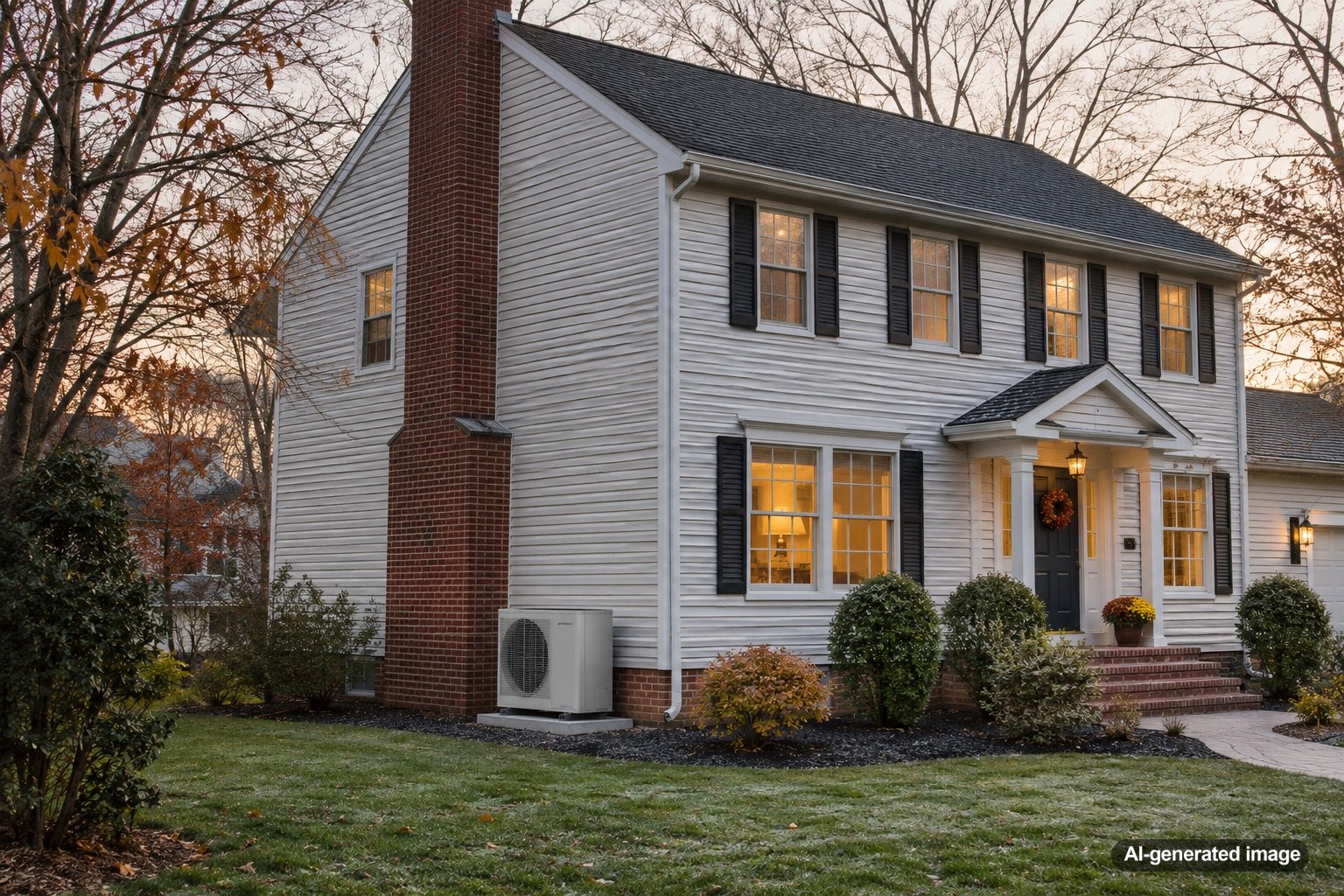
A heat pump can keep a New Jersey home comfortable through surprisingly cold weather, but there is an important temperature that helps determine whether it can handle the heating job on its own. That temperature is called the heat pump balance point. Understanding it can explain why auxiliary heat sometimes turns on, why two homes with similar heat pumps behave differently during winter, and why equipment sizing matters just as much as the efficiency rating on the label.
For homeowners in Central and Northern New Jersey, the balance point is especially relevant when comparing heat pumps, planning a heating system replacement, or trying to understand higher winter electric bills. A properly designed system accounts for the home’s heat loss, the heat pump’s cold-weather capacity, and the role of backup heating. Those factors are important parts of evaluating heating installation and replacement options.
The heat pump thermal balance point is the outdoor temperature at which the heat pump’s maximum available heating capacity equals the amount of heat the building needs to stay at its desired indoor temperature.
- Above the balance point, the heat pump generally has enough capacity to heat the home without supplemental heating.
- Below the balance point, the home’s heating demand exceeds the heat pump’s available output, so supplemental heat may be needed.
- The balance point depends on both the specific heat pump and the building’s heating requirements.
- Cold-climate heat pumps and improvements to insulation and air sealing can help lower the balance point.
- The thermal balance point is not necessarily the most economical temperature for switching between a heat pump and another heating source.
What Does Heat Pump Balance Point Actually Mean?
Think of a house as constantly losing heat during winter. Warm indoor air and heated surfaces transfer energy toward the colder outdoors through walls, windows, ceilings, floors, and air leaks. As the outdoor temperature falls, the amount of heating needed to maintain a comfortable indoor temperature generally increases.
An air-source heat pump works in the opposite direction. It extracts heat from outdoor air and transfers that energy inside. Many conventional heat pumps deliver less heating capacity as outdoor temperatures decline, although modern cold-climate models can maintain substantially more capacity at lower temperatures.
The balance point is where these two conditions meet: the home’s heating demand and the heat pump’s maximum available heating output.
Above that intersection: The heat pump can generally satisfy the home’s heating load by itself.
At that intersection: The heat pump’s available output approximately matches the home’s heating demand.
Below that intersection: The heat pump cannot fully satisfy the load on its own, and another heat source may need to supply the difference.
This is the thermal balance point, sometimes called the heating capacity balance point. It is a system-design characteristic, not a universal outdoor temperature that applies to every heat pump.
A Practical Example: What Happens When New Jersey Temperatures Drop?
Consider a hypothetical New Jersey home with a heat pump that can deliver 30,000 BTU per hour of heating at an outdoor temperature of 30 degrees Fahrenheit. Suppose the home’s calculated heating demand at that same temperature is also 30,000 BTU per hour.
In this simplified example, 30 degrees Fahrenheit is the thermal balance point.
Now imagine the outdoor temperature falls to 15 degrees. The home might need 38,000 BTU per hour, while the heat pump may be capable of delivering only 27,000 BTU per hour under those conditions.
The difference is 11,000 BTU per hour. An appropriately designed supplemental heating system would need to cover that shortfall to maintain the desired indoor temperature.
These numbers are illustrative rather than performance specifications for a particular heat pump. Actual heating capacity depends on the equipment model, operating conditions, airflow, defrost operation, and other factors. A professional load calculation and manufacturer performance data are needed to establish a meaningful balance point.
The example also shows why a heat pump that performs well during a mild November afternoon may behave differently during a prolonged January cold snap. The heating requirement changes with outdoor conditions, even when the thermostat setting stays the same.
Why Heat Pump Balance Point Matters in New Jersey
1. New Jersey winters include both mild and very cold conditions
Central and Northern New Jersey experience a wide range of winter temperatures. A heating system may operate through relatively mild daytime weather, freezing overnight conditions, and occasional periods of much colder air.
Those temperature swings make the balance point important because a heat pump may handle most of the season independently while relying on supplemental heating during a smaller number of colder periods.
For example, a well-insulated home in a relatively moderate location may need substantially less heat than a drafty house in a colder, more exposed part of Northern New Jersey. The same outdoor temperature does not produce the same heating demand in every building.
2. Backup heat can change winter operating costs
Many air-source heat pump systems use electric resistance heating as supplemental heat. Electric resistance heat converts electrical energy directly into heat, while a heat pump moves heat from outdoors to indoors. Under suitable conditions, the heat pump can deliver multiple units of heating energy for each unit of electricity consumed.
When electric resistance backup operates more frequently, total electricity consumption may increase. That does not automatically mean the equipment is malfunctioning. It may simply mean the outdoor temperature has fallen below the thermal balance point or that the thermostat has requested additional heating capacity.
However, frequent auxiliary heat operation during relatively mild weather can justify a professional evaluation of the thermostat configuration, airflow, equipment performance, and heating load.
3. The balance point affects how the system should be sized
Choosing a heat pump based only on the home’s square footage can produce misleading results. Two houses with identical floor areas may have very different heating requirements because of insulation, air leakage, windows, ceiling heights, ductwork, and exposure to wind.
A contractor should evaluate the home’s heating load and compare it with the proposed equipment’s heating capacity at relevant outdoor temperatures.
Oversizing is not automatically the answer. A larger heat pump can create cooling-season performance concerns, unnecessary costs, or inefficient cycling under lighter loads. Variable-speed equipment can offer more flexibility, but its minimum and maximum capacities still need to suit the building.
4. The balance point influences backup heating decisions
Some homes are designed around a heat pump with electric auxiliary heat. Others use a dual-fuel arrangement that combines a heat pump with a furnace.
The balance point helps determine when backup capacity may be needed, but it does not dictate that every system should switch completely away from the heat pump at that temperature.
The appropriate operating sequence depends on the equipment configuration, control compatibility, and whether the two heating sources can safely operate together.
Thermal Balance Point vs. Economic Balance Point: An Important Difference
Homeowners sometimes hear the term balance point when discussing efficiency, energy costs, or smart thermostat settings. In these conversations, two different concepts can be confused.
Thermal balance point
The thermal balance point describes heating capacity. It is the temperature at which the heat pump can no longer fully match the home’s heating demand without supplemental assistance.
Economic balance point
The economic balance point describes operating cost. It is the outdoor temperature at which running the heat pump costs approximately the same as using an alternative heating source to deliver equivalent useful heat.
For a dual-fuel system using a gas furnace, the economic comparison depends on electricity rates, natural gas prices, furnace efficiency, and the heat pump’s performance at different outdoor temperatures.
These temperatures may be very different. A heat pump might still have enough capacity to heat the home by itself when another available heating source becomes less expensive to operate.
Conversely, a heat pump may remain economically attractive at temperatures where supplemental capacity is needed, depending on system design and energy prices.
The key distinction: The thermal balance point tells you whether the heat pump has enough capacity. The economic balance point helps compare the cost of delivering heat with different available systems.
Neither number should be assumed from a generic online chart. Economic comparisons can also change as utility rates and fuel prices change.
How Do Contractors Determine a Heat Pump’s Balance Point?
Determining the balance point requires more than checking a thermostat or looking up a heat pump’s advertised efficiency rating. The process involves matching the building’s heat loss against the actual heating performance of the proposed equipment.
Step 1: Calculate the home’s heating load
A residential HVAC contractor can perform a heating load calculation using an appropriate method, such as ACCA Manual J. The calculation accounts for characteristics including insulation, windows, building dimensions, air leakage assumptions, and local outdoor design conditions.
This establishes an estimate of how much heating the home needs under specific conditions.
Step 2: Review heating capacity at different outdoor temperatures
Manufacturers publish performance information showing how much heat their equipment can deliver under specified operating conditions. This is particularly important for variable-speed and cold-climate heat pumps because performance cannot always be represented accurately by a simple straight-line assumption.
A heat pump’s nominal heating capacity at a relatively mild test temperature does not necessarily indicate how much heating it can deliver during a New Jersey cold snap.
Step 3: Compare the capacity curve with the heating load
The contractor can compare the home’s heating requirement across outdoor temperatures with the heat pump’s available capacity at those temperatures.
Where the two curves intersect is the estimated thermal balance point.
Step 4: Plan supplemental heat and controls
Once the balance point is understood, the contractor can assess whether supplemental heat is needed, how much capacity it should provide, and how the system should respond to changing conditions.
For a dual-fuel arrangement, the design must also account for the specific equipment’s allowable operating sequence and the thermostat or control system’s capabilities.
Can a Cold-Climate Heat Pump Have a Lower Balance Point?
Yes. A heat pump designed to retain more heating capacity at low outdoor temperatures may have a lower thermal balance point than a less capable model installed in the same house.
Many cold-climate heat pumps use variable-speed compressors, specialized controls, and other design features to maintain useful heating output during colder weather.
But cold-climate does not mean unlimited heating capacity. Every model has operating limits and a performance profile that should be evaluated against the home’s actual requirements.
One heat pump may be able to meet a home’s heating load at a particular low temperature, while another model may need supplemental heating much sooner.
The important question is not simply whether the equipment is labeled for cold climates. It is whether its published heating capacity matches the particular home’s heating load over the expected operating range.
How Insulation, Air Sealing, and Older Homes Affect the Balance Point
The balance point is partly a property of the house, not just the heating equipment.
Imagine two New Jersey homes equipped with the same heat pump. The first has good attic insulation, relatively tight windows, and limited uncontrolled air leakage. The second has an underinsulated attic, noticeable drafts, and older windows.
The second home may lose heat much faster as outdoor temperatures drop. Its heating demand can exceed the heat pump’s available capacity at a warmer outdoor temperature, producing a higher thermal balance point.
Improving attic insulation, addressing air leakage, or making other appropriate building-envelope upgrades may reduce heating demand and potentially lower the balance point without changing the heat pump.
This is particularly relevant in older New Jersey houses, where renovations, additions, finished attics, or partially insulated spaces can create complicated heating loads.
A room that consistently struggles to stay warm is not necessarily evidence that the entire heat pump is undersized. Poor duct distribution, insulation gaps, or localized air leakage may also contribute.
Does the Thermostat Control the Balance Point?
A compatible thermostat or HVAC control can use outdoor temperature information to determine when certain heating stages are allowed or requested. Some systems include settings for auxiliary heat lockout, compressor lockout, or dual-fuel switchover.
Those control settings are related to system operation, but they are not necessarily identical to the home’s calculated thermal balance point.
For example, a thermostat might be configured to restrict electric auxiliary heating above a selected outdoor temperature. Another system may bring on auxiliary heat when indoor temperature falls too far behind the thermostat setting, even if outdoor conditions are relatively moderate.
Some dual-fuel systems use an outdoor temperature threshold to switch between heat pump operation and furnace heating. That threshold may reflect equipment capacity, operating economics, or another approved control strategy.
Thermostat behavior also varies by manufacturer and system configuration. Certain heat pumps use communicating controls that manage heating stages differently from conventional thermostats.
Changing these settings without understanding the installed equipment can cause poor comfort, unnecessary energy consumption, or improper system operation. Homeowners considering a thermostat upgrade can learn about available thermostat options, but balance-point-related controls should be configured by a qualified HVAC professional.
Why Auxiliary Heat Can Run Even Above the Balance Point
Seeing an AUX HEAT message on a thermostat does not automatically mean the outdoor temperature has dropped below the thermal balance point.
Several normal operating situations can call for supplemental heating even when the heat pump may have sufficient capacity to maintain the desired temperature under steady conditions.
- Thermostat recovery: A large increase in the desired indoor temperature may cause the thermostat to request more heating capacity than the compressor alone can provide quickly.
- Defrost operation: During cold, damp conditions, some heat pumps temporarily use supplemental heat to maintain indoor comfort while frost is cleared from the outdoor coil.
- Control settings: Thermostat staging rules may activate auxiliary heat based on temperature differences, operating time, or other conditions.
- Equipment or airflow problems: Restricted airflow or reduced equipment performance may cause the system to struggle even when its original design should provide adequate heating.
An occasional auxiliary heat cycle is not inherently a problem. Repeated or unusually prolonged operation during milder weather, especially when accompanied by poor comfort, is worth investigating.
What New Jersey Homeowners Can Safely Check
Homeowners cannot determine an accurate thermal balance point simply by watching the outdoor thermometer. However, a few observations can help identify whether the heating system is operating as expected.
- Confirm that the thermostat is set to the intended heating mode and a reasonable indoor temperature.
- Check whether the thermostat displays AUX HEAT, supplemental heat, or emergency heat during ordinary operation.
- Inspect the accessible air filter and replace it when needed according to the equipment’s requirements.
- Make sure supply registers and return-air grilles are not blocked by furniture, rugs, or stored items.
- Observe whether heating problems occur only during very cold weather or also during milder conditions.
- Look for obvious leaves, snow, or debris obstructing the outdoor unit without opening equipment or disturbing electrical components.
It can also help to note the outdoor temperature, indoor thermostat setting, and whether the home maintains comfort when the problem occurs. These details can help a technician distinguish between a possible capacity limitation and an equipment or control issue.
Do not attempt to change compressor lockouts, modify auxiliary heat wiring, bypass safety controls, or work on refrigerant or high-voltage components. These tasks require professional evaluation.
When Should You Have the Heat Pump Evaluated?
A heat pump does not need professional attention simply because supplemental heat operates during very cold weather. Still, certain patterns justify scheduling an inspection.
- The house cannot maintain its desired temperature during weather conditions the system was designed to handle.
- Auxiliary heat operates frequently during relatively mild outdoor temperatures without an obvious reason.
- The heat pump runs continuously while indoor temperatures keep falling.
- Some rooms remain much colder than others despite open vents and a clean filter.
- Heating performance has noticeably declined compared with previous winters under similar conditions.
- A recent thermostat replacement or equipment upgrade has changed how backup heating operates.
These symptoms can have multiple explanations, including airflow restrictions, control problems, sensor errors, defrost issues, equipment performance deficiencies, or an inaccurate original load assessment.
Professional heating service and maintenance can help identify whether the issue involves normal cold-weather capacity limits or an underlying system problem.
Questions to Ask Before Installing a Heat Pump in New Jersey
If you are considering replacing a furnace, upgrading an older heat pump, or adding a heat pump to an existing heating system, balance-point planning deserves a place in the discussion.
Ask the contractor what heating load was calculated for your home and which outdoor design temperature was used. Request an explanation of the proposed heat pump’s heating capacity at colder operating temperatures, rather than relying only on its nominal rating.
It is also reasonable to ask whether the proposed system is intended to handle the full design heating load or operate with supplemental heating during the coldest conditions.
If backup heat is included, ask how it will be controlled, whether the heat pump and supplemental source can operate together, and what circumstances will trigger the backup system.
For a dual-fuel installation, ask whether the switchover strategy is based primarily on heating capacity, operating cost, or another system requirement.
Finally, discuss how cooling requirements affect equipment selection. A heat pump must serve both seasons, and the best heating-only capacity match may not be the best overall solution if it creates cooling or humidity-control problems.
Frequently Asked Questions About Heat Pump Balance Point
What is a normal heat pump balance point temperature?
There is no single normal temperature that applies to all heat pumps. The balance point depends on the equipment’s heating capacity and the home’s heat loss. It can vary substantially between installations, especially when comparing older equipment with modern cold-climate heat pumps. A load calculation and manufacturer performance data provide a more useful answer than a universal temperature estimate.
Does a heat pump stop working below its balance point?
Not necessarily. Below the thermal balance point, the heat pump may continue supplying useful heat, but it cannot independently cover the home’s entire heating demand. Depending on system design, supplemental heat may operate alongside the heat pump or another heating source may take over. The equipment’s minimum operating temperature is a separate specification.
Is the balance point the same as the outdoor temperature where emergency heat turns on?
No. Emergency heat generally refers to a backup heating mode that can operate without relying on the heat pump compressor. Auxiliary heat may supplement normal compressor operation. The thermal balance point is a heating-capacity relationship, not necessarily a thermostat’s emergency heat activation setting.
Can improving insulation change the heat pump balance point?
Yes. Reducing the home’s heat loss decreases the heating capacity required at a given outdoor temperature. That can allow the existing heat pump to meet the home’s demand at colder temperatures, potentially lowering the thermal balance point. The actual change depends on the improvements and the system’s performance characteristics.
Should I set my heat pump thermostat to the balance point temperature?
No. The balance point is an outdoor temperature used for equipment sizing and heating-control planning. It is not an indoor comfort setting. Thermostat lockouts and switchover temperatures should be based on the equipment, building load, control capabilities, and heating strategy. A qualified technician should evaluate those settings rather than relying on a generic recommendation.
The Bottom Line for New Jersey Heat Pump Owners
The heat pump balance point helps explain when a heat pump can heat your home independently and when additional heating capacity may be necessary. In New Jersey, where winter conditions vary considerably, knowing how a proposed heat pump performs at lower outdoor temperatures is an important part of selecting a dependable heating system.
The most useful balance point is one calculated for your specific home and equipment. Proper load calculations, cold-weather capacity data, suitable backup heating, and thoughtfully configured controls all contribute to a system designed for year-round comfort.
Whether you already own a heat pump or are comparing replacement options, a professional assessment can help clarify what your system should be capable of delivering during winter and whether its current operation is consistent with that design.
Thinking about replacing or upgrading your HVAC system?
Meyer & Depew can help you understand your options for comfort, efficiency, and long-term reliability in your New Jersey home or business.
Questions? Contact Meyer & Depew or call 908.272.2100.