



How Can Offices Manage Heating and Cooling Conflicts During Fall?
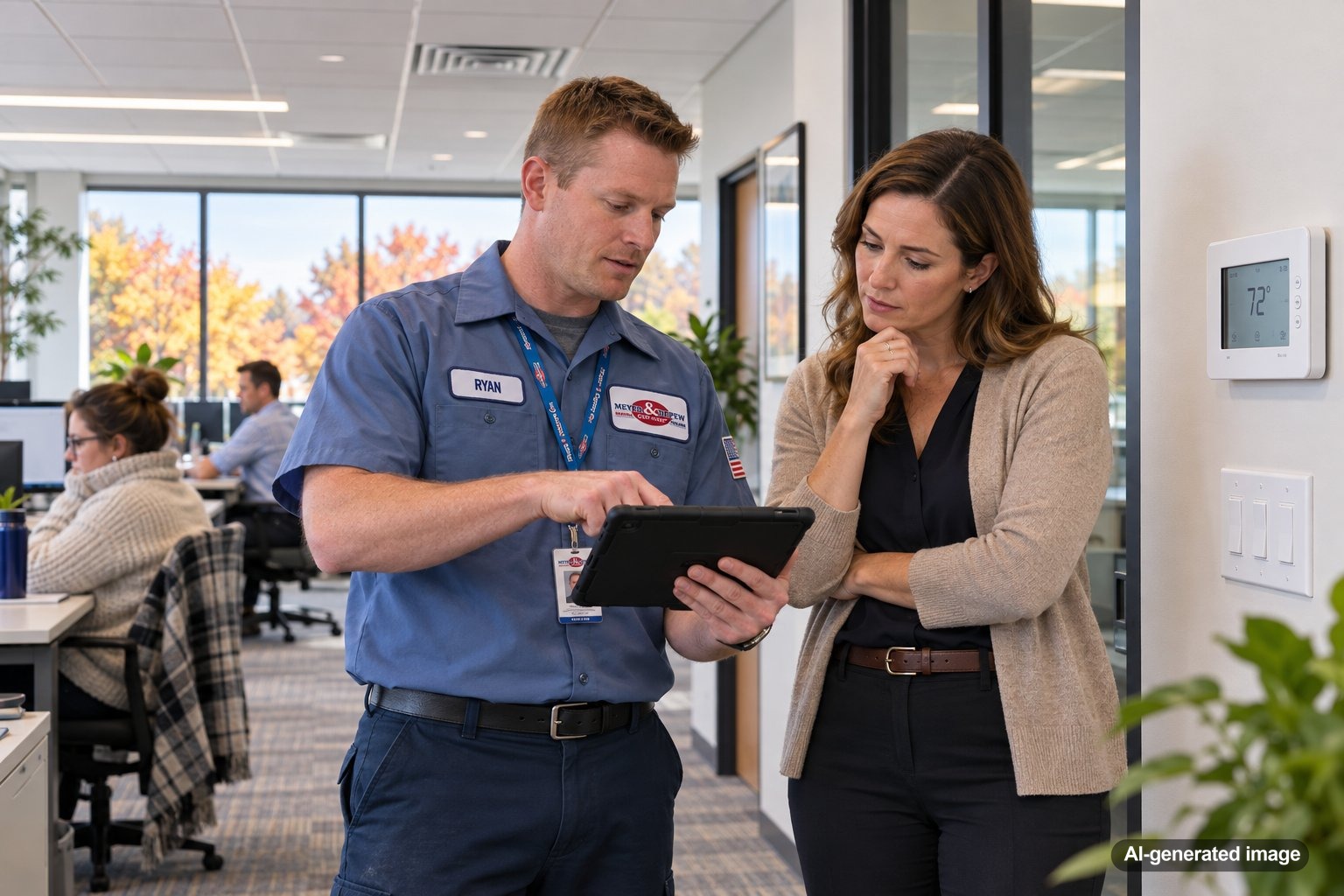
Offices can manage heating and cooling conflicts during fall by coordinating thermostat settings, accounting for different building zones, adjusting schedules for changing outdoor temperatures, and making sure the HVAC system is operating as intended. Fall is a particularly challenging season because a New Jersey office may need heat early in the morning, little conditioning by midday, and cooling in sun-exposed or heavily occupied spaces later in the day.
When different employees or areas of a building seem to want opposite things at the same time, the problem is not always a disagreement about comfort. Solar gain, occupancy, equipment heat, airflow, building orientation, thermostat location, and HVAC controls can all contribute. A thoughtful approach to commercial HVAC operation can reduce unnecessary adjustments while helping facility teams identify problems that deserve professional attention.
To reduce fall heating and cooling conflicts in an office, establish reasonable temperature settings, limit frequent thermostat changes, review HVAC schedules, account for sunny and shaded zones, keep vents and returns unobstructed, and have persistent comfort problems evaluated rather than trying to compensate for them with extreme thermostat settings.
- Use consistent heating and cooling setpoints instead of repeatedly changing the thermostat.
- Review zones separately because perimeter offices and interior spaces can behave very differently.
- Match HVAC schedules to actual occupancy, including early arrivals and late work periods.
- Check for blocked vents, dirty filters, or obvious airflow problems.
- Schedule professional evaluation when certain areas remain consistently too warm or too cold.
Why fall creates unusual office temperature conflicts
Fall is a shoulder season, which means an office building can experience large changes in heating and cooling demand over the course of a single day. A chilly morning may cause the heating system to run before employees arrive. A few hours later, sunshine through large windows, computers, lighting, conference room occupancy, and warmer outdoor temperatures can increase the cooling load.
These conditions are especially noticeable in buildings with multiple exposures. A south- or west-facing office may become warm from afternoon sun while a shaded office on another side of the same building still feels cool. Interior rooms can also retain heat differently because they have less exposure to outdoor walls and windows.
Trying to make every part of the building respond to one thermostat reading can therefore create frustration. The more useful question is whether the HVAC system has enough control to respond appropriately to different zones and loads.
Start with consistent thermostat settings
Frequent thermostat changes can make office comfort harder to manage. When one employee lowers a cooling setting and another later raises the heat, the system may spend the day reacting to competing commands rather than following a stable operating strategy.
Facility managers should establish a reasonable comfort range and determine who is responsible for changing temperature settings. In larger offices, restricting casual thermostat adjustments may prevent well-intentioned changes from affecting other spaces.
It is also worth checking programmed schedules. A thermostat that begins heating too early, maintains occupied settings after everyone leaves, or uses an outdated schedule can contribute to unnecessary operation. Smart or programmable controls can be useful, but the programming still needs to reflect how the building is actually used.
Look at the office as a collection of comfort zones
Temperature conflicts often make more sense when the building is evaluated zone by zone. A corner office with two exterior walls, an interior conference room, an open workspace, and a reception area near an exterior door can have very different heating and cooling requirements.
Commercial buildings with appropriate zoning or multiple control areas may be better equipped to respond to those differences. If one thermostat controls spaces with dramatically different exposures or occupancy patterns, employees may experience recurring comfort complaints even when the equipment itself is operating.
For buildings where uneven temperatures are persistent, a qualified HVAC professional can review the existing controls, zoning arrangement, equipment configuration, and airflow. Depending on the property, the solution may involve control adjustments, airflow balancing, maintenance, or evaluation of whether the current system configuration still matches the way the office is used.
Pay attention to solar gain and changing fall sunlight
Sunlight can create surprisingly large comfort differences in offices. A room that is comfortable at 9 a.m. may become noticeably warmer after several hours of direct afternoon sun, even when the outdoor temperature is moderate.
Blinds and shades can help manage direct solar gain without changing the HVAC system. Facility teams can also document when complaints occur. If one group regularly reports overheating at the same time of day while another section remains comfortable, that pattern provides useful information when evaluating controls and zoning.
The goal should not be to chase every short-term temperature change. Instead, look for repeatable patterns that reveal how the building responds to sunlight, weather, occupancy, and HVAC operation.
Account for people, computers, and conference rooms
Occupancy affects office temperature. A conference room may feel comfortable when empty and warm quickly when several people gather inside. Open offices with computers and other electronic equipment can also have different cooling needs than lightly occupied private offices.
This becomes more noticeable during fall because the outdoor temperature may suggest that cooling is unnecessary even though internal heat sources are still significant. In some buildings, interior spaces can need cooling while perimeter areas need heat.
Facility managers should avoid assuming that all complaints are caused by incorrect thermostat settings. Keeping notes about the location, time of day, occupancy, and weather conditions surrounding comfort complaints can make recurring patterns easier to identify.
Review airflow before making major control changes
Airflow problems can mimic thermostat problems. A workspace may feel too warm or cold because a supply vent is blocked by furniture, a return grille is obstructed, an air filter is restricted, or airflow distribution has changed.
Safe visual checks can help rule out simple issues before more substantial changes are considered. Employees should not adjust dampers inside equipment, open electrical panels, or make mechanical modifications themselves.
- Make sure accessible supply and return vents are open and not blocked by furniture, boxes, or temporary office layouts.
- Check thermostat settings and confirm that the programmed schedule matches current business hours.
- Inspect or replace accessible air filters according to the appropriate maintenance procedure for the building.
- Note whether the problem affects one room, one zone, or the entire office.
- Record whether comfort complaints occur at a particular time of day or during specific outdoor conditions.
Avoid extreme thermostat adjustments
Setting a thermostat dramatically higher or lower usually does not address the reason one office zone is uncomfortable. If a room remains warm because of sunlight, occupancy, or inadequate airflow, an aggressive cooling setting may make other areas too cold. The same problem can happen when someone raises the heat to compensate for a drafty or under-supplied space.
Moderate, consistent settings make it easier to determine whether the building is responding normally. Large adjustments can hide the underlying pattern and create more complaints elsewhere.
Coordinate heating and cooling schedules with actual occupancy
Office schedules often change over time. Hybrid work arrangements, flexible arrival times, weekend use, cleaning crews, and evening meetings can all make an old HVAC schedule less effective.
Review when the building actually becomes occupied and when the last regular occupants leave. Also consider whether different areas operate on different schedules. Conditioning an entire office identically may not make sense when only one section is used during extended hours.
For facilities with more advanced controls, schedule optimization should be handled carefully so that comfort, ventilation needs, equipment requirements, and building operation remain properly coordinated.
Consider whether zoning and controls still fit the building
Office layouts change. A room that was once lightly occupied may become a conference room. Open space may be divided into private offices. Equipment-heavy work areas may be relocated. Yet the HVAC zones and thermostats may remain exactly as they were before the renovation.
If comfort problems appeared after a layout or occupancy change, that history matters. A professional assessment can determine whether the control strategy and air distribution still make sense for the current space. Some commercial properties may benefit from updated zoning or other control strategies, while others may simply need maintenance or adjustments to existing systems.
Use preventive maintenance to catch problems before winter
Fall comfort complaints can also reveal developing HVAC issues before colder weather arrives. Restricted airflow, control problems, sensors that are not reading conditions properly, or equipment that is not transitioning smoothly between operating modes may become more noticeable during changing weather.
Regular commercial HVAC maintenance provides an opportunity to evaluate equipment operation, filters, controls, and other system components before winter demand increases. Meyer & Depew offers information about commercial HVAC maintenance plans for businesses and organizations that want a more structured approach to routine service.
When should an office call an HVAC professional?
Professional evaluation makes sense when comfort conflicts are persistent, when the same zones are repeatedly too hot or too cold, when the system appears to switch operation unusually often, or when ordinary thermostat and airflow checks do not explain the problem.
It is also worth scheduling service when employees notice unusual noises, weak airflow, recurring equipment shutdowns, unexpected temperature swings, or other changes in HVAC performance. These symptoms do not identify a specific failure on their own, but a qualified technician can evaluate the system and determine whether maintenance, repair, control adjustments, or a broader system review is appropriate.
Commercial HVAC equipment and controls can involve high voltage, refrigerant, combustion equipment, and other components that should not be opened or adjusted by office staff. If there is smoke, sparking, an electrical burning odor, a gas odor, or another potentially unsafe condition, prioritize safety and contact the appropriate emergency service, utility, or qualified professional.
Frequently asked questions about fall office HVAC conflicts
Can one part of an office need heat while another needs cooling?
Yes. Different exposures, occupancy levels, sunlight, equipment loads, and building zones can create different needs at the same time. Interior areas may retain heat while perimeter spaces near exterior walls and windows feel cooler.
Should employees be allowed to change office thermostats?
Policies vary, but limiting frequent thermostat changes can make building operation more consistent. A designated facility manager or responsible employee can review comfort complaints and determine whether a setting change or HVAC evaluation is actually needed.
Why does an office get warmer in the afternoon during fall?
Afternoon sunlight, rising outdoor temperatures, occupancy, computers, lighting, and other internal heat sources can all increase the cooling load. West- and south-facing areas may be particularly affected by direct sun.
Can commercial HVAC zoning reduce temperature disagreements?
Properly designed zoning can give different areas more independent temperature control, which may help when spaces have different loads or schedules. Whether zoning is practical depends on the existing HVAC system, controls, ductwork, building layout, and other factors.
Is frequent switching between heating and cooling always a problem?
Not necessarily. Fall weather can create legitimate changes in demand. However, repeated or unusual operation combined with persistent comfort complaints may justify a review of thermostat settings, control sequences, zoning, airflow, and equipment condition.
Fall office comfort is easier to manage when facility teams focus on patterns rather than individual thermostat complaints. Consistent settings, appropriate schedules, clear control of thermostat access, attention to different zones, basic airflow checks, and preventive maintenance can help identify why one part of a building feels different from another. When conflicts continue, an HVAC professional can evaluate whether the issue involves maintenance, controls, airflow, zoning, or the way the building is currently being used.
Need commercial HVAC support in New Jersey?
Meyer & Depew works with businesses, organizations, and commercial properties throughout Central and Northern New Jersey.
Learn more about commercial HVAC maintenance plans.