


Can a Thermostat Read Correctly but Still Control the AC Incorrectly?
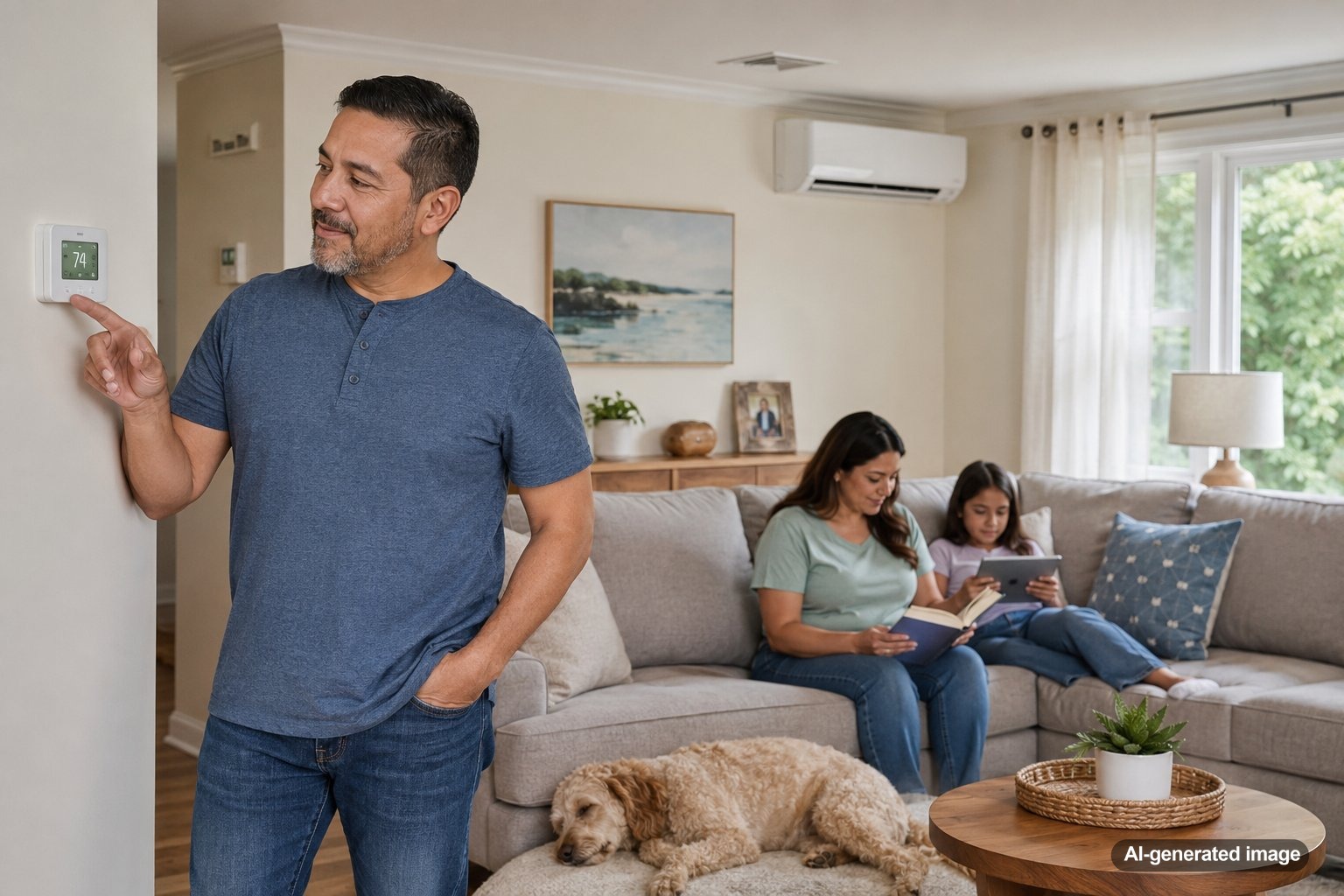
Yes, a thermostat can display an accurate room temperature and still control the AC incorrectly. Measuring temperature is only one part of its job. The thermostat must also interpret schedules, compare the reading with the setpoint, apply programmed operating limits, and send the correct control signals to the cooling system.
That distinction matters when the screen looks normal but the AC starts late, stops too soon, runs longer than expected, short cycles, or fails to turn on. The problem may involve thermostat settings, equipment configuration, low-voltage wiring, a remote sensor, or the HVAC equipment itself. Homeowners in Central and Northern New Jersey can learn more about available thermostat options, but unexplained cooling behavior should be evaluated before replacing any component.
A correct temperature reading does not prove that the thermostat is controlling the AC correctly.
- The displayed temperature may be accurate while the cooling schedule or setpoint is wrong.
- The thermostat may be configured for a different type of HVAC system.
- A wiring or control-circuit issue may prevent the proper cooling signal from reaching the equipment.
- Remote sensors, zoning controls, delays, or energy-saving features may affect when cooling starts.
- The thermostat may be requesting cooling correctly while the AC has a separate mechanical, airflow, or electrical problem.
How a Thermostat Can Read Correctly but Control Cooling Incorrectly
A thermostat performs two related but separate functions. First, it senses or receives a temperature reading. Second, it decides whether to activate cooling based on that reading, the selected mode, the target temperature, programmed settings, and the type of HVAC equipment connected to it.
For example, a thermostat may accurately show 78 degrees while the cooling setpoint is 74 degrees. If the screen indicates a cooling call but the outdoor unit does not start, the temperature sensor may be working perfectly. The control signal may not be reaching the equipment, or the equipment may be unable to respond.
The reverse can also happen. The AC may continue operating after the displayed temperature reaches the setpoint because of an active remote sensor, a programmed temperature range, a staging rule, a dehumidification setting, or a control problem. A small amount of additional runtime can be normal, but persistent overcooling deserves attention.
Common Reasons the Thermostat and AC Seem Out of Sync
Incorrect thermostat mode or schedule
A thermostat can display the room temperature correctly while following a schedule the homeowner has forgotten about. Smart recovery, vacation settings, energy-saving modes, geofencing, utility features, and app-based automations can also change the active setpoint.
Check whether the thermostat is set to Cool rather than Heat, Off, or Fan Only. Then compare the active setpoint on the thermostat with the schedule shown in the app. A temporary hold may expire and return the system to a programmed setting without an obvious equipment failure.
Wrong HVAC equipment configuration
Modern thermostats need to know what type of system they are controlling. A conventional furnace and central AC system uses different control logic from a heat pump. Single-stage and multi-stage systems also require different configurations.
If a thermostat was recently installed, reset, replaced, or reconfigured, it may accurately sense temperature but send the wrong commands. Incorrect heat pump reversing-valve settings, staging selections, or accessory assignments can lead to warm air during a cooling call, incomplete operation, or unexpected cycling.
Loose, damaged, or incorrectly connected control wiring
The thermostat communicates with the HVAC system through low-voltage control wiring. A display can remain powered and show the correct temperature even when the cooling control wire has a poor connection.
For a typical central AC system, the thermostat generally needs to send a cooling request through the appropriate control terminal. A loose connection, damaged wire, corroded splice, or incorrect terminal assignment may interrupt that request. Wiring should not be moved or exposed while power is on. Because improper handling can damage equipment or create a shock risk, questionable wiring is best checked by a qualified technician.
Built-in compressor protection delay
Many thermostats intentionally delay compressor operation after the system shuts off or loses power. This protection helps prevent the compressor from restarting immediately against high refrigerant pressure.
During the delay, the thermostat may show that cooling is requested while the outdoor unit remains off for several minutes. This can be normal. A delay that never clears, repeatedly returns, or appears along with an error message may point to a control or equipment issue.
Remote sensor or smart thermostat priority
Some smart thermostats average multiple sensors or prioritize a selected room at certain times. The thermostat on the wall might read 74 degrees while a bedroom sensor reads 77 degrees, causing the AC to continue running.
Occupancy detection can add another layer. A thermostat may ignore an unoccupied room, switch to a different sensor, or change its comfort profile automatically. Reviewing the active sensor and schedule can explain behavior that otherwise looks incorrect.
Temperature differential and cycle settings
Thermostats usually do not switch cooling on and off at the exact instant the displayed temperature changes by one degree. They use a differential, sometimes called a deadband, to reduce rapid cycling.
A thermostat set to 74 degrees may wait until the room warms slightly above that target before starting the AC. It may then cool slightly below the target before shutting down. A modest operating range is normal. Large swings, very frequent starts, or uncomfortable delays may indicate an inappropriate setting or another system problem.
Zoning system communication problems
In a zoned home, the thermostat is only one part of the control system. Zone dampers, a control panel, discharge-air sensors, bypass components, and multiple thermostats may work together.
One thermostat can report the correct temperature while a stuck damper or control-panel problem sends too little conditioned air to that zone. Homes with persistent room-to-room differences may benefit from an evaluation of the complete zoning system, not just the wall control.
The thermostat is calling correctly, but the AC cannot respond
Sometimes the thermostat is not the source of the problem at all. It may correctly request cooling while the AC has a tripped safety device, clogged filter, drainage issue, failed electrical component, airflow restriction, frozen coil, or outdoor-unit problem.
A useful distinction is whether the thermostat indicates an active cooling call. If it does, but the blower, outdoor unit, or both fail to operate as expected, professional testing can determine where the control sequence stops.
Why the Displayed Temperature Can Be Misleading
A thermostat may show a plausible number without representing comfort throughout the house. Placement affects what it senses. A hallway thermostat can read 74 degrees while an upstairs bedroom is much warmer. Nearby sunlight, lamps, electronics, drafts, exterior walls, or airflow from a supply vent may also affect the local reading.
Some thermostats round the displayed temperature. The internal reading may include fractions of a degree even though the screen shows a whole number. As a result, the system can start or stop without the visible number appearing to change.
Humidity adds another complication during New Jersey summers. A room can be at the target temperature and still feel uncomfortable when indoor humidity is high. Some thermostats can run cooling or connected humidity-control equipment according to humidity settings, which may extend operation beyond what the temperature alone suggests.
Safe Checks Homeowners Can Make
- Confirm that the thermostat is set to Cool and that the active setpoint is below the room temperature.
- Review schedules, holds, vacation modes, energy-saving settings, and app automations.
- Check which remote sensor or comfort profile is currently active.
- Replace thermostat batteries if the model uses them and reports a low-battery condition.
- Inspect or replace a dirty HVAC filter according to the equipment manufacturer’s guidance.
- Make sure supply registers and return-air grilles are open and not blocked.
- Look for an error message, warning icon, or equipment status notice on the thermostat.
- If it is safe to do so, check whether the HVAC breaker has tripped. Reset it only once. If it trips again, leave it off and request professional service.
Avoid removing equipment panels, moving thermostat wires, bypassing safety controls, or testing energized terminals. These steps can damage the thermostat, air handler, furnace control board, or AC equipment.
Clues That Help Separate a Thermostat Problem From an AC Problem
| What you notice | What it may indicate |
|---|---|
| The thermostat never shows a cooling call | Schedule, setpoint, mode, sensor priority, configuration, or thermostat issue |
| The thermostat shows cooling, but neither the blower nor outdoor unit starts | Control wiring, power, safety circuit, control board, or equipment problem |
| The blower runs, but the outdoor unit does not | Outdoor-unit power, controls, electrical components, or a safety-related shutdown |
| The AC starts and stops every few minutes | Thermostat differential, sensor location, airflow restriction, equipment sizing, or another system fault |
| The AC runs well past the setpoint | Remote-sensor priority, humidity control, staging, calibration, wiring, or thermostat failure |
| Warm air comes from vents during a cooling call | System configuration, heat pump setting, wiring, or equipment issue |
These clues narrow the possibilities, but they do not confirm a specific diagnosis. HVAC control problems can produce similar symptoms, and testing may be needed at several points in the system.
When to Call an HVAC Professional
Schedule professional service when the thermostat repeatedly fails to start or stop cooling correctly, the system short cycles, the temperature swings become excessive, or cooling behavior changed after thermostat installation or equipment work. Service is also appropriate when the display reports an error that basic setting checks do not resolve.
Turn the system off and seek prompt help if you notice smoke, sparks, an electrical burning smell, repeated breaker trips, water near electrical components, or unusual equipment noises. Do not continue resetting the system or attempting to bypass a protective shutdown.
A technician can test the thermostat output, control wiring, equipment configuration, transformer voltage, control board, safety circuit, blower operation, outdoor unit, and zoning controls. Evaluating the full operating sequence helps prevent a working thermostat from being replaced when the actual fault is elsewhere.
Frequently Asked Questions
Can a thermostat show the correct temperature and still be defective?
Yes. The temperature-sensing portion may work while an internal relay, terminal, software setting, or communication function does not operate correctly. The thermostat should be tested together with the HVAC system before replacement is recommended.
Why does my thermostat say Cool On when the AC is not running?
A brief delay may be normal because many thermostats protect the compressor from immediate restarts. If the message remains active and the equipment never starts, the cause could involve wiring, power, a safety circuit, the control board, or the AC equipment.
Why does the AC keep running after reaching the thermostat setting?
The thermostat may be using another room sensor, averaging multiple sensors, controlling humidity, completing a staged cycle, or operating within a programmed temperature differential. Persistent overcooling may also indicate a thermostat, wiring, zoning, or equipment problem.
Can a thermostat cause AC short cycling?
It can. Poor thermostat placement, a loose connection, an overly narrow differential, incorrect configuration, or a failing control can contribute to short cycling. Restricted airflow, equipment issues, and improper system sizing can cause similar behavior.
Should I replace the thermostat first?
Not necessarily. Replacing it without testing can leave the original problem unresolved. A professional evaluation can determine whether the thermostat, wiring, settings, zoning components, or AC system needs attention.
An accurate display confirms only that the thermostat can report a temperature. It does not confirm that schedules, sensors, wiring, configuration, control signals, and HVAC equipment are all working together correctly. When safe setting checks do not explain the behavior, testing the complete cooling sequence is the most reliable next step.
Need help with your heating, cooling, or HVAC system?
Meyer & Depew serves homeowners and businesses throughout Central and Northern New Jersey.
Get a quote or call 908.272.2100.