



What Is Demand-Controlled Ventilation in a Commercial Building?
Estimated reading time: 8 minutes
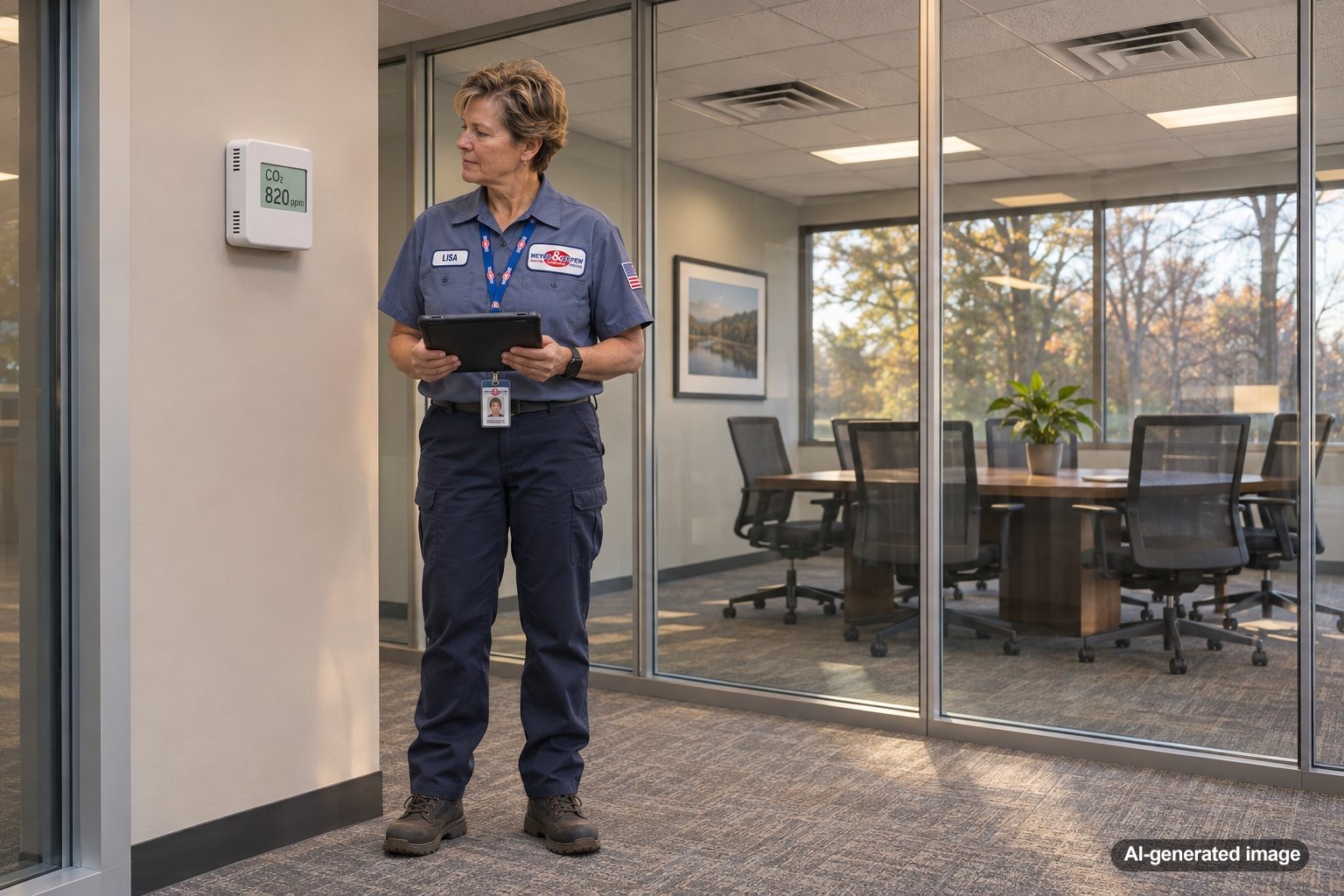
A commercial building that holds 100 people at lunchtime and only 15 people by midafternoon does not necessarily need the same amount of outdoor ventilation air throughout the day. Yet many HVAC systems operate on fixed ventilation schedules or airflow settings regardless of how many people are actually occupying the space. Demand-controlled ventilation, often abbreviated DCV, addresses this mismatch by adjusting outdoor air ventilation based on changing building conditions and occupancy demand.
For businesses and property managers in Central and Northern New Jersey, demand-controlled ventilation can be worth exploring when office attendance varies, conference rooms sit empty between meetings, or retail traffic changes significantly throughout the day. Understanding how the technology works can help building owners make more informed decisions about comfort, ventilation, and operating costs. It is one of several control strategies that may be evaluated as part of a broader commercial HVAC system assessment.
Demand-controlled ventilation is an HVAC control strategy that adjusts the amount of outdoor air supplied to a commercial space according to its ventilation needs, commonly using carbon dioxide sensors or occupancy information.
- It can reduce unnecessary outdoor air intake during periods of low occupancy.
- It increases ventilation when monitored conditions indicate greater demand.
- It is particularly useful in spaces with substantial occupancy changes.
- Proper design must maintain required minimum ventilation and account for pollutants that are not directly related to occupancy.
How Does Demand-Controlled Ventilation Work?
Traditional commercial ventilation systems often introduce outdoor air at a predetermined rate. This provides a straightforward approach to ventilation, but the actual number of occupants may change considerably during operating hours.
A demand-controlled ventilation system uses sensors, control logic, and compatible HVAC equipment to adjust outdoor airflow as conditions change. Carbon dioxide, or CO2, sensing is a common approach because people generate CO2 as they breathe. In an occupied space, rising indoor CO2 levels relative to outdoor conditions can provide information about the relationship between occupancy and ventilation.
When a room becomes more heavily occupied, a properly configured system may increase the outdoor air delivered to that space. When occupancy decreases, the controls may reduce outdoor airflow while maintaining applicable minimum ventilation requirements.
Depending on the HVAC design, these adjustments may involve outdoor air dampers, variable airflow controls, air handling units, rooftop equipment, or a building automation system. Not every commercial HVAC system can support demand-controlled ventilation without modifications.
Why Would a Commercial Building Need Variable Ventilation?
Outdoor ventilation air is important for indoor air quality, but bringing that air indoors also creates heating, cooling, and sometimes dehumidification demands. During a humid New Jersey summer, incoming outdoor air may need substantial moisture removal. During winter, cold outdoor air must be heated before it can comfortably enter occupied areas.
If a building continuously introduces ventilation air based on an assumed high occupancy level, it may condition more outdoor air than necessary during quieter periods. Demand-controlled ventilation can reduce this unnecessary conditioning load in suitable applications.
Consider three examples:
- Conference rooms: A meeting room may accommodate 30 people but remain empty for several hours. Occupancy-responsive ventilation can better match airflow to actual use.
- Restaurants and event spaces: Customer counts can change dramatically between busy periods and slower hours. Ventilation controls may respond to those changes, although kitchen exhaust and makeup air requirements must be addressed separately.
- Office buildings: Hybrid work schedules can create substantial differences between anticipated and actual attendance. A well-designed ventilation strategy may accommodate those variations.
Demand-controlled ventilation generally offers the greatest opportunity where occupancy varies widely and outdoor air conditioning represents a meaningful portion of the HVAC load.
What Equipment Makes Demand-Controlled Ventilation Possible?
Successful DCV depends on more than installing a sensor on the wall. The sensing equipment, HVAC controls, ventilation delivery system, and building operating schedule must work together.
CO2 Sensors
CO2 sensors are frequently installed in representative occupied areas or return air locations, depending on the system design. Their readings help the controls determine whether ventilation demand is increasing or decreasing. Sensor placement, accuracy, calibration, and maintenance are important because unreliable readings can lead to poor control decisions.
Occupancy Sensors and Scheduling
Some systems use people-counting technology, occupancy signals, or building schedules instead of, or alongside, CO2 measurements. Direct occupancy information may be especially useful when a room’s population changes faster than its CO2 concentration responds.
Outdoor Air Dampers and HVAC Controls
Motorized dampers and control systems regulate outdoor airflow. In some installations, existing rooftop units or air handling equipment may already have compatible components. In others, additional hardware, airflow measurement, or programming may be necessary.
The system must also maintain appropriate airflow relationships and building pressure. Simply closing an outdoor air damper based on a CO2 reading is not a complete ventilation control strategy.
Does Demand-Controlled Ventilation Improve Indoor Air Quality?
Demand-controlled ventilation can help match outdoor air delivery to occupancy-related needs, but it does not automatically improve every aspect of indoor air quality.
CO2 sensors primarily help evaluate ventilation relative to occupant-generated CO2. They do not directly measure every contaminant that might be present in a commercial building, including cleaning chemical vapors, odors from building materials, or particulate pollution.
Some ventilation requirements are driven by the building area or specific sources of contamination rather than the number of people present. These requirements may remain even when a space is unoccupied.
For that reason, DCV should be designed around the applicable ventilation standards, building codes, space classifications, and actual use of the property. Demand-controlled ventilation is not a substitute for appropriate filtration, source control, dedicated exhaust, or other commercial air purification considerations.
When Is Demand-Controlled Ventilation a Good Investment?
Not every building will benefit equally from demand-controlled ventilation. A facility manager should evaluate the following factors before committing to an upgrade.
Occupancy Patterns
Spaces with major differences between peak and normal occupancy are generally more promising candidates than spaces with consistently high attendance. A room that operates near capacity throughout the day may have limited opportunities to reduce ventilation.
Existing HVAC Equipment
The type, age, and configuration of existing equipment affect installation complexity. A modern building automation system may provide a practical integration path, while older equipment may require control or mechanical upgrades.
Climate and Operating Hours
Buildings with long operating hours and substantial outdoor air conditioning requirements may have greater opportunities for energy reduction. New Jersey’s seasonal heating, cooling, and humidity conditions make these factors particularly relevant.
Maintenance and Control Reliability
DCV adds components that require periodic inspection and verification. Sensors can drift, dampers can stick, and control settings can become inappropriate when spaces are remodeled or their use changes. A poorly maintained system may not deliver the expected results.
Potential savings should be evaluated through a building-specific analysis rather than assumed from equipment specifications alone.
What Should Facility Managers Check Before Upgrading?
Before requesting a demand-controlled ventilation proposal, building owners and facility managers can gather information that helps an HVAC professional assess the opportunity.
- Document the building’s normal operating hours and major occupancy changes.
- Identify conference rooms, training rooms, dining areas, and other spaces with irregular use.
- Review existing building automation information and available ventilation schedules.
- Note recurring comfort complaints, stuffiness, or humidity concerns.
- Locate available equipment documentation and past maintenance records.
- Identify recent renovations or changes in how commercial spaces are occupied.
These are observation and documentation tasks, not instructions to modify HVAC controls. Outdoor air damper settings, ventilation minimums, sensor calibration, and system programming should be evaluated by qualified professionals.
Why Professional Design and Commissioning Matter
A professional evaluation is especially important when a building uses multiple rooftop units, variable air volume systems, specialized exhaust, or interconnected building pressure controls.
During an assessment, an HVAC professional can evaluate existing ventilation rates, occupancy requirements, equipment capabilities, control sequences, and applicable codes. The assessment should also consider whether outdoor air quantities can be verified throughout the system’s operating range.
Commissioning is another critical step. After installation or control changes, technicians should confirm that sensors respond correctly, dampers operate as intended, and required ventilation is maintained at both low and high occupancy. They should also check how the system interacts with economizer operation, heating, cooling, and humidity management.
Ongoing inspections can help identify control issues before they become persistent comfort or ventilation problems. A structured commercial HVAC maintenance plan can provide a framework for reviewing equipment condition and recurring performance concerns.
Frequently Asked Questions About Demand-Controlled Ventilation
Is demand-controlled ventilation the same as a CO2 monitor?
No. A CO2 monitor measures carbon dioxide concentration, while demand-controlled ventilation uses sensor information or other occupancy indicators to adjust ventilation. A standalone monitor does not change airflow unless it is integrated with appropriate controls and equipment.
Can demand-controlled ventilation be added to an existing rooftop HVAC unit?
Sometimes. Compatibility depends on the rooftop unit’s controls, damper arrangement, ventilation requirements, and operating capabilities. A qualified HVAC contractor can determine whether a retrofit is practical or whether additional equipment is required.
Does demand-controlled ventilation shut off fresh air when nobody is in the building?
Not necessarily. Some spaces require outdoor ventilation or exhaust regardless of occupancy. A properly designed system maintains applicable minimums and coordinates ventilation with the building’s operating and safety requirements.
Will demand-controlled ventilation always lower energy bills?
No. Results depend on occupancy variation, climate, existing ventilation rates, equipment efficiency, system configuration, and control performance. In some buildings, the energy savings opportunity may be modest relative to installation and maintenance costs.
How often should demand-controlled ventilation sensors be checked?
Inspection and calibration needs depend on the sensor manufacturer’s recommendations, the operating environment, and the control system. Sensor accuracy and ventilation response should be included in an appropriate professional maintenance and verification program.
The Bottom Line for New Jersey Commercial Buildings
Demand-controlled ventilation allows commercial HVAC systems to respond more closely to changing occupancy instead of relying exclusively on fixed outdoor airflow settings. When correctly designed, installed, and maintained, it may reduce unnecessary heating and cooling loads while preserving required ventilation. Its suitability depends on the building’s occupancy patterns, equipment, and applicable requirements.
For commercial property owners and facility managers in Central and Northern New Jersey, the practical next step is to evaluate the existing system before deciding whether DCV makes sense. An assessment can help distinguish a worthwhile controls improvement from a more extensive ventilation or equipment upgrade.
Need commercial HVAC support in New Jersey?
Meyer & Depew works with businesses, organizations, and commercial properties throughout Central and Northern New Jersey.
Learn more about commercial HVAC maintenance plans.