



Why Does One Office Need Heat While Another Still Needs Air Conditioning?
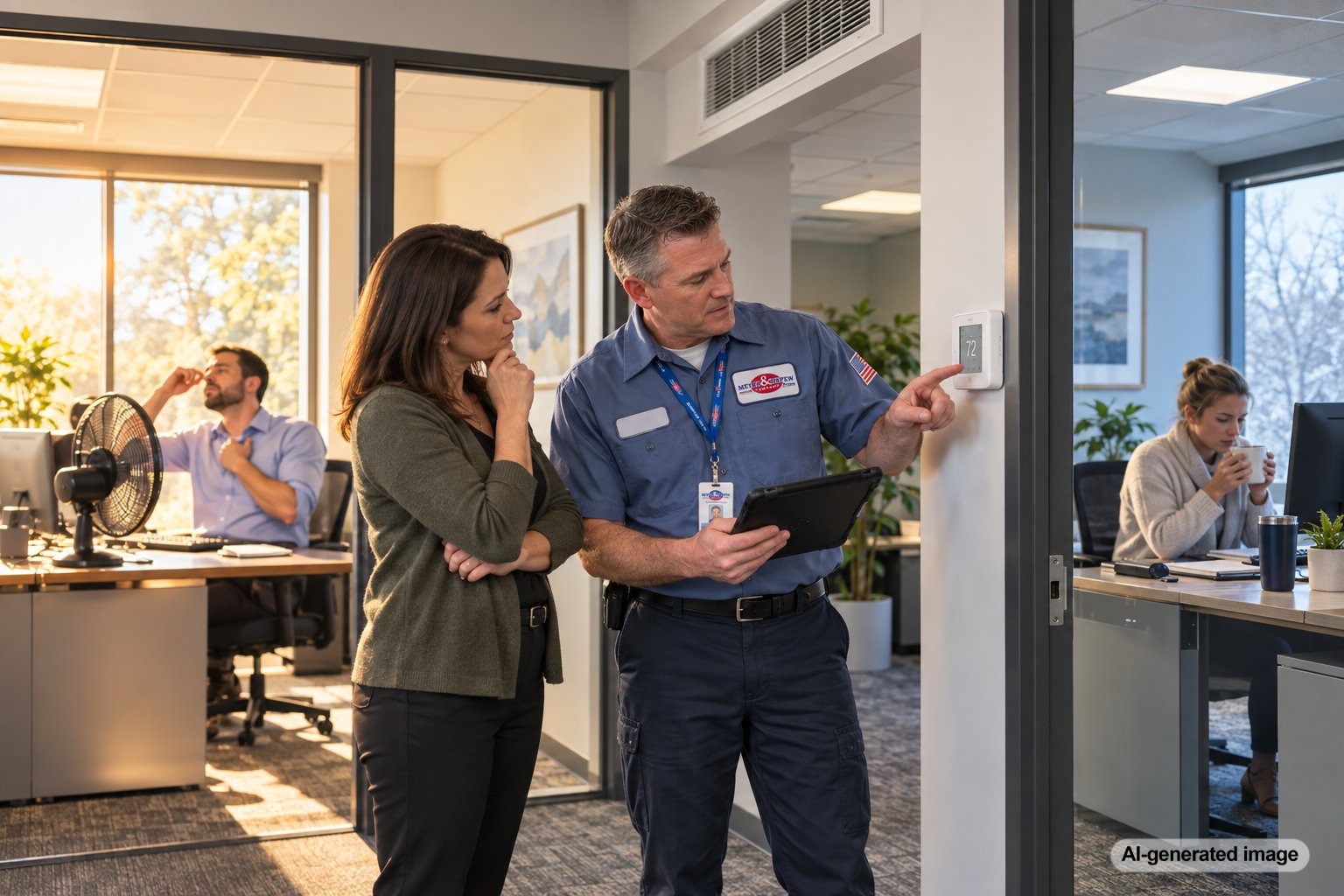
One office can feel cold enough to need heat while another office in the same building still needs AC. That may sound contradictory, but it is common in commercial buildings. Differences in sunlight, occupancy, equipment, airflow, building orientation, thermostat placement, and HVAC zoning can create very different heating and cooling loads only a few rooms apart.
For businesses in Central and Northern New Jersey, the problem can become especially noticeable during spring and fall, when cool mornings, warm afternoons, strong sun, and changing occupancy patterns all affect the building at once. A well-designed commercial HVAC system should respond to those changing loads without making employees constantly adjust thermostats or use portable heaters and fans.
Different offices can need heat and AC at the same time because each space gains and loses heat differently. Exterior exposure, windows, people, computers, lighting, airflow, thermostat location, and zoning all matter. If the temperature differences are persistent or severe, the HVAC system may need balancing, controls adjustments, maintenance, or a closer look at how the building is divided into zones.
Why two offices in the same building can feel completely different
An HVAC system does not simply heat or cool a building as one uniform box. Every room has its own heat load. An interior office with no windows may behave very differently from a corner office with large south-facing glass. A conference room occupied by ten people produces more heat than an empty private office. A server closet, copier area, or workspace filled with computers can add heat even when outdoor temperatures are cool.
The result is that one part of the building may be losing heat while another is gaining it. When the HVAC system, ductwork, controls, or zoning cannot respond effectively to those differences, employees experience the familiar pattern of one room feeling chilly while another feels stuffy or overheated.
Sunlight can turn one office into a warm zone
Solar heat gain is one of the biggest reasons neighboring offices can need opposite HVAC responses. Rooms facing south or west may receive strong afternoon sun through windows, while shaded or north-facing rooms remain much cooler.
This difference can be substantial even when the outdoor temperature is moderate. During a New Jersey fall afternoon, for example, sunlight through large windows can make a perimeter office warm enough to require cooling while an interior or shaded room still benefits from heat.
Window size, glass type, blinds, exterior shading, and the amount of exposed wall area can all influence how quickly an office heats up or cools down.
People and office equipment create their own heat
Occupancy is another major factor. People release heat, and so do computers, monitors, printers, copiers, kitchen equipment, lighting, and other electronics. A busy conference room can warm up quickly compared with a nearby office occupied by one person.
These internal heat sources help explain why a building may need cooling even on a relatively cool day. The outdoor temperature is only one part of the equation. What is happening inside each space matters just as much.
Airflow may not be balanced evenly
Temperature differences can also point to an airflow issue. Some offices may receive more conditioned air than they need, while others receive too little. Closed dampers, blocked supply registers, obstructed return grilles, duct leakage, dirty filters, or system balancing problems can contribute to uneven comfort.
In commercial buildings, airflow balancing is particularly important because the duct system may serve many rooms with different requirements. A change in office layout can also affect airflow. Adding walls, moving workstations, changing ceiling configurations, or converting a storage area into occupied space may alter how the original HVAC design performs.
One thermostat may be controlling several very different spaces
Thermostat placement matters. If several offices share one HVAC zone, the thermostat can only respond to the temperature where its sensor is located. It may not know that a sunny corner office is several degrees warmer or that a shaded office down the hall feels cold.
A thermostat near an exterior door, copier, kitchen, supply vent, window, or high-traffic area may also receive temperature readings that do not represent the rest of the zone accurately.
When large temperature differences are caused by the way spaces are grouped together, better zoning or more advanced controls may be worth evaluating. Commercial buildings with changing occupancy and diverse space types may also benefit from technologies such as Variable Refrigerant Flow (VRF) Systems, depending on the building and application.
Building orientation changes the heating and cooling load throughout the day
An office that is comfortable at 9 a.m. may feel completely different at 3 p.m. East-facing rooms often warm earlier in the day, while west-facing rooms may receive intense afternoon sun. Upper floors can also experience different heat loads than lower floors, and perimeter spaces generally respond more strongly to outdoor conditions than interior spaces.
This daily movement of heat can make fixed HVAC schedules or poorly configured controls less effective. A system that works reasonably well during one part of the day may struggle later when solar exposure and occupancy shift.
Seasonal transitions make the problem more obvious
Spring and fall tend to expose office comfort differences because outdoor temperatures can change quickly. A chilly morning may create a genuine heating load, followed by a mild or warm afternoon that pushes sunny or heavily occupied spaces toward cooling.
Commercial HVAC controls need to handle these shoulder-season conditions without unnecessary conflict between systems. If heating and cooling repeatedly operate against each other, a qualified HVAC professional can review schedules, setpoints, zoning, sensors, equipment operation, and the building’s actual comfort patterns.
Could the HVAC system actually be heating and cooling at the same time?
In some buildings, simultaneous heating and cooling is intentional. Certain commercial systems are designed so separate zones can receive different conditioning based on their individual loads. That can be useful in buildings where perimeter offices, interior spaces, conference rooms, and equipment-heavy areas have very different needs.
In other situations, however, unnecessary simultaneous heating and cooling may indicate control problems, poor setpoint coordination, incorrect schedules, malfunctioning sensors, or equipment that is not operating as intended. It is important not to assume that seeing heat in one area and cooling in another automatically means something is wrong.
Safe things facility staff can check first
- Compare thermostat settings and actual room temperatures in the affected areas.
- Make sure supply registers and return grilles are open and not blocked by furniture, boxes, or office partitions.
- Note whether the problem happens at a particular time of day, such as during strong afternoon sunlight.
- Check whether conference rooms or high-equipment areas become uncomfortable only when occupied.
- Review whether recent renovations, workstation changes, or new walls altered the original office layout.
- Document recurring hot and cold areas so an HVAC professional can evaluate patterns instead of relying on a single temperature reading.
Facility staff should avoid opening HVAC equipment, changing electrical components, bypassing controls, or making adjustments inside commercial mechanical systems unless they are qualified to do so.
When professional evaluation makes sense
Occasional temperature differences are normal, especially in buildings with strong sun exposure or rapidly changing occupancy. Professional service is worth considering when certain offices are consistently uncomfortable, employees constantly adjust thermostats, portable heaters become common, some zones run almost continuously, or heating and cooling seem to work against each other.
A commercial HVAC technician can evaluate airflow, filters, equipment operation, thermostat and sensor placement, zoning, control sequences, duct conditions, and system schedules. The goal is not simply to make every thermostat display the same number. It is to understand why each area behaves differently and determine whether the system is responding appropriately.
Regular commercial maintenance can also help identify airflow, control, and equipment issues before they become persistent comfort complaints. Businesses that want a more structured approach can learn about Meyer & Depew’s commercial HVAC maintenance plans.
Frequently asked questions
Is it normal for one part of an office to need heat while another needs AC?
It can be. Different zones may have different heating and cooling loads because of sunlight, occupancy, equipment, exterior exposure, and airflow. The key question is whether the HVAC system is designed and controlled to handle those differences efficiently.
Can thermostat placement cause office temperature problems?
Yes. A thermostat or sensor located near a window, exterior door, supply vent, copier, kitchen, or other unusual heat source may not represent the temperature experienced throughout the rest of the zone.
Can office renovations create hot and cold spots?
Yes. Adding walls, changing room uses, moving workstations, or altering ceiling layouts can change airflow and occupancy loads. The original HVAC layout may no longer match how the space is being used.
Would zoning solve uneven office temperatures?
Zoning can help in some buildings by allowing areas with different loads to receive different amounts of heating or cooling. Whether it is practical depends on the existing HVAC system, ductwork, controls, building layout, and comfort goals.
Why are office temperature differences worse in spring and fall?
Morning and afternoon temperatures can vary significantly, while sunlight and internal heat from people and equipment continue to change throughout the day. That can cause some areas to need heating while others already need cooling.
When one office needs heat while another still needs AC, the issue is usually a difference in heat gain, heat loss, airflow, occupancy, or HVAC zoning rather than a contradiction. Tracking when and where the problem occurs gives a commercial HVAC professional useful information for evaluating the system and determining whether maintenance, balancing, controls changes, or a different zoning strategy may help.
Need commercial HVAC support in New Jersey?
Meyer & Depew works with businesses, organizations, and commercial properties throughout Central and Northern New Jersey.
Learn more about commercial HVAC maintenance plans.