


Why Do Commercial Heating Systems Need Economizer Checks Before Winter? Prevent Heat Loss and Hidden HVAC Problems
Estimated reading time: 8 minutes
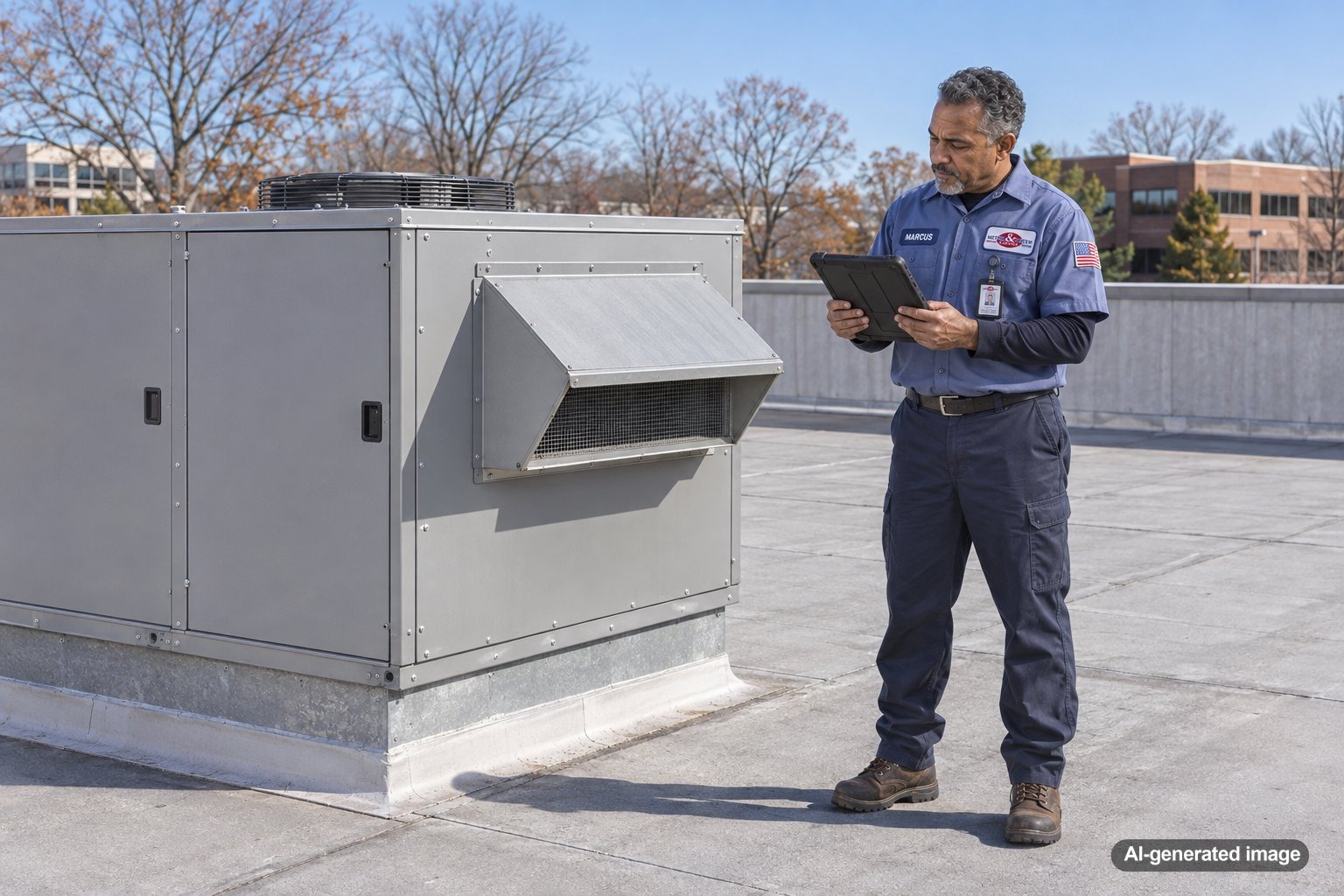
Why do commercial heating systems need economizer checks before winter? A malfunctioning economizer can introduce excessive outdoor air into a building, increasing heating demand, creating uncomfortable drafts, and interfering with normal equipment operation. Although economizers are commonly associated with energy-efficient cooling, their ability to regulate outdoor airflow remains important throughout the heating season.
For commercial property owners and facility managers across Central and Northern New Jersey, the transition from mild fall afternoons to freezing winter mornings presents a valuable opportunity to identify problems that may have gone unnoticed during warmer weather. Including economizer inspections in scheduled commercial HVAC maintenance helps ensure that heating equipment, ventilation controls, and outdoor air dampers are working together as intended.
Commercial HVAC economizers need pre-winter inspections to verify damper movement, sensor accuracy, ventilation settings, and coordination with heating controls. Proper operation can help limit unnecessary cold air intake while maintaining required ventilation and reducing avoidable heating demand.
What Does an Economizer Do in a Commercial HVAC System?
An air-side economizer uses outdoor air to help cool a commercial building when outside conditions are suitable. Instead of relying entirely on mechanical cooling, the system adjusts outdoor and return air dampers to take advantage of favorable outdoor temperatures and, depending on its controls, humidity conditions.
Economizers are commonly found in packaged rooftop HVAC units serving offices, retail stores, schools, restaurants, and other commercial properties. They may include motorized dampers, actuators, temperature sensors, humidity sensors, control modules, and relief air components.
During winter, an economizer generally limits outdoor air intake to the amount needed for ventilation when the equipment is heating. However, buildings with substantial internal heat gains may still benefit from economizer cooling during cold weather. The correct operating position depends on the equipment design, occupancy, ventilation requirements, and current heating or cooling demand.
Why Economizer Problems Become More Noticeable During Winter
A damper that remains partially open beyond its intended ventilation position might not create an obvious comfort problem during September or October. Once outdoor temperatures approach freezing, that same condition can introduce significantly colder air into the HVAC system.
Excessive Outdoor Air Increases Heating Demand
Commercial heating equipment must warm incoming outdoor air before distributing conditioned air throughout the building. When an economizer admits more outdoor air than necessary, the heating system may operate longer to maintain the thermostat setting.
In a building with multiple rooftop units, a malfunction affecting just one economizer can create unusually high heating demand in a particular zone while the rest of the property operates normally.
Cold Drafts Can Affect Occupant Comfort
Employees working beneath supply registers may report uncomfortable drafts even when the thermostat indicates an acceptable room temperature. Depending on the equipment configuration, excessive outdoor air intake can contribute to lower-than-expected supply air temperatures.
These complaints may be especially noticeable when a rooftop unit operates in occupied fan mode between heating cycles.
Incorrect Damper Positions Can Reduce Ventilation
An economizer stuck closed presents a different concern. Although restricting outdoor air might appear to reduce heating demand, insufficient ventilation can contribute to stale indoor conditions and interfere with the building’s intended ventilation performance.
A properly operating economizer balances ventilation needs with heating and cooling requirements rather than simply keeping outdoor air dampers closed during winter.
Excessive Cold Air May Create Freeze Protection Concerns
Commercial air-handling equipment containing water-based heating or cooling coils may face additional risks when exposed to excessive freezing outdoor air. Depending on the equipment design and available freeze protection controls, abnormal mixed air temperatures could contribute to protective shutdowns or coil damage.
Not every rooftop unit contains water coils, but facility managers should understand whether their particular equipment has components vulnerable to freezing.
What Should a Pre-Winter Economizer Inspection Include?
A comprehensive economizer inspection involves more than confirming that a damper appears to open and close. A qualified commercial HVAC technician should evaluate how the mechanical components, sensors, and controls interact under appropriate operating conditions.
- Damper movement: Inspect outdoor, return, and relief air dampers, where applicable, for binding, corrosion, damage, and incomplete travel.
- Actuator performance: Verify that motorized damper actuators respond correctly to control commands and move the dampers through their intended operating range.
- Damper seals: Evaluate worn seals, damaged blades, and other conditions that may allow unwanted outdoor air leakage.
- Sensor accuracy: Evaluate outdoor air, return air, mixed air, and other relevant sensors for readings consistent with actual conditions.
- Ventilation settings: Confirm that minimum outdoor air settings are appropriate for the building’s ventilation requirements and equipment design.
- Heating coordination: Verify that economizer operation responds appropriately to heating demand without unnecessarily introducing excess outdoor air.
- Protective controls: Evaluate applicable low-temperature limits, freeze protection devices, and equipment-specific safety sequences.
- Occupancy schedules: Confirm that occupied and unoccupied operating schedules reflect the building’s actual use.
Where practical, technicians may also review building automation trends, measure outdoor airflow, and compare commanded damper positions with actual mechanical movement. These checks can reveal problems that a visual inspection alone might miss.
Why a Damper Position Reading Does Not Tell the Whole Story
Facility managers with building automation systems may be able to view economizer damper commands remotely. However, a displayed command does not necessarily confirm that the damper physically reached the requested position.
A disconnected linkage, slipping actuator connection, damaged blade, or mechanical obstruction can prevent the damper from following its command. Even systems equipped with position feedback may not identify every mechanical problem downstream of the actuator.
There is another important distinction: damper opening percentage is not the same as outdoor airflow percentage. Airflow also depends on fan operation, duct pressure, damper characteristics, and other system conditions. A damper setting alone cannot establish whether the building is receiving its required ventilation.
Physical inspection and appropriate airflow evaluation are particularly valuable before winter, when small control discrepancies may become more consequential.
Why New Jersey’s Changing Winter Conditions Matter
Commercial buildings throughout Central and Northern New Jersey experience substantial changes in outdoor temperature during the heating season. A building may require considerable heating when employees arrive in the morning but need cooling later in the day because of sunlight, office equipment, lighting, or customer traffic.
Consider an office building with perimeter spaces that need heat while interior conference rooms require cooling. Its HVAC equipment may encounter different heating, ventilation, and economizer cooling demands throughout the same day.
An economizer must respond correctly to those changing conditions. Keeping every outdoor air damper permanently closed for winter is not an appropriate substitute for properly functioning controls.
Warning Signs of a Commercial HVAC Economizer Problem
Facility managers should pay attention to changes in building comfort, equipment operation, and heating consumption, particularly when outdoor temperatures begin to fall.
- Heating equipment runs noticeably longer than expected during comparable weather conditions.
- Employees report cold drafts beneath supply air registers.
- One building zone consistently struggles to maintain its temperature.
- Heating consumption increases without an obvious change in occupancy or operating hours.
- Building automation systems report unusual mixed air temperatures or economizer faults.
- Indoor spaces become unusually stuffy during occupied hours.
- Equipment experiences recurring low-temperature alarms or protective shutdowns.
- Heating and economizer cooling appear to operate against each other unexpectedly.
These symptoms do not establish that an economizer has failed. Airflow restrictions, heating equipment problems, inaccurate sensors, duct leakage, and building envelope issues can produce similar conditions. Professional evaluation helps distinguish among these possibilities.
What Facility Managers Can Safely Check Before Scheduling Service
Property managers do not need to open rooftop equipment or adjust mechanical controls to gather useful information about possible economizer problems.
Review existing maintenance records to determine whether economizer operation was documented during previous service visits. Note when comfort complaints occur, which zones are affected, and whether the problems correspond with colder outdoor temperatures or changes in occupancy.
If your building has an automation system, review available temperature readings, equipment alarms, operating schedules, and damper commands without modifying control settings. Historical information can help a technician identify intermittent problems that may not occur during a service appointment.
Leave rooftop access, electrical testing, actuator adjustments, ventilation balancing, and protective control testing to qualified HVAC professionals. Never disable ventilation or bypass equipment safety controls in an attempt to reduce heating consumption.
When Should Commercial Economizer Checks Be Scheduled?
Early fall is generally a practical time to schedule economizer inspections alongside commercial heating maintenance. Completing these checks before sustained freezing temperatures can provide additional time to address worn components, inaccurate sensors, or control problems.
Economizers also deserve attention after rooftop unit repairs, actuator replacement, building automation upgrades, significant occupancy changes, or recurring ventilation complaints. Any of these circumstances may affect how the equipment introduces and regulates outdoor air.
For properties with multiple rooftop units, maintaining equipment-specific inspection records makes it easier to identify recurring failures, prioritize repairs, and compare operating performance over successive heating seasons.
Frequently Asked Questions About Commercial HVAC Economizers
Should an economizer be completely closed during winter?
Not necessarily. During occupied heating operation, the economizer generally needs to accommodate the building’s required outdoor ventilation. Some commercial systems may also use economizer cooling during winter when internal cooling demand exists and outdoor conditions are suitable.
Can a faulty economizer increase commercial heating bills?
Yes. An economizer that admits excessive cold outdoor air can increase the amount of heating required to maintain indoor temperatures. The actual energy impact depends on outdoor conditions, airflow, equipment efficiency, building operation, and the nature of the malfunction.
Do all commercial heating systems have economizers?
No. Air-side economizers are common in many packaged rooftop units and commercial air-handling systems, but they are not present in every HVAC configuration. A qualified technician can identify which equipment has economizer controls and determine its maintenance requirements.
Can an economizer cause a commercial heating system to blow cold air?
Excessive outdoor air intake may contribute to unusually cool supply air or uncomfortable drafts. However, heating component failures, airflow problems, and incorrect thermostat or control settings can cause similar symptoms. A professional inspection can help identify the underlying cause.
Does routine commercial HVAC maintenance automatically include economizer testing?
Not always. Maintenance agreements differ in scope, and a general heating inspection may not include detailed economizer functional testing or airflow verification. Facility managers should confirm which economizer components and operating sequences are covered.
Make Economizer Performance Part of Winter HVAC Preparation
Reliable commercial heating involves more than inspecting burners, heat exchangers, filters, and blower motors. The components responsible for introducing outdoor air also influence heating demand, ventilation, and occupant comfort.
By including economizer performance in preventive maintenance, New Jersey businesses can identify potential problems before colder weather makes them more disruptive. A properly functioning economizer helps the HVAC system deliver necessary ventilation without creating avoidable heating loads.
Need commercial HVAC support in New Jersey?
Meyer & Depew works with businesses, organizations, and commercial properties throughout Central and Northern New Jersey.
Learn more about commercial HVAC maintenance plans.