

Can Economizer Settings Cause Comfort Problems During Fall Weather?
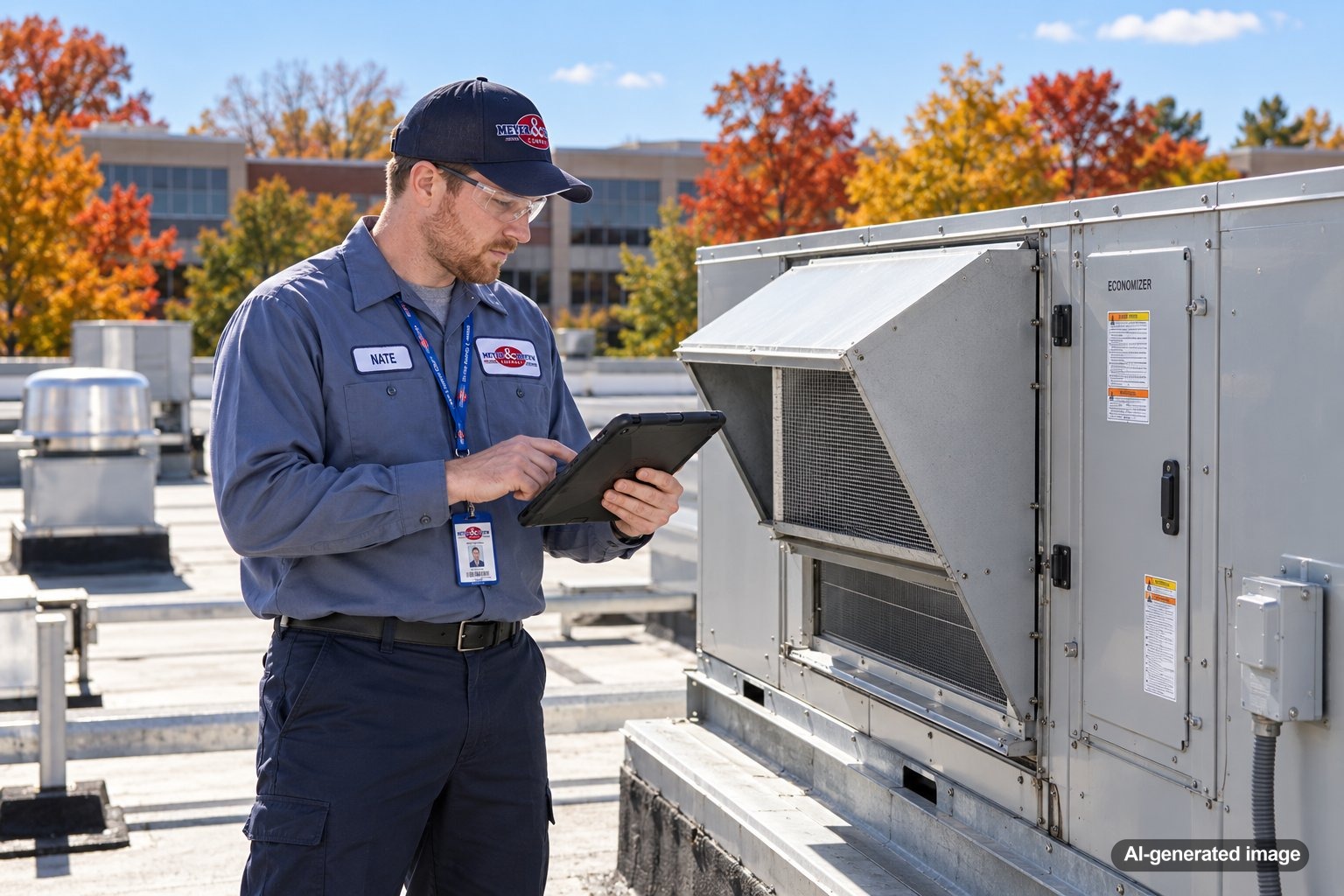
Yes. Economizer settings can contribute to comfort problems during fall weather, especially in commercial buildings where outdoor temperatures can swing significantly between morning, afternoon, and evening. An air-side economizer is designed to use suitable outdoor air for cooling when conditions allow, but incorrect setpoints, sensor problems, damper issues, or poor control sequences can bring in too much or too little outdoor air at the wrong time.
Fall can make these problems especially noticeable in Central and Northern New Jersey. A cool morning may favor economizer operation, while warmer or more humid conditions later in the day may require a different response. If your building develops recurring comfort complaints during these transitions, a review of the economizer and overall commercial HVAC maintenance strategy may help identify the cause.
Economizer-related fall comfort problems can occur when outdoor air dampers, temperature or humidity sensors, minimum ventilation settings, or control sequences do not respond properly to changing conditions.
- Too much cool outdoor air can make occupied areas feel cold.
- Too little outdoor air can affect ventilation and building pressure.
- Humidity can remain uncomfortable even when outdoor temperature seems favorable.
- Faulty or poorly calibrated sensors can cause the economizer to operate at the wrong time.
- Incorrect schedules or control sequences can create problems during morning warm-up and changing occupancy.
What Does an HVAC Economizer Actually Do?
An air-side economizer allows a commercial HVAC system to use outdoor air for cooling when outdoor conditions are favorable. Instead of relying entirely on mechanical cooling, the system can adjust outdoor-air and return-air dampers to produce an appropriate supply-air temperature.
When outdoor conditions are not suitable for economizer cooling, the controls should reduce outdoor-air intake to the amount required for normal ventilation. The exact control strategy depends on the equipment, building design, sensors, building automation system, and applicable ventilation requirements.
This sounds straightforward, but fall weather puts the controls through frequent transitions. Outdoor temperatures may be cool enough for economizer operation in the morning and substantially warmer later. Humidity can also change independently of temperature. The system needs accurate information and a sound control sequence to respond appropriately.
Why Fall Weather Can Expose Economizer Problems
Economizers often receive more attention during spring and fall because these shoulder seasons provide many opportunities to use outdoor air for cooling. They also create some of the most complicated operating conditions.
A commercial building may have substantial internal heat from occupants, lighting, computers, kitchen equipment, or other processes even when it is chilly outside. Some areas may need cooling while perimeter spaces need heat. The economizer has to work with the rest of the HVAC system rather than simply reacting to one outdoor temperature reading.
In New Jersey, large temperature swings can make a marginal control problem easier to notice. A building that seems comfortable on a steady summer day may develop cold drafts, warm interior zones, or inconsistent temperatures during a mild fall afternoon.
Economizer Settings That Can Affect Comfort
High-limit settings
An economizer uses a high-limit control to determine when outdoor conditions are no longer appropriate for economizer cooling. Depending on the system, this decision may be based on outdoor temperature, a comparison between outdoor and return-air temperatures, enthalpy, or a combination of temperature and humidity measurements.
If the control strategy enables economizer operation under unsuitable conditions, the system may introduce outdoor air when mechanical cooling or another operating mode would be more appropriate. If it disables economizer operation too early, the building may miss useful outdoor-air cooling and rely more heavily on mechanical cooling.
Minimum outdoor-air position
The minimum outdoor-air setting determines how the ventilation system behaves when full economizer cooling is not needed. A damper position that is inappropriate for the actual system or occupancy can contribute to temperature complaints, pressure problems, and unnecessary conditioning of outdoor air.
Damper position alone also does not always tell the complete story. Actual airflow depends on factors such as fan operation, system pressure, damper characteristics, and the overall air-handling configuration. A qualified commercial HVAC technician can evaluate how the system is actually operating instead of assuming that a percentage shown by the controller equals a specific amount of airflow.
Supply-air temperature control
During economizer operation, outdoor and return air are typically mixed as part of maintaining an appropriate supply-air temperature. If the supply-air target or control sequence is poorly matched to the building, occupants may notice cool drafts or rooms that oscillate between warm and cool.
The problem may be most noticeable in spaces close to supply registers or in zones with relatively light heating loads. Interior zones can behave very differently from offices along exterior walls, making the overall sequence important.
Sensor Problems Can Make Good Settings Behave Badly
A control sequence can be logically correct and still perform poorly if the information feeding it is wrong. Economizer operation may depend on outdoor-air temperature sensors, return-air sensors, mixed-air or supply-air sensors, and, on some systems, humidity or enthalpy measurements.
A sensor that has drifted out of calibration may tell the controller that outdoor conditions are suitable when they are not. A poorly located outdoor sensor can also be affected by direct sunlight, nearby exhaust, or another local condition that does not accurately represent the air entering the system.
Humidity sensing deserves particular attention because moisture conditions can complicate economizer decisions. Cool outdoor air is not automatically dry air. A system that evaluates temperature without adequately accounting for the rest of the building’s control strategy may deliver acceptable temperatures while occupants still experience clammy or inconsistent conditions.
Damper Problems Can Look Like Control Problems
The controller can command the correct economizer position while the physical dampers fail to respond correctly. A damper may stick, an actuator may not travel through its intended range, linkages may be loose, or blades may not seal as expected.
For example, an outdoor-air damper that remains farther open than commanded could introduce excessive cool air after the economizer should have returned toward minimum ventilation. A damper that does not open sufficiently may prevent useful outdoor-air cooling and cause mechanical cooling to operate when the economizer should be contributing.
This distinction matters because changing software setpoints will not correct a mechanical damper problem. Proper troubleshooting generally requires checking both the control signals and the actual equipment response.
Morning Warm-Up Can Create a Different Kind of Complaint
Commercial buildings can behave very differently immediately before and after occupants arrive. After a cool fall night, the building may need heating during morning warm-up. Later, internal heat gains may create a cooling demand even while outdoor conditions remain cool.
If occupancy schedules, warm-up sequences, economizer commands, and ventilation controls are not coordinated, occupants may arrive to spaces that are too cold or experience abrupt temperature changes shortly after the system switches into occupied mode.
These complaints can be intermittent, which makes them easy to dismiss. Reviewing trend data from the building automation system can be particularly helpful because it can show outdoor temperature, supply-air temperature, damper commands, zone temperatures, and equipment stages during the period when complaints occur.
Could the Economizer Cause Some Rooms to Be Comfortable and Others Not?
It can contribute, but the economizer may not be the only factor. Commercial HVAC systems often serve zones with very different loads. A conference room filled with people may require cooling while a lightly occupied perimeter office needs heat. Large windows, solar exposure, building orientation, airflow balancing, zoning, and terminal-unit operation can all influence what occupants experience.
Economizer operation changes the temperature and quantity of outdoor air entering the central system, so problems elsewhere in the air distribution system may become more noticeable when economizer mode begins. A thorough evaluation should consider the complete air-handling and zoning sequence instead of treating every fall comfort complaint as an economizer failure.
Humidity and Economizer Operation
Temperature alone does not determine whether outdoor air will produce comfortable indoor conditions. Moisture content matters too. Depending on the control strategy and outdoor conditions, bringing in additional outside air can change the building’s humidity load.
This is one reason an HVAC system should not be judged solely by whether the thermostat reaches its temperature setpoint. A building may technically be at the requested temperature while occupants describe the space as damp, clammy, drafty, or otherwise uncomfortable.
The appropriate economizer strategy depends on the equipment and building. Facility managers should avoid making arbitrary humidity, damper, or economizer adjustments without understanding how those settings interact with ventilation, cooling, heating, and building pressure.
Building Pressure Can Be Part of the Problem
An economizer can bring substantially more outdoor air into a building than the normal minimum ventilation amount. That additional air needs an appropriate relief or exhaust path. If outdoor-air intake and relief are not coordinated, pressure relationships can change.
Building pressure problems may show up as doors that become unusually difficult to open or close, drafts around entrances, unexpected air movement, or other operational complaints. These symptoms do not prove the economizer is responsible, but they can provide useful clues during troubleshooting.
What Facility Managers Can Safely Check
- Record the time and location of comfort complaints rather than relying on general descriptions.
- Note outdoor temperature and weather conditions when problems occur.
- Check whether complaints begin around scheduled occupancy, morning warm-up, or another operating-mode change.
- Review accessible building automation trends for zone temperature, outdoor temperature, supply-air temperature, and economizer commands.
- Confirm that operating schedules have not been unintentionally changed.
- Look for blocked supply or return grilles in the affected spaces.
- Document whether the issue affects the entire building, one air handler, or only a few zones.
Avoid manually forcing dampers, bypassing controls, changing safety-related settings, or making undocumented control adjustments. Those actions can create new problems and make the original issue harder to diagnose.
Why Random Setpoint Changes Can Make Troubleshooting Harder
When occupants are uncomfortable, changing an economizer setpoint can seem like an easy experiment. The problem is that commercial HVAC controls are interconnected. A change that improves one zone for a few hours may increase mechanical cooling, disrupt ventilation, affect another zone, or create a new problem under different weather conditions.
Repeated undocumented changes can also erase valuable evidence. A better approach is to record the symptoms and operating conditions, evaluate what the controller is commanding, verify what the dampers and equipment are actually doing, and then make targeted adjustments when appropriate.
When to Have the Economizer Professionally Evaluated
Professional evaluation makes sense when comfort problems repeatedly occur during mild weather, especially if the issue appears during transitions between heating, cooling, and economizer operation. It is also worth investigating when the building has persistent drafts, unusual temperature swings, unexplained simultaneous heating and cooling, or recurring complaints concentrated around specific times of day.
A qualified commercial HVAC technician can evaluate sensors, actuators, dampers, minimum outdoor-air operation, supply-air control, equipment staging, schedules, and the sequence of operation. For properties with a building automation system, trend data can help separate an occasional weather-related event from a repeatable control problem.
Meyer & Depew provides commercial HVAC services for businesses and organizations throughout Central and Northern New Jersey.
Frequently Asked Questions About Economizers and Fall Comfort
Can an economizer make a commercial building too cold?
Yes, excessive outdoor-air intake or an incorrect control sequence can contribute to cold supply air or drafts. The underlying cause could involve settings, sensors, dampers, airflow, or interaction with other HVAC controls, so the system should be evaluated rather than assuming one setting is responsible.
Why does the problem only happen in spring and fall?
Mild weather creates more opportunities for economizer operation and more frequent transitions between heating, mechanical cooling, and outdoor-air cooling. Those changing conditions can expose sensor, damper, scheduling, and control-sequence problems that are less obvious during steady summer or winter weather.
Does a cool outdoor temperature always mean the economizer should be open?
No. Economizer operation depends on the system’s control strategy and operating conditions. Temperature, humidity, return-air conditions, supply-air needs, occupancy, ventilation requirements, and equipment design may all influence how the system should respond.
Can economizer problems increase energy use?
They can. An economizer that does not operate when conditions are favorable may miss opportunities to reduce mechanical cooling. Excessive or inappropriate outdoor-air intake can also increase the amount of air that must be heated, cooled, or dehumidified. Actual energy impact depends on the building and the nature of the problem.
Should a facility manager change economizer settings when occupants complain?
It is generally better to document the complaint and operating conditions before changing control parameters. Because economizer settings interact with ventilation, heating, cooling, humidity, and building pressure, unexplained adjustments can mask the real problem or create new ones.
Economizer settings can absolutely contribute to fall comfort problems, but the setpoint itself is only one part of the system. Sensors, dampers, airflow, schedules, humidity, building pressure, zoning, and the overall sequence of operation should be considered together. Fall’s rapidly changing conditions often make existing control issues easier to see.
Need commercial HVAC support in New Jersey?
Meyer & Depew works with businesses, organizations, and commercial properties throughout Central and Northern New Jersey.
Learn more about commercial HVAC maintenance plans.