



Can a Mini Split Help Cool a Converted Porch?
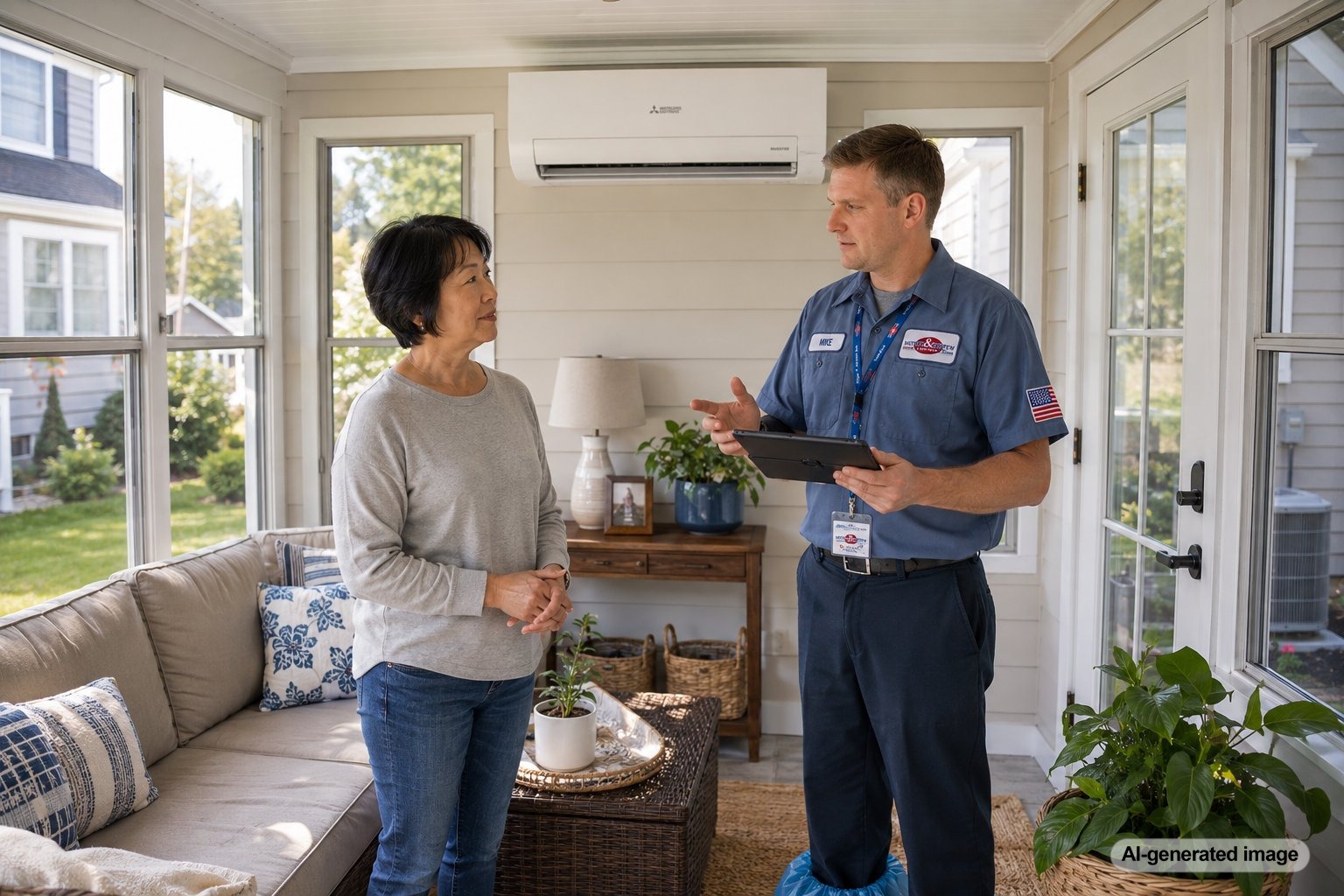
Yes, a mini split can often help cool a converted porch, especially when the space has been enclosed and insulated but is not connected to the home’s central ductwork. For many New Jersey homes, a porch that once felt comfortable in spring can become hot, humid, and difficult to use during summer afternoons. A ductless mini split may be a practical way to add targeted cooling without trying to force an existing central AC system to handle a space it was never designed to serve.
The key is whether the porch is truly ready to be conditioned. Glass exposure, insulation, air leaks, ceiling height, sun direction, and how the room connects to the rest of the house all affect performance. Meyer & Depew can help homeowners evaluate whether a ductless mini split system is a smart fit for a converted porch, sunroom, or other hard-to-cool area.
A mini split may be a strong option for cooling a converted porch when the room is enclosed, reasonably insulated, and used often enough to justify dedicated comfort control.
- It can cool the porch without adding new ductwork.
- It gives the room its own thermostat and comfort zone.
- It may help reduce uneven temperatures between the porch and main living space.
- It still needs proper sizing, placement, and installation to perform well.
Why converted porches are often hard to cool
A converted porch is not always the same as a standard room addition. Many porches were originally built as semi-outdoor spaces, which means they may have more windows, thinner insulation, older framing, or more air leakage than the rest of the home. Once the porch is enclosed, those conditions can make the room gain heat quickly and hold humidity longer than expected.
In Central and Northern New Jersey, summer humidity can make this worse. A room with several exterior walls and a lot of glass may feel sticky even when the rest of the house is comfortable. If the central AC system was not sized to include the porch, extending a duct into that space can sometimes create more problems, including weaker airflow in other rooms or poor temperature balance.
How a mini split helps a porch feel more usable
A ductless mini split is designed to heat or cool a specific area. Instead of relying on long duct runs, it uses an indoor unit mounted in or near the room and an outdoor unit connected by refrigerant lines. For a converted porch, that room-by-room approach can be helpful because the porch has different comfort demands than the rest of the home.
The biggest advantage is control. You can cool the porch when you are using it and adjust it separately from the central thermostat. That can be useful if the porch gets strong afternoon sun, has a different occupancy pattern, or is used as an office, sitting room, playroom, exercise space, or dining area. A mini split can also support better zoning when one room needs attention without changing the temperature in the entire house.
For homeowners already dealing with uneven cooling, it may also be worth learning about zoning systems and other comfort controls. The right approach depends on whether the porch is the only problem area or part of a larger whole-home comfort issue.
What needs to be evaluated before installing one
Not every enclosed porch is automatically ready for a mini split. A qualified HVAC professional should look at the room’s size, insulation level, window area, ceiling height, sun exposure, and how often the space is used. These details help determine the appropriate system capacity and indoor unit placement.
Oversizing can be just as problematic as undersizing. A mini split that is too large may cool the air quickly but cycle off before it removes enough humidity. A system that is too small may run constantly and still struggle on hot afternoons. Proper sizing matters because porch comfort is often shaped by both temperature and moisture, not just the number on the thermostat.
Insulation and air sealing matter
A mini split works best when the porch can hold conditioned air. If the room has leaky windows, gaps around doors, an uninsulated floor, or thin ceiling insulation, the system may have to work harder than it should. Before investing in dedicated cooling, homeowners should think about the condition of the room envelope.
Simple improvements, such as sealing obvious drafts, making sure windows close properly, and adding appropriate window coverings, may help reduce heat gain. Larger improvements, such as insulation upgrades or window replacement, should be considered as part of the bigger comfort picture. The better the porch contains cool air, the more useful a mini split is likely to feel.
Safe checks homeowners can make first
- Notice when the porch is hottest, such as late morning, afternoon, or evening.
- Check whether doors and windows close tightly and whether obvious drafts are present.
- Look at whether the porch has shades, blinds, or window treatments to reduce solar heat gain.
- Consider how often the room is used and whether comfort is needed daily or only occasionally.
- Avoid opening HVAC equipment, modifying wiring, adding refrigerant, or attempting major system changes yourself.
These observations can help a technician understand how the room behaves. They do not replace a proper load evaluation, but they can make the conversation more productive and help narrow down the right comfort solution.
When a mini split may not be the best answer
A mini split may not be the right choice if the porch is poorly enclosed, rarely used, or still functions more like a seasonal outdoor space than a conditioned room. It may also be less effective if the room has major air leaks or extreme solar gain that has not been addressed. In those cases, the first step may be improving the room itself before adding HVAC equipment.
There are also times when the porch issue is part of a larger cooling problem. If nearby rooms are also uncomfortable, the central AC system is short cycling, airflow is weak, or humidity is high throughout the home, the better next step may be a broader cooling evaluation. Meyer & Depew’s residential AC services can help identify whether the concern is limited to the porch or connected to the home’s overall HVAC performance.
FAQ about mini splits for converted porches
Can a mini split cool a porch with a lot of windows?
It may be able to, but window area and sun exposure are major factors. A porch with large windows may need careful sizing, strategic indoor unit placement, and steps to reduce heat gain.
Does a converted porch need ductwork for a mini split?
No. A ductless mini split does not require traditional ductwork, which is one reason it is often considered for porches, sunrooms, finished garages, and additions.
Can one mini split cool the porch and nearby rooms?
Sometimes it can help adjacent areas slightly, but it should not be treated as a guaranteed solution for multiple rooms. Mini splits perform best when designed around the specific area they are intended to condition.
Can a mini split also heat a converted porch?
Many mini split systems can provide both cooling and heating. Whether that makes sense depends on the porch construction, insulation, and how the room is used during colder New Jersey weather.
The bottom line for New Jersey homeowners
A mini split can be a practical way to cool a converted porch when the room is enclosed well enough to hold conditioned air and the system is properly sized for the space. It is especially useful when the porch is not served by ductwork or needs its own comfort zone.
For the best results, treat the porch as its own comfort project rather than simply adding equipment and hoping it works. Room conditions, humidity, insulation, sun exposure, and system sizing all matter. A professional evaluation can help determine whether a mini split, zoning improvement, AC service, or another approach is the better fit.
Thinking about replacing or upgrading your HVAC system?
Meyer & Depew can help you understand your options for comfort, efficiency, and long-term reliability in your New Jersey home or business.
Questions? Contact Meyer & Depew or call 908.272.2100.