



How Can You Tell Which Way a Furnace Filter Should Face?
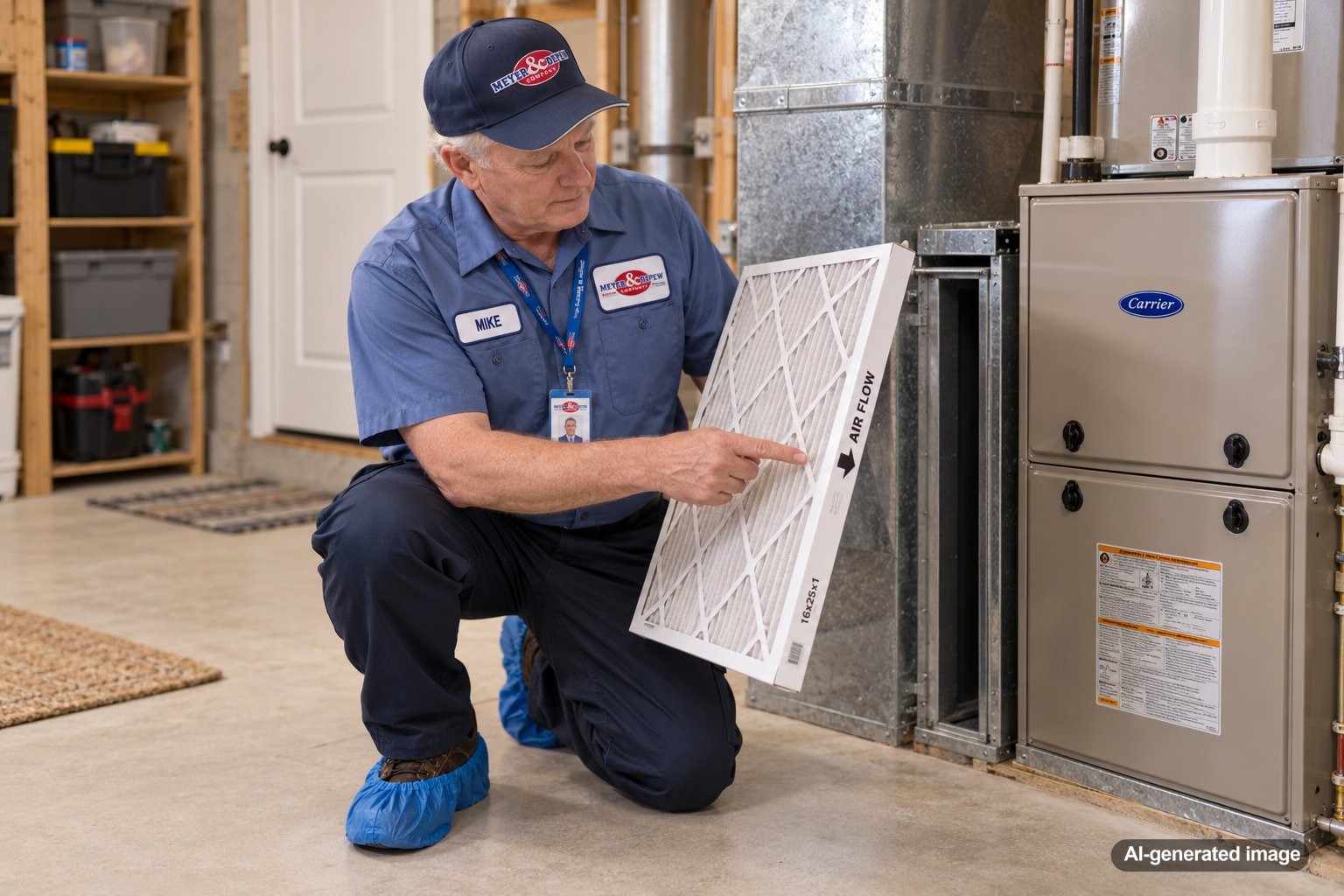
A furnace filter should normally be installed with the airflow arrow pointing toward the furnace, air handler, or blower compartment. The arrow shows the direction air is supposed to travel through the filter, not which side should face the room. In a typical forced-air system, return air moves from the home through the filter and then into the HVAC equipment.
Getting the direction right matters because many filters are built to handle airflow in one direction. Installing one backward may allow the filter material to flex more than intended and can contribute to unnecessary airflow restriction. If you are unsure about your system or notice ongoing airflow problems, Meyer & Depew’s Heating Service and Maintenance team can evaluate the equipment and filter setup.
Look for an arrow printed on the edge of the filter. Install the filter so that arrow points in the same direction the air travels, which is generally toward the furnace, air handler, or blower.
- The arrow should generally point toward the HVAC equipment.
- Do not assume the cleaner-looking or reinforced side determines direction.
- Note the arrow position before removing the old filter if it was installed correctly.
- If there is no arrow or the filter location is confusing, check the equipment documentation or ask a qualified HVAC professional.
What does the arrow on a furnace filter mean?
The arrow printed on a disposable furnace or HVAC filter is an airflow-direction marker. It tells you which way air should pass through the filter. In most residential systems, air is pulled from return vents, travels through return ductwork, passes through the filter, and then enters the blower section of the furnace or air handler.
Because the filter is positioned before the blower in many systems, the arrow usually points away from the return grille and toward the equipment. If your filter is installed in a return grille instead of directly beside the furnace, the same principle applies: the arrow points into the duct, because that is where the returning air is going.
How to identify airflow direction in common filter locations
Filter beside the furnace or air handler
If the filter slides into a rack or cabinet directly next to the furnace or air handler, look at where the return duct enters the equipment. Air travels from that return duct through the filter and toward the blower. The filter arrow should point toward the equipment.
Filter behind a return-air grille
Some homes have filters installed behind large return grilles in a hallway, ceiling, or wall. In this arrangement, room air is pulled through the grille and then into the return duct. The filter arrow should therefore point away from the room and into the duct opening.
More than one return filter
Some HVAC systems use filters at multiple return grilles. Each filter should follow the airflow direction at its own location. If the system has an unusual filter cabinet, multiple return paths, or a setup you cannot identify confidently, it is better to verify the configuration than guess.
Why does filter direction matter?
Many pleated filters have a supporting structure on the downstream side. That support helps the filter media hold its shape as the blower pulls air through it. When the filter is installed backward, the material may not be supported as intended.
A backward filter does not automatically mean the HVAC system will fail, but it can work against proper airflow and filtration. Airflow is already affected by factors such as filter thickness, filter condition, duct restrictions, blocked return grilles, and the type of filter being used. Correct installation removes one avoidable variable.
What if the filter has no arrow?
If you cannot find an airflow arrow, first inspect all four edges of the filter because the marking may be faint. You can also check the packaging or the manufacturer’s installation information for that specific filter.
Do not rely solely on assumptions about which side looks stronger. Filter construction varies. If there is still no clear indication, determine the system’s airflow direction before installing it or have a qualified HVAC technician confirm the correct orientation.
What happens if you installed the furnace filter backward?
If you discover that the filter is backward, turn the HVAC system off at the thermostat before accessing the filter, then reinstall the filter in the correct direction if it is safe and straightforward to do so. Make sure it sits properly in the rack or grille and that the access panel or grille closes normally.
If the filter has become bent, damaged, unusually dirty, or pulled out of shape, replacing it may be more appropriate than reinstalling it. Avoid forcing an incorrectly sized filter into place.
Safe checks when replacing your furnace filter
- Look for the airflow arrow on the filter frame before installation.
- Notice which direction the old filter arrow was pointing before removing it.
- Make sure the replacement filter matches the required dimensions.
- Confirm that nearby return and supply vents are open and not blocked by furniture or household items.
- Check that the filter slides into its rack without excessive force or large gaps.
Filter replacement is one of the simpler HVAC maintenance tasks homeowners can often handle themselves. You should not open sealed furnace compartments, modify electrical components, bypass safety switches, or make equipment adjustments while trying to solve a filter problem.
Can the wrong filter cause airflow problems?
Filter direction is only one part of the airflow picture. A filter that is extremely dirty, improperly sized, or inappropriate for the system can also restrict airflow. Other possible contributors include blocked return grilles, closed supply vents, duct restrictions, blower issues, and equipment problems.
If you replace or correctly orient the filter but still notice weak airflow, unusual noises, frequent cycling, or rooms that are difficult to heat or cool, professional evaluation can help identify what is actually causing the problem rather than assuming the filter is responsible.
Frequently asked questions about furnace filter direction
Should the arrow on a furnace filter point up or down?
There is no universal up-or-down rule. The arrow should point in the direction of airflow. Depending on the location of your furnace, air handler, or return grille, that may be up, down, sideways, or toward the equipment.
Should the furnace filter arrow point toward the blower?
In a typical system where the filter is located on the return side of the equipment, yes. The arrow generally points toward the blower because return air passes through the filter before reaching it.
Which side of a furnace filter faces the return vent?
The upstream side faces the incoming return air, while the arrow points downstream toward the HVAC equipment. The specific appearance of each side varies by filter, so use the airflow arrow rather than color or texture as your guide.
Can I run my furnace with the filter backward?
If you notice that the filter is backward, correcting its orientation is the sensible next step. Continued operation with an incorrectly installed filter may affect how well the filter holds its shape and how air moves through it.
How often should I check my furnace filter?
The appropriate interval depends on the filter, system, household conditions, pets, occupancy, and how often the HVAC system runs. Instead of relying on one universal schedule, inspect the filter periodically and follow the equipment and filter manufacturer’s recommendations.
The easiest rule to remember is that the airflow arrow follows the air. For most furnace and air-handler filter locations, that means the arrow points toward the HVAC equipment. When the system layout is not obvious, confirm the airflow direction rather than guessing.
Want to make HVAC maintenance easier to stay on top of?
A service plan can help keep routine heating and cooling maintenance on your calendar before small issues become bigger headaches.
You can also request a service appointment.