



How to Compare AC Efficiency Ratings Without Getting Overwhelmed
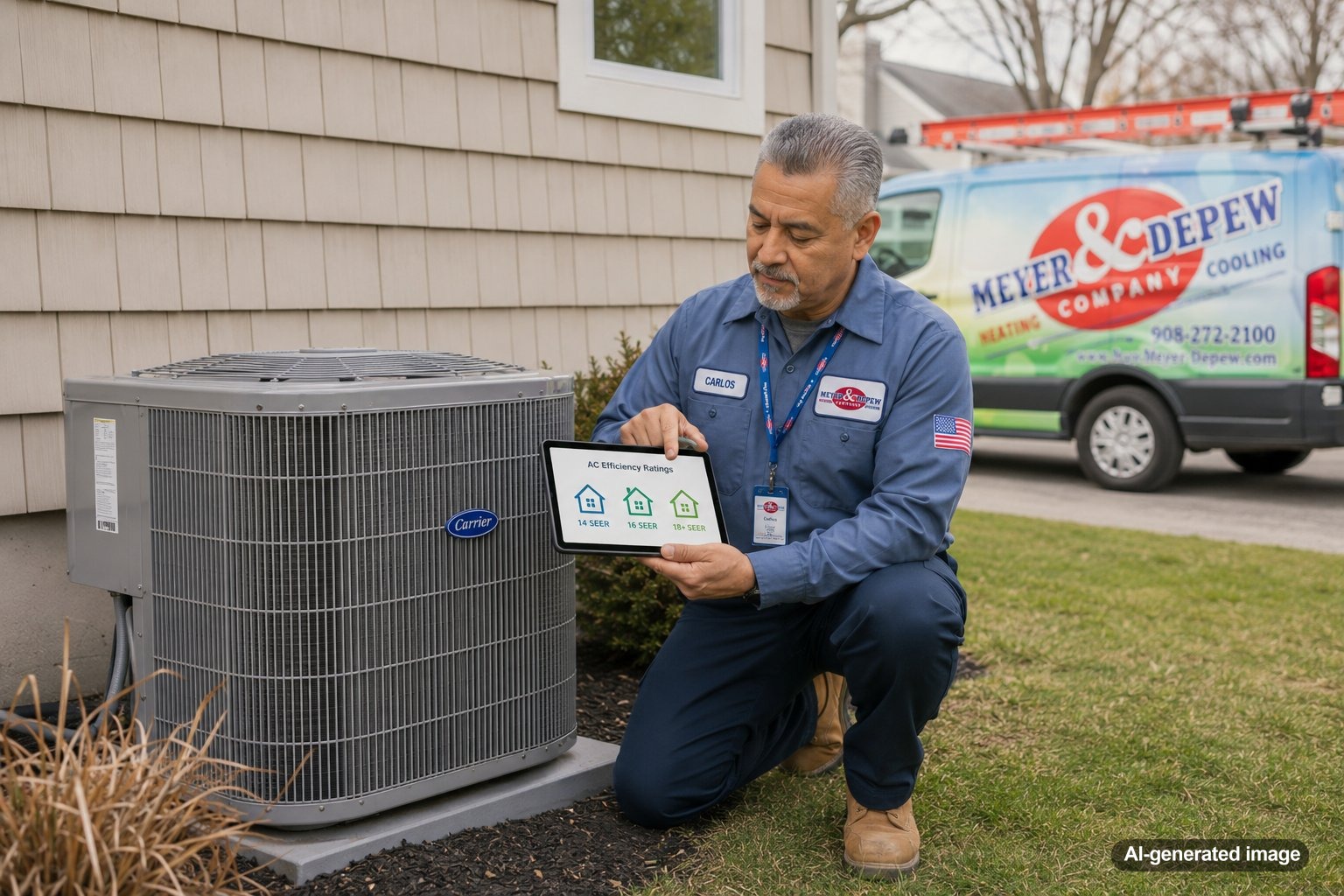
Comparing AC efficiency ratings can feel harder than it should. Between SEER2, EER2, ENERGY STAR labels, equipment sizes, comfort features, and contractor recommendations, many homeowners start with a simple question and end up staring at a wall of numbers. The goal is not to memorize every rating. The goal is to understand what each number can tell you, what it cannot tell you, and how it fits your home in Central and Northern New Jersey.
A more efficient air conditioner may help reduce cooling energy use, but the best choice is not always the unit with the biggest number on the brochure. Proper sizing, ductwork, humidity control, installation quality, and your home’s layout all matter. If you are comparing systems, Meyer & Depew’s AC installation and replacement services can help you look beyond the ratings and choose equipment that makes sense for your comfort needs.
Start with SEER2 for seasonal efficiency, then look at EER2 if your home struggles during very hot weather. Compare systems in the same size range, ask how the rating was achieved, and consider comfort features such as variable-speed operation and humidity control. A high-efficiency AC system still needs proper installation, airflow, and ductwork to perform well.
What AC efficiency ratings are really trying to tell you
AC efficiency ratings are designed to show how much cooling a system can provide for the energy it uses. A higher rating generally means the equipment can deliver cooling more efficiently under the test conditions used for that rating. That can be helpful when you are comparing models, but it is only one part of the decision.
The most common rating homeowners see is SEER2, which stands for Seasonal Energy Efficiency Ratio 2. It is intended to represent cooling efficiency across a typical cooling season. Older systems may have been labeled with SEER instead of SEER2, so do not compare the numbers as if they are identical. SEER2 uses updated testing methods, which means it gives a newer reference point for today’s equipment.
EER2, or Energy Efficiency Ratio 2, looks at efficiency under more specific high-load conditions. That can matter in New Jersey homes that struggle during humid summer afternoons, especially if the AC runs for long periods and still has trouble keeping the house comfortable. SEER2 is useful for broad comparison, while EER2 can help show how a system may perform when the heat is more intense.
SEER2 matters, but it is not the whole story
It is tempting to treat SEER2 as the final answer. Higher number, better system, decision made. In real homes, the picture is more practical than that. A higher SEER2 rating may help reduce energy use, but only if the system is properly matched to the home and installed correctly.
For example, an oversized AC system can cool the air too quickly without running long enough to remove enough humidity. That can leave rooms feeling damp, sticky, or uneven even if the equipment has an impressive efficiency rating. An undersized system may run almost constantly during hot stretches and still fall behind. In both cases, the rating on the unit does not fix a sizing or airflow problem.
Duct condition also plays a major role. Leaky, undersized, poorly insulated, or restricted ductwork can reduce comfort and make the system work harder. If your upstairs rooms are always warmer, certain vents barely move air, or the system short cycles, the answer may not be to chase the highest SEER2 number. A qualified HVAC professional can evaluate whether the system, ductwork, thermostat, and airflow are working together.
How to compare two AC systems without getting lost
When you are looking at two or three replacement options, compare them in a simple order. First, confirm that each option is properly sized for your home. Second, compare SEER2 ratings. Third, look at comfort features. Fourth, review the installation plan, not just the equipment name.
A system with a slightly lower efficiency rating but better humidity control, stronger airflow design, and more appropriate sizing may be a better fit than a higher-rated unit installed without attention to the details. This is especially true in older New Jersey homes, additions, finished attics, and houses with rooms that heat up differently throughout the day.
| Rating or factor | What it helps you compare | What to remember |
|---|---|---|
| SEER2 | Seasonal cooling efficiency | Useful for broad comparison, but not a complete comfort guarantee. |
| EER2 | Efficiency during hotter operating conditions | Helpful when a home struggles during heat waves or high-demand afternoons. |
| System size | Whether the equipment matches the home | Too large or too small can hurt comfort and efficiency. |
| Compressor and blower type | How steadily the system can cool | Two-stage or variable-speed systems may improve comfort in some homes. |
| Installation quality | How well the system can perform in real use | Even efficient equipment can disappoint if airflow, setup, or ductwork are wrong. |
Why the highest rating is not always the best value
A very high-efficiency AC system can be a smart investment for some homes, especially if the current system is old, cooling costs are high, or comfort problems are tied to long run times and poor humidity control. Still, the highest rating is not automatically the best choice for every homeowner.
Think about how long you plan to stay in the home, how heavily you use air conditioning, whether your current system keeps up, and whether your ductwork or insulation has known issues. A homeowner who uses AC lightly may not weigh the efficiency upgrade the same way as a household that runs cooling for long stretches through humid summer weather.
Comfort features can also matter as much as the rating itself. Two-stage and variable-speed systems can often run at lower output for longer cycles, which may help with steadier temperatures and better moisture removal. For some homes, that can feel more meaningful than a small difference in rating alone.
Questions to ask before choosing an efficient AC system
Before approving a replacement proposal, ask a few direct questions. What size system is being recommended, and why? Are there known ductwork or airflow issues that should be addressed? What is the SEER2 rating? Is there an EER2 rating available? Does the system use single-stage, two-stage, or variable-speed operation? How will the thermostat, airflow, and installation setup affect performance?
These questions help move the conversation away from a single number and toward a more complete comfort plan. They also make it easier to compare quotes fairly. If one proposal includes duct modifications, thermostat updates, or airflow corrections and another only lists equipment, the prices and ratings may not tell the whole story.
- Which rooms are usually too warm or too humid.
- How old your current AC system is, if you know.
- Whether your energy bills have changed noticeably.
- How often the system runs during hot weather.
- Whether vents, returns, or filters have airflow issues.
When efficiency ratings point toward replacement instead of repair
Efficiency ratings become especially useful when you are deciding whether to keep repairing an older AC system or begin planning for replacement. If your system is aging, needs frequent service, struggles during hot weather, or uses older technology, a new system may offer better efficiency and comfort features. That does not mean replacement is always the right answer, but it may be worth comparing options.
For a system that is newer, well maintained, and experiencing a specific repair issue, service may still make sense. If the system is older and repair costs are starting to add up, it is reasonable to compare the cost of repair against the value of installing a more efficient system. Meyer & Depew also offers AC service and maintenance for homeowners who want a professional evaluation before making that decision.
FAQ: AC efficiency ratings
Is a higher SEER2 rating always better?
A higher SEER2 rating generally indicates better seasonal cooling efficiency under test conditions. In your home, comfort and performance also depend on proper sizing, ductwork, airflow, thermostat setup, and installation quality.
What is more important, SEER2 or EER2?
SEER2 is usually the main rating homeowners use for broad seasonal comparison. EER2 can be helpful when comparing how systems perform under hotter, higher-demand conditions.
Can a new AC system lower my energy bills?
A more efficient AC system may help reduce cooling energy use, especially when replacing older equipment, but savings depend on your home, usage habits, system design, weather, and installation quality. No contractor should promise a specific savings amount without a detailed evaluation.
Should I replace my AC just to get a higher rating?
Not necessarily. If your current system is reliable, comfortable, and not causing high operating costs, replacement may not be urgent. If it is older, unreliable, inefficient, or struggling to cool your home, comparing replacement options can be worthwhile.
Who can help me compare AC options in New Jersey?
A qualified HVAC contractor can review your current system, comfort concerns, ductwork, and cooling needs before recommending options. For homeowners in Central and Northern New Jersey, Meyer & Depew can help you compare efficiency, comfort, and installation considerations in a practical way.
Use AC efficiency ratings as a guide, not a shortcut. SEER2 and EER2 can help you compare equipment, but the right system depends on your home’s size, airflow, humidity challenges, ductwork, and how the equipment is installed.
Thinking about replacing or upgrading your HVAC system?
Meyer & Depew can help you understand your options for comfort, efficiency, and long-term reliability in your New Jersey home or business.
Questions? Contact Meyer & Depew or call 908.272.2100.