



Why Does a Mini Split Heat One Side of a Room Better Than the Other?
Estimated reading time: 15 minutes
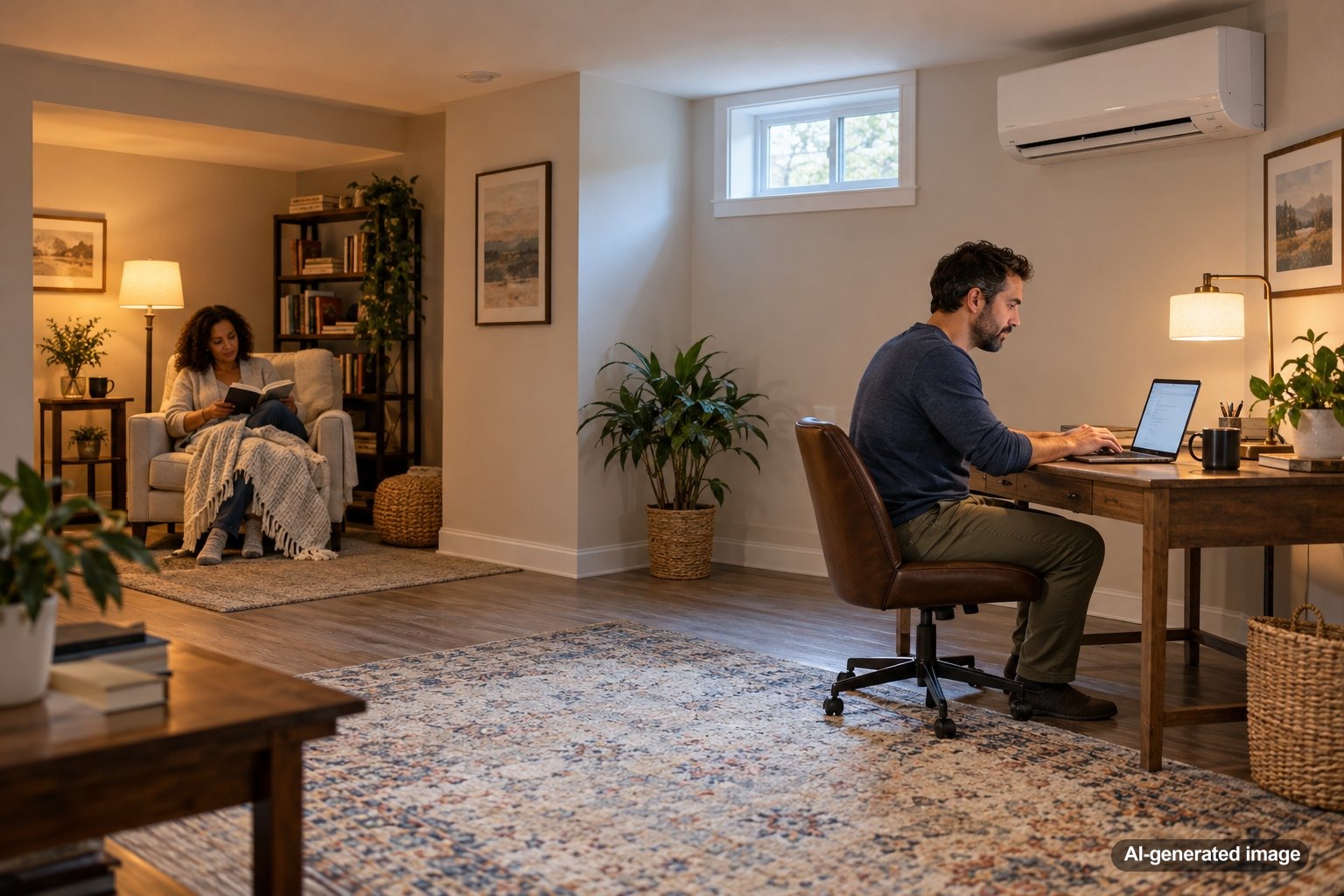
A mini split can make the area directly beneath it feel wonderfully warm while leaving the opposite side of the room noticeably chilly. You might feel comfortable sitting near the indoor unit, only to walk toward the windows or across the room and wonder why the heating never quite reaches that spot. This uneven warmth is a common comfort complaint with ductless heating systems, especially in larger rooms, open floor plans, and older New Jersey homes where heat loss varies from one wall to another.
The most likely explanation is a combination of airflow direction, room layout, temperature differences, and how the mini split senses when the room is warm enough. Sometimes a simple setting adjustment helps. Other times, the system’s placement, capacity, or mechanical condition needs professional attention. Understanding the difference can help you make the right decision without repeatedly turning up the thermostat.
A mini split usually heats one side of a room better because its warm air is not circulating evenly or because one area loses heat faster than another. Common reasons include:
- Louvers directing warm air toward one part of the room.
- Low fan speed limiting how far heated air travels.
- Furniture, partitions, or room geometry restricting airflow.
- Cold windows, exterior walls, or drafts creating uneven heat loss.
- The indoor unit sensing its target temperature before the entire room becomes comfortable.
- Installation, equipment sizing, or maintenance issues affecting heating performance.
The first checks should focus on safe, accessible controls and obvious airflow obstructions, not opening or modifying the equipment.
Why Mini Split Heat Does Not Spread Evenly Across a Room
A ductless mini split heats a room by moving indoor air across a heated coil and distributing that air through its louvers. Unlike a traditional ducted heating system with supply registers in several locations, a typical wall-mounted mini split delivers conditioned air from one primary position.
That distinction matters. The unit may be producing adequate heat, but delivering that heat throughout the occupied space is a separate challenge.
Consider a rectangular living room with a wall-mounted mini split at one end. Warm air leaves the unit and travels into the room, but its direction, velocity, and interaction with furniture determine where it goes. The area nearest the unit may reach a comfortable temperature long before the far corner does.
Warm air also tends to rise. If the discharge angle is too high, heated air can collect closer to the ceiling instead of reaching people seated at floor level. High ceilings, stair openings, and unusual room shapes can make this effect more noticeable.
A properly designed ductless mini split system accounts for room size, placement, airflow, and heating requirements. However, even a well-installed system may need different operating settings as outdoor conditions change.
1. The Airflow Louvers May Be Pointing in the Wrong Direction
One of the simplest explanations for uneven mini split heating is the direction of the discharge air.
When a wall-mounted unit operates in heating mode, directing warm air downward often helps deliver heat toward the occupied portion of the room. If the louvers are pointed too high, the warm air may circulate near the ceiling instead.
Some models automatically change louver positions when switching between heating and cooling. Others allow users to select fixed positions or activate a swing function.
What to check: Use the remote control or manufacturer-approved app to review the vertical airflow setting. If the unit supports it, try a downward heating position or the appropriate automatic airflow mode recommended in the owner’s manual.
A horizontal swing feature, where available, may also help spread air across a wider section of the room.
Do not force the louvers by hand. Motorized vanes and their linkages can be damaged by manual adjustment on models that require electronic control.
2. The Fan Speed May Be Too Low to Move Heat Across the Room
A mini split operating at a low fan speed can feel especially warm close to the indoor unit. However, the heated air may not travel far enough to mix effectively with cooler air on the other side of the room.
This is particularly noticeable in long rooms or spaces with substantial distance between the unit and the main seating area.
Some systems automatically reduce fan speed as the room approaches its temperature setpoint. That may be appropriate for maintaining comfort in a compact room, but it can sometimes leave distant areas feeling cooler.
What to check: If your system permits manual fan-speed adjustments in heating mode, compare its performance on the automatic setting with an appropriate medium or higher setting.
Allow the system time to operate before evaluating the difference. A higher fan speed may improve air mixing, but it can also produce more noticeable airflow and sound. Automatic control may still be the better everyday setting for some models.
Keep in mind that certain mini splits override user-selected fan settings during startup, defrost, or other protective operating sequences. That behavior does not necessarily indicate a malfunction.
3. The Mini Split May Be Measuring Temperature in the Warmest Part of the Room
Many ductless indoor units sense room temperature near the unit itself, often using a sensor associated with the return-air path. Depending on the model, other sensing options may also be available.
This can produce a surprising result: the mini split appears satisfied with the room temperature even though someone sitting across the room still feels cold.
For example, suppose the controller is set to 70 degrees Fahrenheit. If air returning to the indoor unit reaches the system’s target temperature, the unit may reduce its heating output. Meanwhile, a chair near an exterior window could remain several degrees cooler.
The thermostat setting represents the system’s control target. It does not guarantee that every point in the room will match that temperature.
Does the Remote Control Measure Room Temperature?
That depends on the equipment. Some systems offer a remote-sensor or follow-me style function that uses a sensor in a controller or another supported location. Many do not, and the exact behavior varies by manufacturer and model.
Check the owner’s manual before assuming that moving the remote will change how the system measures room temperature.
If temperature sensing contributes to an ongoing comfort problem, a qualified technician can review available control settings and compatible sensor options.
4. Windows and Exterior Walls May Be Cooling One Side Faster
Uneven heating is not always an airflow problem. Sometimes one portion of the room simply loses heat much faster than the rest.
This is especially relevant in Central and Northern New Jersey, where cold weather can expose drafts and insulation weaknesses that are less noticeable during mild conditions.
Imagine a family room with a mini split mounted on an interior wall. The opposite side contains several large windows and a sliding glass door. Even with warm air moving throughout the room, the window side may feel cooler because of heat loss through the glass, cold interior surfaces, and localized drafts.
Several building characteristics can contribute:
- Large windows: Colder glass surfaces can make nearby seating areas feel less comfortable, even when the air temperature is reasonable.
- Exterior doors: Worn weatherstripping or gaps can admit cold air.
- Insulation differences: One exterior wall may lose heat faster than another.
- High or vaulted ceilings: Warm air may accumulate above the occupied space.
- Open stairways: Heated air can move into an adjoining upper level.
- Sun exposure: A sunny section of a room may feel warmer during the day, creating a different comfort pattern after sunset.
Increasing the mini split’s set temperature may make the area near the unit uncomfortably warm without adequately addressing the colder side.
When the temperature difference follows the location of windows or exterior walls, evaluating the building envelope may be just as important as evaluating the equipment.
5. Furniture and Room Layout Can Interrupt Air Circulation
A mini split does not need a visible barrier directly in front of it to experience uneven air distribution.
Tall bookcases, partial walls, kitchen islands, room dividers, and large furniture arrangements can change how conditioned air circulates.
Consider a combined living and dining room. The mini split may be installed above the living area, while the dining space sits around a corner behind a partial wall. Both spaces technically share one room, but air may not move freely between them.
Moving a small obstacle can sometimes improve circulation. Other layouts present limitations that cannot be corrected by furniture placement alone.
It is also important to keep the indoor unit’s air intake and discharge paths unobstructed. Blocking either can interfere with normal operation.
Homeowners should maintain the clearances specified by the equipment manufacturer rather than relying on a universal distance for every mini split model.
6. The Indoor Unit May Be Poorly Positioned for the Room
Indoor-unit placement has a major influence on comfort.
A unit mounted at one end of a long room may struggle to distribute heat evenly to the opposite end. A unit installed too close to an obstruction or in a recessed area may have difficulty circulating air through the full space.
Another common situation involves a room that was changed after the system was installed. A new partition, converted porch, expanded seating area, or revised furniture arrangement can alter airflow without any change to the HVAC equipment itself.
For example, a mini split originally selected for a relatively open room might provide noticeably different comfort after the homeowner divides that space into separate functional areas.
In these cases, increasing the fan speed may help somewhat, but it cannot always overcome the geometry of the space.
A professional evaluation can determine whether improved control settings, an adjusted room layout, or a different indoor-unit arrangement would be appropriate.
7. The Mini Split May Not Have Enough Heating Capacity for the Space
A mini split that heats one end of a room effectively but struggles across the rest of the space may be experiencing a heating-load problem.
Equipment capacity is often discussed in BTU per hour, but selecting a system based on room square footage alone can overlook important details.
A proper heating-load assessment considers factors such as insulation, windows, ceiling height, infiltration, room configuration, and the outdoor design temperatures expected in the area.
Cold-weather heating performance matters because a heat pump’s available capacity can change as outdoor temperatures fall. The exact relationship depends on the equipment and its operating conditions.
Why the Problem May Be Worse on Colder Nights
Suppose a mini split distributes heat reasonably well when outdoor temperatures are in the 40s. During a much colder night, heat loss through the room’s exterior surfaces increases.
If the system’s available heating output is insufficient for those conditions, the coldest portion of the room may become noticeably uncomfortable.
That does not automatically mean the unit was incorrectly sized. Maintenance problems, airflow restrictions, control issues, and the building’s actual heat loss also deserve evaluation.
A qualified HVAC professional can compare the equipment’s rated cold-weather performance with the space’s heating requirements before recommending a change.
8. Maintenance or Equipment Problems May Be Reducing Heating Performance
Uneven heating can sometimes be a symptom of reduced system performance rather than a room-design limitation.
A dirty indoor filter can restrict airflow. Other potential causes include issues with the indoor blower, temperature sensors, refrigerant circuit, or outdoor unit operation.
The system may continue producing warm air while delivering less heating capacity or airflow than expected.
Watch for patterns that suggest a service issue:
- The system used to heat the entire room more evenly, but its performance has changed.
- The indoor unit delivers noticeably weaker airflow than it previously did.
- The mini split runs for extended periods without maintaining comfortable temperatures.
- The system displays an error code or repeatedly stops unexpectedly.
- The outdoor unit develops unusual ice accumulation or does not seem to complete its normal operating cycles.
- Unusual sounds or other operating changes accompany the uneven heating.
Some intermittent changes in airflow and heating output are normal during heat pump defrost cycles. However, persistent performance problems or repeated error codes deserve professional attention.
Homeowners should not attempt to open refrigerant components, troubleshoot internal electrical parts, or bypass safety controls.
Routine heating service and maintenance can help identify problems that affect comfort and system operation.
What You Can Safely Check Before Scheduling Service
Before assuming the mini split needs repair or replacement, review a few simple conditions that can influence room comfort.
- Confirm heating mode. Make sure the controller is set to Heat rather than Cool, Dry, or an unintended operating mode.
- Review the temperature setting. Choose a reasonable heating target and give the system time to respond.
- Check the airflow direction. Use the remote or approved controls to select a suitable heating position for the louvers.
- Compare fan settings. If supported, test whether a different fan speed improves comfort across the room.
- Inspect the air filter. Clean or replace accessible filters according to the manufacturer’s instructions.
- Remove obvious airflow obstructions. Look for tall furniture, decorative objects, or other items interfering with the indoor unit’s intake or discharge.
- Check windows and doors. Look for obvious drafts or gaps that could explain why one area feels colder.
- Observe the outdoor unit safely. Look from a safe distance for leaves, debris, or snow blocking required airflow clearances. Do not open or disassemble the equipment.
Make one or two adjustments at a time and allow the system to stabilize. Changing several settings repeatedly makes it difficult to determine which factor is responsible.
How to Tell Whether the Problem Is Airflow or Heat Loss
One useful approach is to identify exactly where and when the temperature difference occurs.
If the room is warm near the mini split but cooler farther away: Air distribution, fan speed, louver direction, room geometry, or temperature sensing may be important factors.
If the cold area is next to windows or exterior doors: Heat loss and drafts may be contributing even if the mini split is working normally.
If the problem occurs mainly during very cold weather: Heating capacity, cold-weather equipment performance, and building heat loss warrant closer attention.
If the problem is new: Compare the current behavior with previous heating seasons. A sudden decline may point toward maintenance or equipment issues.
If the room has a high ceiling: Warm air stratification may make the upper space warmer than the occupied area below.
For a more objective comparison, place a reliable room thermometer at approximately the same height in different occupied areas, away from direct sunlight and obvious drafts. Take readings after conditions have stabilized rather than comparing temperatures during the first few minutes of startup.
A consistent difference can give a service technician useful information about the room’s comfort pattern.
Would a Second Mini Split Indoor Unit Help?
In some rooms, the best long-term answer may involve distributing heating from more than one location.
Large open-concept spaces, long additions, irregular floor plans, or rooms divided into distinct zones can be difficult to condition uniformly from a single wall-mounted unit.
A second indoor unit may provide better coverage in a suitable design, but it is not automatically necessary or compatible with every existing outdoor unit.
Adding equipment requires an evaluation of available system capacity, manufacturer compatibility, piping requirements, electrical considerations, and the actual heating loads.
Other solutions could include choosing a more appropriate indoor-unit location, addressing insulation and air leakage, or evaluating different zoning systems for the home’s overall comfort needs.
The important distinction is whether the existing unit has a correctable performance problem or whether the room needs a different heating-distribution strategy.
When Should You Call an HVAC Professional?
Consider scheduling service when straightforward airflow adjustments do not improve the temperature difference or when the system’s performance has noticeably declined.
A professional inspection is especially useful if the mini split no longer reaches its target temperature, produces weak airflow, displays recurring error codes, or struggles significantly during colder weather.
A qualified technician may evaluate operating temperatures, airflow, sensor readings, equipment condition, and whether the system’s installation is appropriate for the room.
For homeowners in Central and Northern New Jersey, it is worth having uneven heating evaluated before the coldest part of the heating season, particularly when a mini split supplies most or all of the room’s heat.
If the equipment produces smoke, sparks, or an electrical burning smell, stop using it if safe to do so and seek appropriate professional or emergency assistance.
Frequently Asked Questions About Uneven Mini Split Heating
Why is it warm directly under my mini split but cold across the room?
The heated air may not be reaching the far side effectively, or that area may be losing heat faster. Louver direction, fan speed, room shape, windows, and thermostat sensing can all contribute. Begin with safe airflow and control checks.
Should mini split louvers point up or down when heating?
For many wall-mounted mini splits, directing heated air downward helps warm the occupied portion of the room because warm air naturally rises. However, follow the manufacturer’s heating-mode recommendations for your specific unit. Some models automatically control louver positioning.
Will increasing the fan speed make my mini split heat more evenly?
It may improve air circulation and help warm air reach more distant areas. However, fan speed alone cannot correct excessive heat loss, inadequate heating capacity, or a poorly positioned indoor unit. Some models also control fan speed automatically during certain operating conditions.
Does uneven heating mean my mini split is too small?
Not necessarily. A correctly sized system can still distribute air unevenly because of room layout, airflow settings, or localized heat loss. A heating-load evaluation and equipment inspection can help determine whether capacity is actually the problem.
Why does my mini split heat the room unevenly only in winter?
Colder outdoor conditions increase heat loss through windows, exterior walls, and air leaks. The heat pump’s available heating capacity may also vary with outdoor temperature. These effects can make differences between parts of the room much more noticeable during winter than during mild weather.
Getting More Consistent Warmth From Your Mini Split
When a mini split heats one side of a room better than the other, the solution starts with understanding where the heat goes and where the room loses it. Small changes to airflow direction, fan operation, and obstructions may improve comfort. Persistent differences can require a closer look at temperature sensing, installation, heating capacity, or the building itself.
Rather than continually raising the temperature setting, focus on finding the cause of the imbalance. That approach can help avoid overheating the area near the indoor unit while leaving the distant side uncomfortable.
Meyer & Depew helps homeowners throughout Central and Northern New Jersey evaluate heating performance, ductless comfort concerns, and HVAC system operation. If your mini split is no longer heating the room as expected, a professional assessment can help identify practical next steps.
Need help with your heating, cooling, or HVAC system?
Meyer & Depew serves homeowners and businesses throughout Central and Northern New Jersey.
Get a quote or call 908.272.2100.